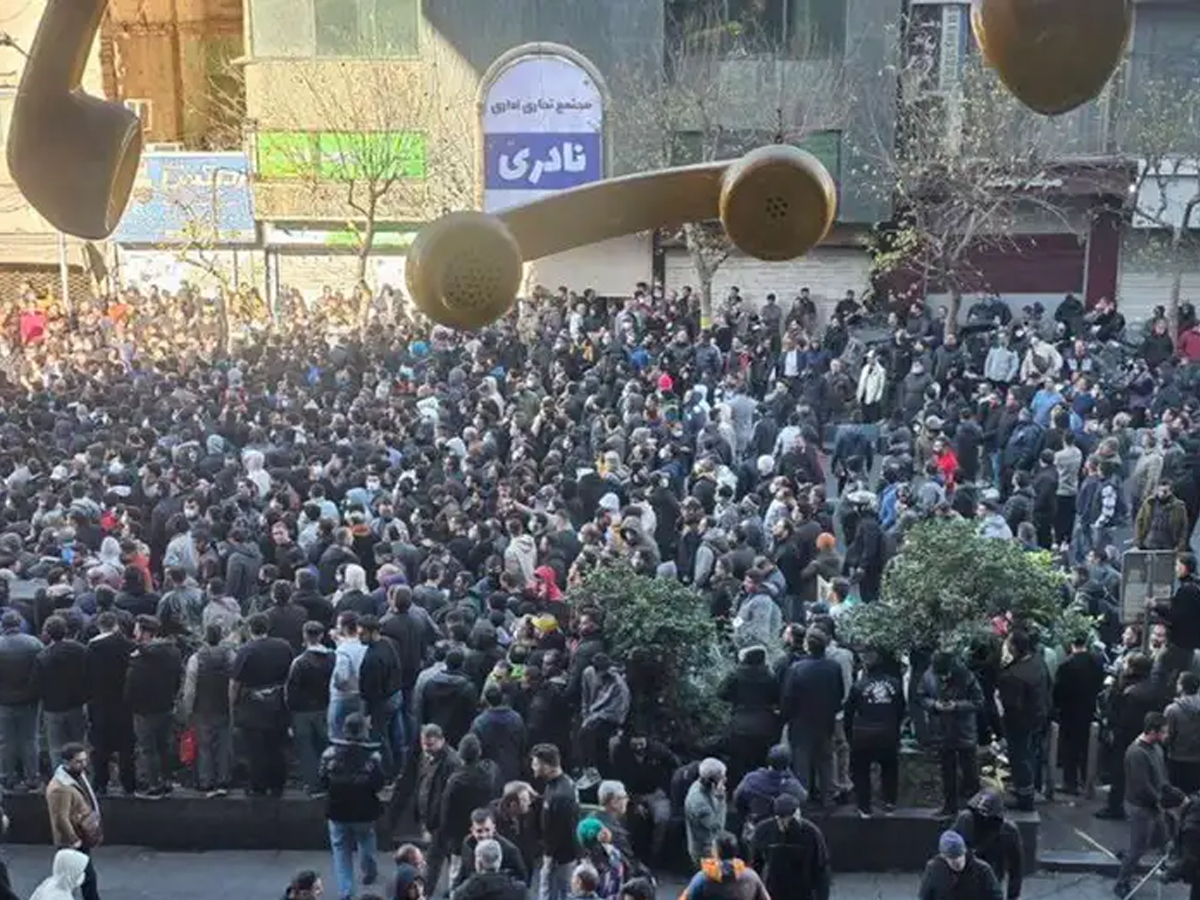
Iran is witnessing its largest wave of protests in three years as citizens take to the streets over high inflation, a depreciating currency, and economic stagnation. The unrest has spread to major cities, including Qom, a key religious stronghold, with clashes between security forces and demonstrators resulting in multiple deaths and injuries.
The protests began on Sunday when shopkeepers and market vendors protested the government’s handling of falling currency value and rising prices. Students from universities joined the movement, forcing several bazaars to shut down. While primarily driven by economic grievances, demonstrators are also raising slogans against Iran’s theocratic system, signaling broader social discontent.
US Warns Iran Over Protest Crackdown
US President Donald Trump weighed in on the unrest, issuing a warning to Tehran. He stated, “If Iran shoots and violently kills peaceful protesters, America would come to their rescue. We are locked and loaded and ready to go.”
His comments added international attention to the protests and heightened tensions as security forces continued to crack down on demonstrators.
Authorities have reported at least seven deaths from clashes between protesters and security forces. Among the casualties is a member of the Basij, a volunteer paramilitary force linked to Iran’s Revolutionary Guards, who was killed in Kuhdasht, while 13 others were injured. The Basij blamed demonstrators for exploiting the protests, highlighting the volatile environment in the country.
Videos circulating on social media show security forces opening fire in cities such as Nurabad in Lorestan and Hamadan in western Iran. Demonstrators have largely ignored curfews and continued to gather in public spaces.
Protests Reach Religious and Political Centers
For the first time in decades, pro-monarchy slogans have been heard during rallies, including in Qom, Iran’s clerical hub. This shows that economic frustrations are evolving into political demands. Exiled prince Reza Pahlavi praised the protesters, calling those who lost their lives “true heroes of this land” and urging unity until Iran attains freedom.
The protests have expanded beyond Tehran and other urban centers, reflecting widespread dissatisfaction with both economic mismanagement and the country’s governance structure.
Economic Crisis Fuels Public Outrage
Iran’s national currency, the rial, has lost over a third of its value against the US dollar in the past year. This sharp depreciation has fueled double-digit inflation, further straining the purchasing power of ordinary Iranians. Prices for essential goods have skyrocketed, causing public frustration and driving protests across the nation.
President Masoud Pezeshkian acknowledged the economic challenges but said his options are limited. One US dollar currently costs around 1.4 million rials, making everyday life increasingly difficult for citizens.
Student and Merchant Participation Intensifies Protests
The movement is not limited to one segment of society. Students from universities and shopkeepers have been actively involved, showing the protests’ multi-generational and cross-sector appeal. Many markets have been shut down in solidarity, demonstrating the scale of public dissatisfaction.
The protests are largely peaceful, but the government’s response has escalated tensions, resulting in violent clashes.
Political and Social Implications
While economic hardship triggered the protests, many Iranians are now expressing opposition to the theocratic regime, indicating deeper political unrest. Analysts suggest that continued economic decline, coupled with political dissatisfaction, could lead to a prolonged period of instability in Iran.
International actors have closely monitored the events, with warnings from the US highlighting the global significance of Iran’s internal crisis. The unfolding situation is being closely watched by human rights organizations and foreign governments as they assess potential diplomatic and humanitarian responses.
The ongoing unrest in Iran underscores the deep frustrations of citizens grappling with economic uncertainty and limited freedoms. As protests continue to spread, authorities face mounting pressure to address both economic hardships and political grievances to prevent further escalation.