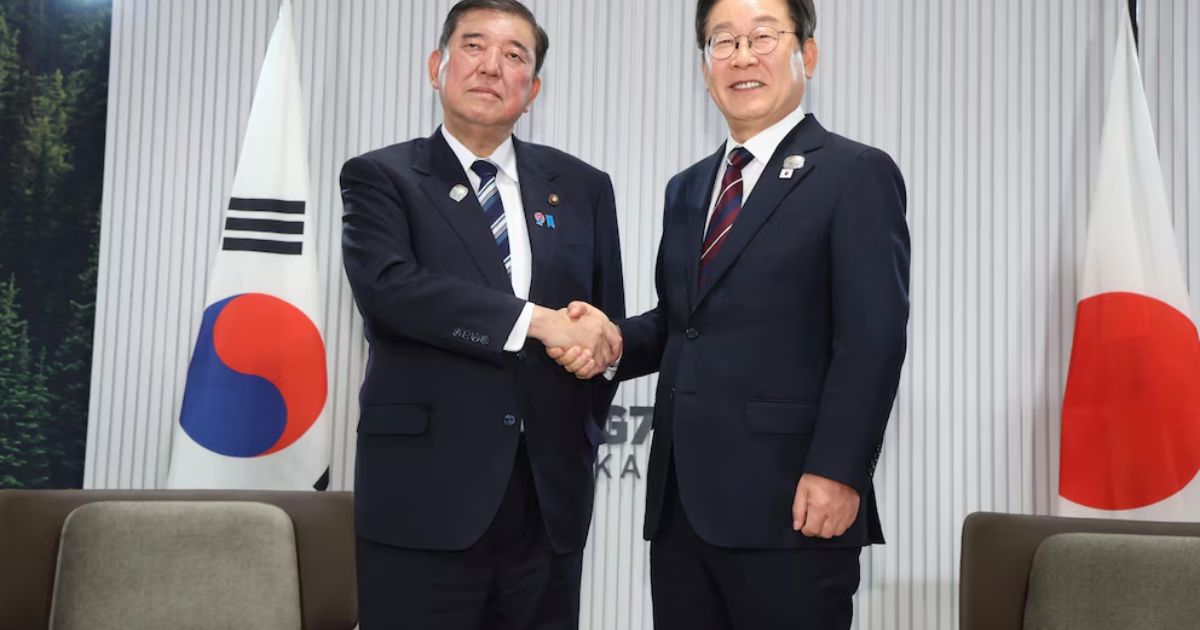
Japanese Prime Minister Shigeru Ishiba received South Korean President Lee Jae Myung in Tokyo on Saturday, in a historic visit to reaffirm security ties, soften historical tensions, and highlight the two countries’ mutual dependence on Washington amid evolving regional politics.
Strengthening Security Under US Partnership
This was Lee’s first official Japan visit since he became president in June, and the two leaders used the meeting to underscore security alliances. They reaffirmed the trilateral cooperation with the United States under an agreement signed by their predecessors, as well as promising closer cooperation against North Korea’s missile and nuclear threats.
As the strategic situation around both nations becomes more serious, the value of our relations, as well as trilateral partnership with the United States, becomes more important,” Ishiba told a joint press conference.
The two leaders decided to resume shuttle diplomacy, enhance people-to-people contacts like working holiday scheme, and intensify cooperation in defence, economic security, and new technology like artificial intelligence.
Breaking Down Historical Tensions and Political Changes
Lee’s presidential win following the impeachment of hardline President Yoon Suk Yeol caused Tokyo fears that relations might be put on a hard path. The liberal president has previously condemned attempts to ease ties strained by residual resentment of Japan’s colonial era. Seoul has also recently expressed “deep disappointment and regret” following the visit of Japanese officials to the Yasukuni Shrine, a sensitive issue for many Koreans.
But Lee’s choice of Tokyo as his initial foreign destination ahead of Washington was welcomed in Japan, indicating that despite past differences, Seoul cherishes its alliance with Tokyo. For Ishiba, who is under pressure from the right-wing challengers within his own party following his party’s July election loss, the summit provided a welcome diplomatic victory.
Common Challenges: China, North Korea, and Trade
Aside from history, both administrations are also in agreement when it comes to today’s challenges. Japan and South Korea are still at the core of Washington’s Asian strategy, with some 80,000 US troops, dozens of warships, and hundreds of military planes stationed there. Collectively, the two neighbors are viewed as key in checking China’s expanding regional influence and countering North Korea’s developing weapons program.
On trade, Tokyo and Seoul also have something in common. Both recently agreed to implement 15 percent tariffs on US imports after former President Donald Trump threatened with even higher duties. This pragmatic move reflects how economic security now intersects with their strategic decisions.
Lee encapsulated the mood of the visit, declaring, “We concurred that unshakeable cooperation between South Korea, the US and Japan is most crucial in the fast-shifting global environment, and made a commitment to establish a virtuous circle where the promotion of South Korea-Japan ties results in enhanced cooperation.”
ALSO READ: PM Modi’s Japan Trip Could Unlock $68 Billion Investment Deal: Report
Looking Ahead to Washington
Lee’s trip to Tokyo is only two days before his first summit with US President Donald Trump in Washington. That summit will likely discuss China’s increasing influence, North Korea’s aggressive behavior, and Seoul’s contributions of funds to US troops deployed in South Korea an item Trump has long insisted on.
For the time being, Lee’s warm welcome in Tokyo indicates that both Japan and South Korea are prepared to set aside old disputes in favor of pragmatism and stand together as Asia is confronted with an ever more complicated security landscape.