
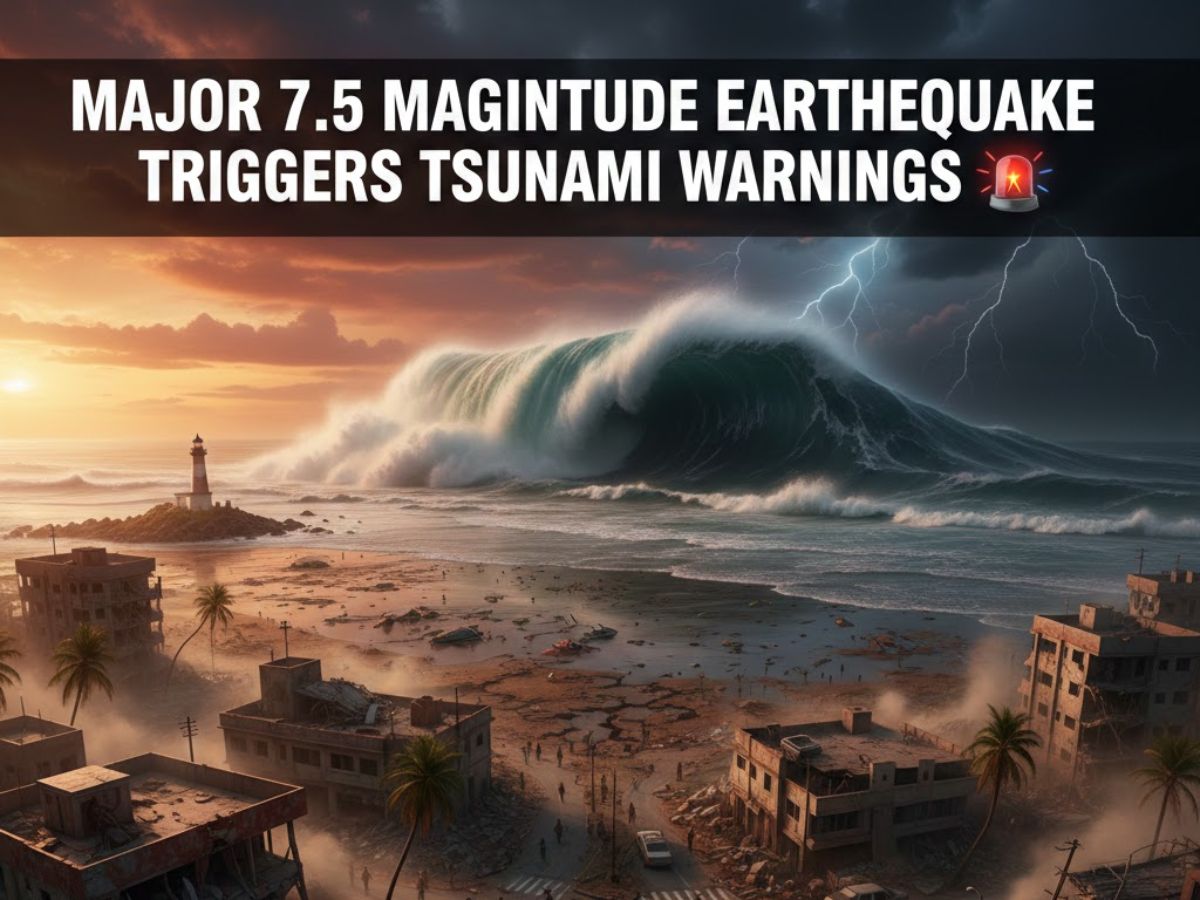
A severe earthquake with a preliminary magnitude of 7.5 jolted northeastern Japan on Monday night, prompting authorities to issue tsunami warnings and order approximately 90,000 residents to evacuate coastal areas. The quake, which struck off the coast of Aomori prefecture, was felt as a severe “upper 6” intensity in some cities, strong enough to make standing impossible—and triggered fears of a significant tsunami.
What was the Location of Earthquake?
According to the Japan Meteorological Agency (JMA), the earthquake happened at 11:15 p.m. local time (1415 GMT), with its epicenter being 80 km off the coast of Aomori prefecture at a depth of 54 km.
Critical updates include:
- Tsunami Threat: The JMA warned of a potential tsunami as high as 3 meters (10 feet). Subsequently, tsunamis measuring 20 to 70 cm were observed at several ports in the warned regions.
- Intensity: The tremor registered an “upper 6” on Japan’s 7-point shindo scale in Hachinohe city—a level where it becomes impossible to remain standing, heavy furniture can topple, and buildings sustain damage to walls and windows.
- Warnings Issued: Tsunami warnings were in effect for the prefectures of Hokkaido, Aomori, and Iwate.
What is the Immediate Impact and Response?
In a flash, authorities suspended transportation services and issued evacuation orders. Early reports revealed little immediate information on significant losses or damage. Public broadcaster NHK cited a hotel employee in Hachinohe stating a number of people were injured and taken to hospital, but all were conscious.
Key responses were:
- Evacuations: Orders for about 90,000 residents to move to higher ground.
- Transport Halt: East Japan Railway suspended some services in the affected area.
- Power Outages: Tohoku Electric Power reported hundreds of households without electricity.
- Nuclear Plants: No abnormalities were reported at nuclear power plants in the region.
Why is This Region Particularly Sensitive?
The earthquake struck the same northeastern region devastated by the catastrophic 9.0-magnitude earthquake and tsunami on March 11, 2011. That disaster killed nearly 20,000 people and triggered the Fukushima Daiichi nuclear meltdown.
Drawing lessons from 2011—when a major foreshock occurred two days before the megaquake—the JMA immediately issued a one-week “megaquake advisory” for a wide region, warning that more powerful earthquakes could occur in the coming days. This advisory system is now a standard precaution for significant tremors in seismically active zones like Japan’s Pacific coast.
Also Read: Europe Rallies Behind Zelensky While Questioning US Proposal to End Ukraine War
Your Questions Answered: Japan Earthquake FAQs
Q: What is the difference between magnitude and seismic intensity?
A: Magnitude measures the energy released at the earthquake’s source. Seismic intensity (Shindo) measures the strength of shaking at a specific location. An “upper 6” intensity indicates very strong ground shaking capable of causing structural damage.
Q: Have there been any tsunamis yet?
A: Yes. Following the quake, tsunamis ranging from 20 cm to 70 cm (7 to 27 inches) were observed at several ports. The highest warning was for waves up to 3 meters.
Q: Is there a risk of a nuclear incident like Fukushima?
A: There were no anomalies at the local nuclear sites, according to utilities. Since the 2011 accident, Japan has tightened safety rules. However, considering the history of the area, the situation is being attentively watched.
Q: Why was a “megaquake advisory” issued?
A: It is a precautionary measure based on the 2011 experience. A significant quake in this zone can sometimes be a foreshock to an even larger event. The advisory urges heightened preparedness for a week.
Q: How prone is Japan to earthquakes?
A: Extremely prone. Located on the Pacific “Ring of Fire,” Japan experiences frequent seismic activity, accounting for about 20% of the world’s earthquakes of magnitude 6.0 or greater.
Also Read: Europe Rallies Behind Zelensky While Questioning US Proposal to End Ukraine War