
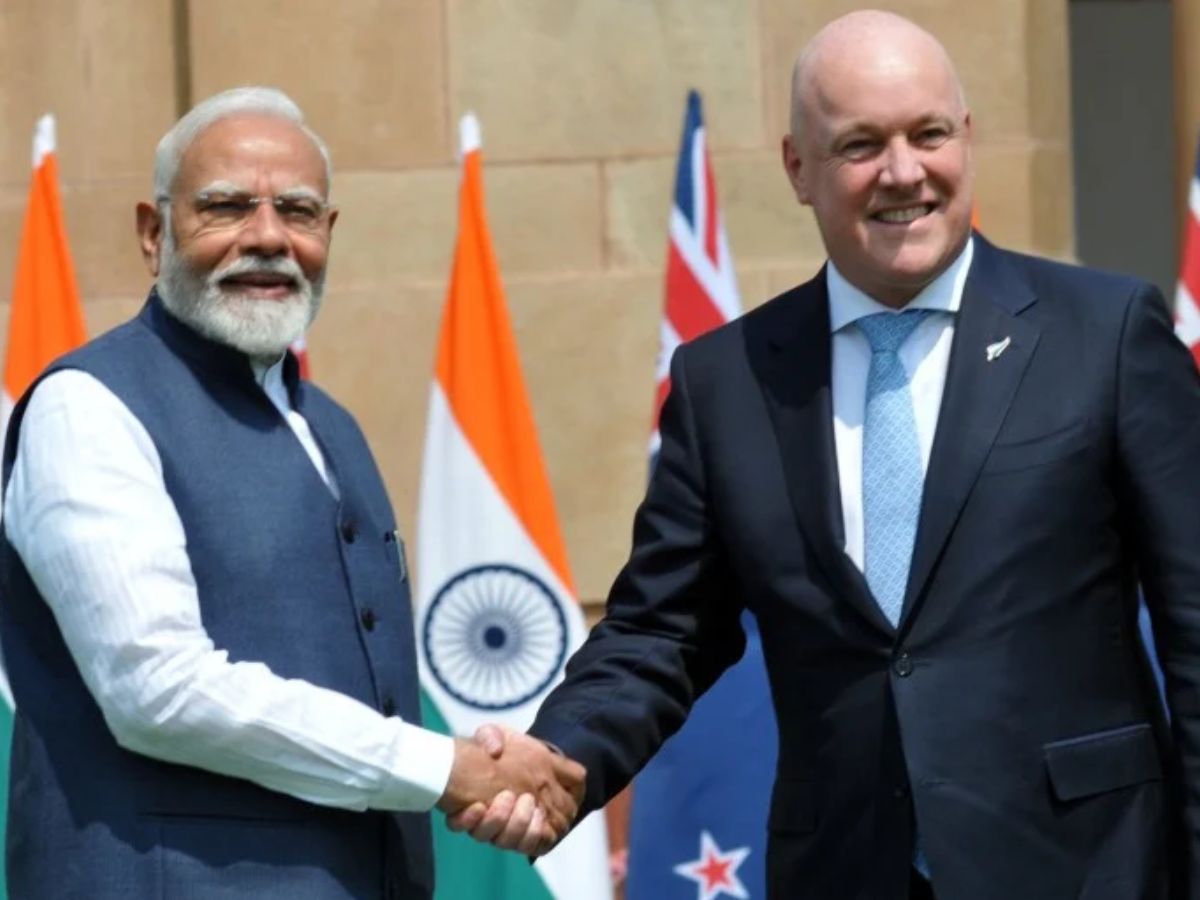
New Zealand Prime Minister Christopher Luxon has welcomed the new Free Trade Agreement (FTA) with India. His comments came only days after New Zealand’s foreign minister publicly raised concerns about the deal.
Luxon called the agreement a major success for his government. He said it would help strengthen the country’s economy and support long-term growth.
Luxon said, “We said we’d secure a Free Trade Agreement with India in our first term, and we’ve delivered.”
He also highlighted its economic value, saying the deal would bring “more jobs, higher incomes and more exports by opening the door to 1.4 billion Indian consumers.”
He added that the agreement fits into his government’s wider plan, which he described as “Fixing the basics. building the future.”
Coalition Split Over the FTA
While Luxon celebrated the deal, it has caused disagreement within New Zealand’s ruling coalition. Foreign Minister Winston Peters, who leads the New Zealand First (NZF) party, strongly criticised the agreement. He called it “neither free nor fair.”
Peters said he had raised his concerns with India’s External Affairs Minister S Jaishankar. Even though he opposed the deal, he said he had “utmost respect” for the Indian minister.
Also Read: India–New Zealand Announce Free Trade Agreement Boosting Trade & Investment
FTA Followed Modi–Luxon Talks
The trade deal was announced earlier this week after talks between Prime Minister Narendra Modi and Christopher Luxon. Both leaders said the agreement could double trade between the two countries within five years.
They also said it could lead to $20 billion in Indian investments over the next 15 years.
Trade talks between India and New Zealand began in March. When the deal was announced, both leaders said it reflected their “shared ambition and political will to further deepen ties.”
Peters Calls It a ‘Low-Quality’ Agreement
Winston Peters argued that New Zealand gave away too much while gaining very little in return. He said his party had warned the government not to rush the deal.
In a post on X, Peters wrote, “New Zealand First urged its coalition partner not to rush into concluding a low-quality deal with India, and to use all three years of this Parliamentary cycle in order to get the best possible deal.”
He accused the government of focusing on speed instead of fairness. He said, “National preferred doing a quick, low-quality deal over doing the hard work necessary to get a fair deal that delivers for both New Zealanders and Indians.”
Dairy Sector at the Heart of the Dispute
One of Peters’ biggest concerns is how the agreement affects New Zealand’s dairy industry. He said New Zealand opened its markets to India, but India did not reduce tariffs on key dairy imports in return.
Peters said, “This is not a good deal for New Zealand farmers and is impossible to defend to our rural communities.”
He added that the India agreement would be “New Zealand’s first trade deal to exclude our major dairy products – including milk, cheese and butter.”
Also Read: What Did PM Modi Say About SIR & Infiltrators at the Guwahati Rally?
Debate Over the Deal Continues
While Luxon sees the FTA as a major breakthrough that will boost exports and jobs, critics within his own coalition argue it weakens New Zealand’s farming sector and was rushed without proper negotiation.
The disagreement shows that even as New Zealand moves closer to India economically, political divisions at home remain strong.