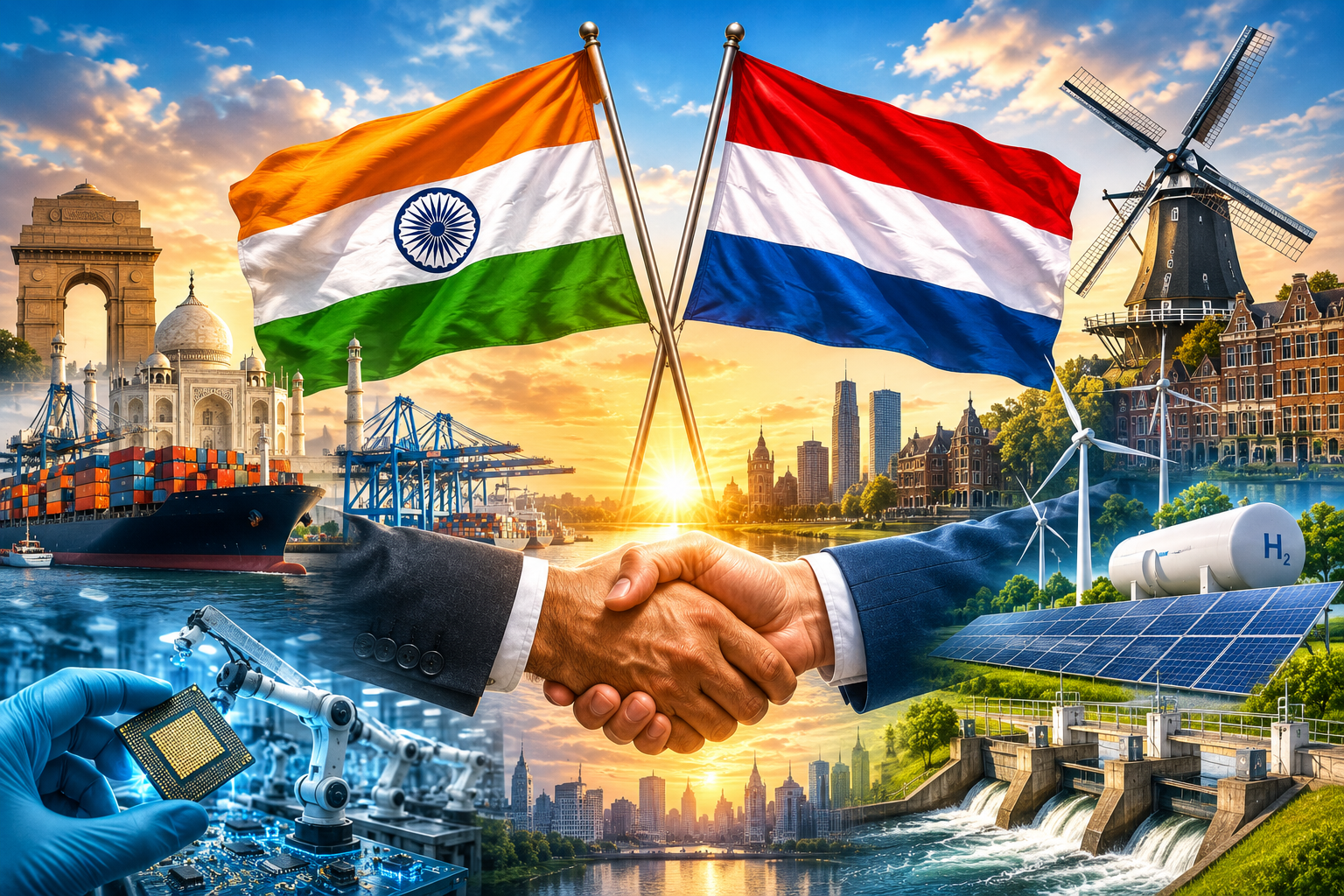
The relationship between India and the Netherlands represents one of the most enduring and steadily evolving partnerships between India and Europe. What began as a commercial interaction during the age of maritime empires in the seventeenth century has transformed into a multidimensional strategic relationship encompassing trade, technology, climate cooperation, semiconductors, clean energy, education, and cultural diplomacy. Prime Minister Narendra Modi’s visit to the Netherlands in May 2026 marked a major milestone in this evolution, as both countries elevated their ties to a formal “Strategic Partnership” for the period 2026–2030.
The contemporary India–Netherlands partnership is deeply rooted in history but increasingly shaped by the demands of a changing global order. In an era marked by geopolitical uncertainty, technological competition, climate change, supply-chain vulnerabilities, and energy transition, the two countries have found strong areas of convergence. The Netherlands sees India not merely as a large consumer market but as an emerging global power and a crucial strategic partner in Asia. India, meanwhile, views the Netherlands as a gateway to Europe, a technological innovator, and a valuable collaborator in sustainable development.
Historical Foundations of the Relationship
The origins of India–Netherlands relations can be traced back to the early seventeenth century when the Dutch East India Company, known as the Vereenigde Oostindische Compagnie (VOC), established commercial links with the Indian subcontinent. During this period, the Dutch emerged as one of the most influential European maritime powers competing for access to Asian trade routes.
The Dutch established trading settlements in various parts of India, including Pulicat in present-day Tamil Nadu, Cochin in Kerala, Surat in Gujarat, Nagapattinam, Chinsurah in Bengal, and parts of the Coromandel Coast. Their primary interests revolved around spices, textiles, indigo, silk, saltpetre, and precious commodities that connected India to global trade networks.
Unlike the British, the Dutch did not establish extensive territorial control over India. Their engagement remained largely commercial, though their influence significantly shaped maritime trade patterns in the Indian Ocean. Dutch records and archives from this period today remain valuable sources for historians studying South Asian economic and political history.
After the decline of the VOC in the late eighteenth century and the rise of British dominance in India, Dutch influence gradually diminished. Nevertheless, historical interactions left behind cultural and archival linkages that continue to shape modern academic and heritage collaborations between the two countries.
Diplomatic Relations After Independence
Modern diplomatic relations between independent India and the Netherlands were formally established in 1947, shortly after India achieved independence. The relationship during the early decades remained cordial but relatively limited, primarily centred on trade and development cooperation.
During the Cold War era, India pursued a policy of non-alignment, while the Netherlands remained closely integrated within the Western alliance system through NATO and the European Community. Despite differing geopolitical orientations, the two countries maintained constructive engagement and gradually expanded cooperation in agriculture, water management, science, and technology.
By the late twentieth century, economic liberalisation in India opened new opportunities for Dutch businesses and investors. Simultaneously, India’s growing economic and geopolitical importance encouraged European nations, including the Netherlands, to deepen engagement with New Delhi.
The relationship entered a new phase in the twenty-first century as India emerged as a major global economy and the Netherlands increasingly positioned itself as a leader in innovation, sustainable technology, climate adaptation, logistics, and advanced manufacturing.
Strategic Convergence in the Twenty-First Century
The transformation of India–Netherlands relations into a strategic partnership reflects broader geopolitical and economic changes taking place globally.
Today, both countries share common interests in preserving a rules-based international order, promoting secure maritime trade routes, ensuring resilient supply chains, combating climate change, and accelerating technological innovation.
The Netherlands occupies an important position within Europe due to its advanced infrastructure, global ports, technological ecosystem, and strong industrial base. Rotterdam, Europe’s largest port, serves as a crucial logistical gateway for Indian exports into the European market.
India, meanwhile, offers scale, manufacturing potential, technological talent, and one of the world’s fastest-growing digital economies. The partnership between Dutch technological expertise and Indian industrial capacity has created a framework often described as “innovation meets scale.”
This convergence became particularly visible during Prime Minister Modi’s 2026 visit, where both countries agreed to institutionalise cooperation through regular high-level dialogues and sector-specific partnerships.
Economic and Trade Relations
Economic engagement forms the backbone of India–Netherlands relations. Over the last decade, bilateral trade and investment have expanded significantly, making the Netherlands one of India’s most important economic partners in Europe.
Bilateral trade crossed approximately USD 27.8 billion in 2024–25, highlighting the rapid growth of commercial ties. India enjoys a substantial trade surplus with the Netherlands, exporting petroleum products, pharmaceuticals, chemicals, textiles, machinery, agricultural products, and engineering goods.
The Netherlands has emerged as one of the largest destinations for Indian exports in Europe. Its world-class ports and logistics infrastructure make it a strategic entry point for Indian goods into the wider European market.
At the same time, Dutch exports to India include advanced machinery, medical equipment, chemicals, semiconductor technologies, renewable-energy systems, and high-end industrial products.
Investment relations are equally significant. The Netherlands is among the top foreign investors in India, with cumulative investments exceeding USD 55 billion. Dutch companies are active across logistics, renewable energy, agriculture, food processing, water technology, urban infrastructure, and digital innovation.
More than 300 Dutch companies operate in India, while over 300 Indian companies have established a presence in the Netherlands. Major Indian firms view the Netherlands as an ideal base for European operations because of its business-friendly environment, connectivity, and strategic location.
Organisations such as the Netherlands India Chamber of Commerce & Trade (NICCT) and the Indian Business Chamber (IBC) have further strengthened business collaboration and investment flows.
Semiconductor Cooperation and Technological Partnership
One of the most strategically important dimensions of the contemporary partnership is cooperation in semiconductors and advanced technologies.
Global semiconductor supply chains have become increasingly important amid rising technological competition and geopolitical tensions. India’s ambition to build domestic semiconductor manufacturing capabilities aligns strongly with Dutch expertise in the sector.
The Netherlands is home to globally significant semiconductor equipment and technology companies, including ASML, which plays a critical role in global chip manufacturing.
During Prime Minister Modi’s visit, cooperation between Tata Electronics and ASML received significant attention. The collaboration is expected to support India’s semiconductor fabrication ambitions, particularly in Dholera, Gujarat, under the India Semiconductor Mission.
The partnership includes skill development, research collaboration, training programmes, and innovation ecosystems aimed at strengthening India’s position in global semiconductor value chains.
This cooperation demonstrates how India–Netherlands relations are increasingly shifting toward frontier technologies and strategic industries rather than traditional trade alone.
Water Management and Climate Cooperation
Water management has become one of the most distinctive pillars of India–Netherlands cooperation.
The Netherlands possesses globally recognised expertise in flood control, delta management, coastal engineering, and water sustainability due to its unique geography and centuries-long struggle against rising sea levels.
India, facing increasing climate-related challenges such as floods, droughts, river pollution, and urban water stress, has benefited from Dutch technical expertise in several projects.
Cooperation has expanded in areas such as:
● River rejuvenation
● Urban water systems
● Coastal resilience
● Smart irrigation
● Sustainable agriculture
● Wastewater treatment
A major example is the proposed Kalpasar Project in Gujarat, which seeks to create a freshwater reservoir across the Gulf of Khambhat while integrating irrigation, transport, and tidal power infrastructure. Dutch technical cooperation is expected to support sustainable implementation of this ambitious initiative.
Climate change and sustainability now occupy a central position in bilateral engagement. Both countries are collaborating on renewable energy, carbon reduction, green infrastructure, and climate adaptation technologies.
Green Hydrogen and Energy Transition
Energy transition has emerged as another major area of collaboration between India and the Netherlands.
Both countries recognise green hydrogen as a critical component of future clean-energy systems. India’s rapidly expanding renewable-energy sector and the Netherlands’ expertise in green technologies create natural synergies.
The India–Netherlands Roadmap on Green Hydrogen aims to strengthen cooperation in:
● Green hydrogen production
● Technology transfer
● Infrastructure development
● Investment promotion
● Knowledge sharing
● Export partnerships
The establishment of a Joint Working Group on Renewable Energy reflects growing institutional cooperation in bioenergy, battery storage, renewable systems, and circular industrial models.
Additionally, the renewal of energy-transition cooperation between NITI Aayog and Dutch institutions demonstrates the importance both countries attach to long-term sustainability and energy security.
Agriculture, Dairy, and Food Security
Agriculture remains another significant pillar of bilateral cooperation.
The Netherlands is one of the world’s leading agricultural innovators despite its small geographical size. Its expertise in precision farming, dairy production, food processing, horticulture, and climate-smart agriculture has attracted India’s interest.
Recent initiatives include:
● An Indo-Dutch Centre of Excellence for Flowers in Tripura
● A Centre of Excellence in Dairy Training in Bengaluru
● Cooperation in animal husbandry and sustainable agriculture
These collaborations aim to improve productivity, strengthen rural livelihoods, increase farmers’ incomes, and promote climate-resilient agricultural systems.
The partnership also supports food security, supply-chain efficiency, and sustainable farming practices at a time when global agricultural systems face increasing climate pressures.
Cultural and Educational Linkages
People-to-people ties constitute one of the strongest foundations of India–Netherlands relations.
The Netherlands hosts the second-largest Indian diaspora in Europe after the United Kingdom and the largest on mainland Europe. The Indian-origin community, including the Surinami-Hindustani population, has played an important role in strengthening social and cultural connections.
This diaspora acts as a bridge between the two societies, contributing significantly to business, education, politics, healthcare, academia, and public life in the Netherlands.
Educational cooperation has also expanded steadily. Thousands of Indian students pursue higher education in Dutch universities, especially in science, engineering, technology, management, and innovation-related disciplines.
Institutional collaborations such as:
● Nalanda University and the University of Groningen
● Leiden University Libraries and the Archaeological Survey of India
demonstrate growing academic and research cooperation.
The restitution of the 11th-century Chola copper plates during Prime Minister Modi’s visit symbolised not only cultural diplomacy but also growing mutual respect for historical heritage and civilisational links.
These copper plates, containing Tamil and Sanskrit inscriptions linked to the Chola period, hold immense historical importance and represent a milestone in international cultural repatriation.
The elevation of India–Netherlands ties to a Strategic Partnership marks a significant diplomatic development.
The partnership reflects broader geopolitical realities in which middle powers and technologically advanced economies increasingly seek diversified partnerships beyond traditional alliances.
India and the Netherlands now cooperate on:
● Maritime security
● Indo-Pacific stability
● Supply-chain resilience
● Climate governance
● Digital innovation
● International trade rules
● Sustainable development goals
The Netherlands has also supported stronger India–European Union engagement, including ongoing discussions around trade and technology cooperation.
As geopolitical tensions reshape global politics, both countries view strategic collaboration as essential for economic resilience and technological competitiveness.
The growing India–Netherlands partnership reflects the changing nature of international relations in the twenty-first century.
Today’s global order is increasingly multipolar, technologically driven, and shaped by issues such as energy security, supply-chain resilience, climate change, and digital transformation.
In this environment, India and the Netherlands have identified strong complementarities:
● Dutch innovation and infrastructure
● Indian scale and manufacturing potential
● Shared commitment to sustainability
● Common interest in open trade
● Support for international cooperation
The relationship is no longer confined to traditional diplomacy. Instead, it encompasses strategic technologies, clean energy transitions, advanced manufacturing, education, logistics, and innovation ecosystems.
Prime Minister Modi’s 2026 visit accelerated this transformation by institutionalising cooperation across multiple sectors and signalling a long-term strategic vision.
India–Netherlands relations have evolved remarkably from seventeenth-century maritime trade links into a modern strategic partnership rooted in technology, sustainability, innovation, and global cooperation.
The historical legacy of commerce and cultural interaction has gradually expanded into a multidimensional relationship that now addresses some of the most pressing challenges of the contemporary world — climate change, energy transition, resilient supply chains, technological competition, and sustainable development.
The elevation of ties to a Strategic Partnership for 2026–2030 represents not merely a diplomatic milestone but a reflection of growing geopolitical convergence and mutual confidence.
As India strengthens its engagement with Europe and the Netherlands deepens its strategic presence in Asia, the partnership is likely to play an increasingly important role in shaping economic resilience, technological collaboration, and sustainable global governance in the years ahead.