
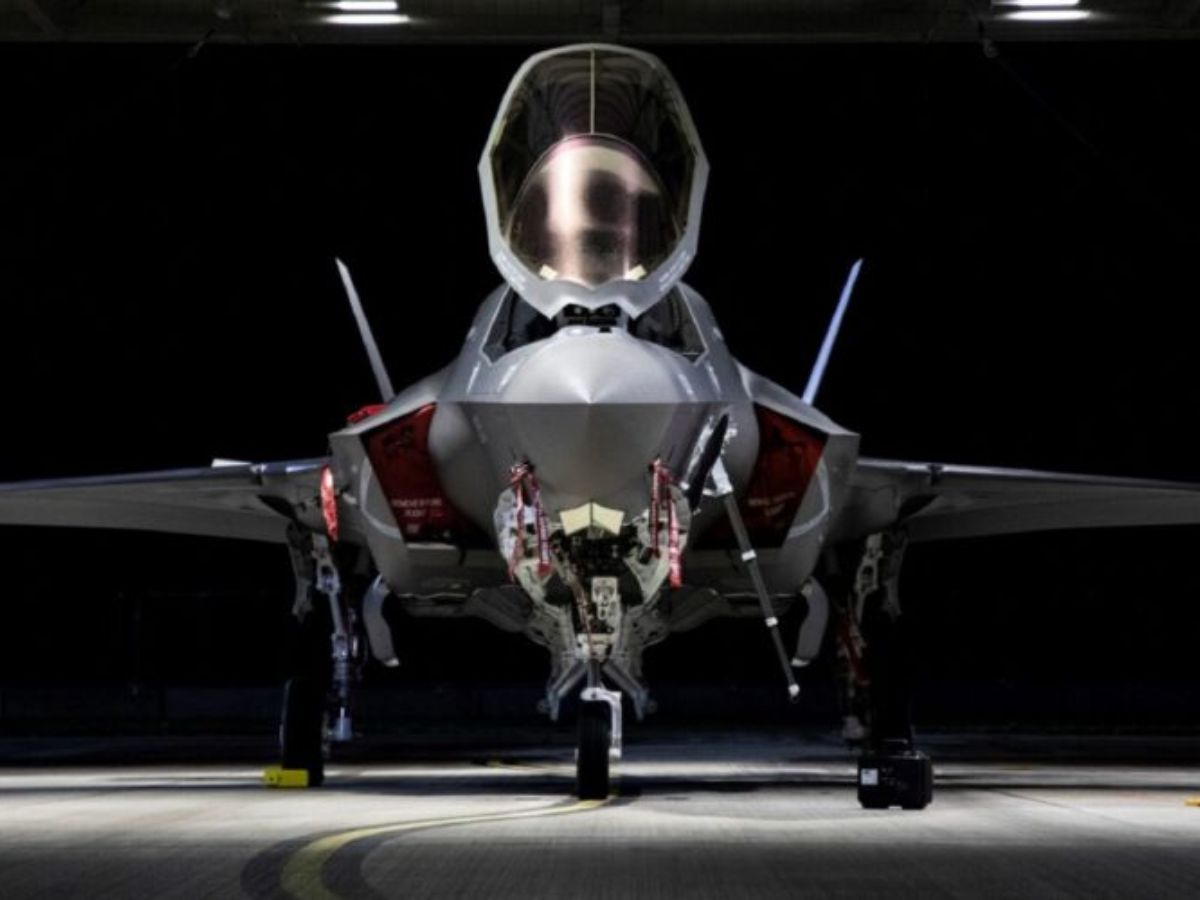
In a decision that could reshape regional geopolitics, President Donald Trump’s United States has agreed to provide Saudi Arabia with the cutting-edge F-35 fighter jet. The renewed assurance given during Crown Prince Mohammed bin Salman’s trip to Washington marks a crucial moment, sparking debates about tech security and the balance of power in an unstable region.
What Makes the F-35 So Special?
The F-35 Lightning II is known as America’s top stealth fighter jet, offering far more power than older aircraft. As a fifth-generation jet, it uses stealth features, advanced sensors, and high-end radar systems. Its design allows it to easily shift between air-to-air fighting and air-to-ground strikes within a single mission. As expert Bradley Bowman notes, its stealth coating makes it extremely difficult for enemy defenses to detect, fundamentally changing the combat dynamic.
Also Read: Pakistan on Maximum Alert as FM Raises Specter of ‘All-Out War’ with India
Why Does Saudi Arabia Want This Jet?
For Saudi Arabia, getting the F-35 is about gaining a strong military advantage. The jet is seen as the “centerpiece of modern warfare” and a key asset for global security, with a solid combat record in Afghanistan and NATO missions. Owning this technology would greatly boost the Royal Saudi Air Force’s strength and defense. For Crown Prince MBS, it is a top-level weapon to counter rivals and reinforce Saudi Arabia’s position as a leading military power in the Middle East.
What Are the Major Concerns for the United States?
The proposed sale comes with major concerns. The biggest worry is that sensitive U.S. technology could be exposed. Since China is Saudi Arabia’s largest trading partner, there are fears that Beijing might gain access to the F-35’s valuable stealth and sensor systems. Furthermore, the sale risks upsetting Israel’s Qualitative Military Edge (QME), a long-standing US policy ensuring Israel’s military superiority over neighboring states. Israel, which already uses the F-35, depends on this technological advantage for its security.
Also Read: CAQM’s Urgent Directive to Postpone All Sports Events as AQI Worsens in Delhi-NCR States
How Could This Sale Reshape the Middle East?
The introduction of the F-35 into the Saudi arsenal has the potential to alter the military balance in the Middle East. It would provide Saudi Arabia with a capability that only a handful of nations possess, changing strategic calculations for the entire region. The deal occurs amidst complex diplomatic efforts, including a US-backed Gaza peace plan that relies on Israeli support. Granting such advanced weaponry to Saudi Arabia forces a delicate recalibration of alliances and security assurances, particularly for Israel.