
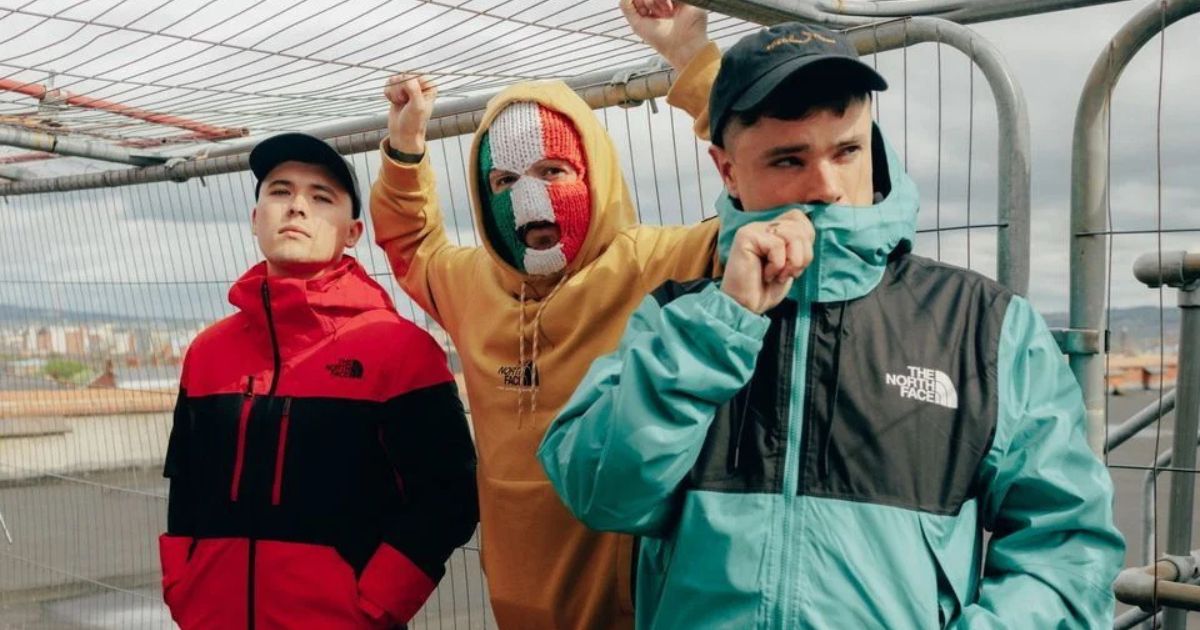
The Hungarian government has barred all three members of the Irish-language rap group Kneecap from entering the country, just weeks before their scheduled performance at one of Europe’s largest music events—the Sziget Festival in Budapest.
In a series of decrees published Thursday, Hungary’s immigration authority—the National Directorate-General for Aliens Policing—declared band members Naoise Ó Cairealláin, J.J. Ó Dochartaigh, and Liam Óg ÓhAnnaidh to be “serious threats to national security,” banning them from Hungarian territory for the next three years.
The move has ignited international debate, drawing attention to Kneecap’s controversial political messaging and Hungary’s tightening stance on expression linked to Palestinian solidarity and Irish republicanism.
From Coachella to controversy: What sparked the ban?
Belfast-born Kneecap is renowned for fusing intense rap with incisive sarcasm, Irish republican symbolism, and thought-provoking political criticism. The group frequently receives criticism for their political remarks, drug references, and foul language that is seen as supporting terrorist organizations like Hamas and Hezbollah.
The band’s recent performance at Coachella 2024 drew sharp criticism after the group accused Israel of committing genocide in Gaza, allegedly “enabled by the U.S. government.” That moment triggered a wave of backlash—including calls for their U.S. visas to be revoked and the cancellation of several scheduled shows.
Their performance at Sziget Festival—slated for August 11, the event’s closing day—had already been the subject of public pressure from Hungarian officials and conservative groups.
Hungarian government cites antisemitism and national security
Zoltán Kovács, the Hungarian government’s official spokesperson, confirmed the move on social platform X (formerly Twitter), stating:
“The decision to ban Kneecap was due to antisemitic hate speech and open praise for Hamas and Hezbollah. Hungary maintains zero tolerance toward antisemitism.”
Hungary’s Minister for European Affairs, János Bóka, had earlier issued a letter to Sziget organizers urging them to cancel Kneecap’s appearance—citing the government’s “zero-tolerance” policy on antisemitism. This view has been echoed by hundreds of Hungarian cultural figures, who signed a petition demanding the band be dropped from the festival lineup.
Kneecap hits back: “We’re being silenced.”
Kneecap has denied ever supporting Hamas or Hezbollah and says it does not condone violence. The group claims their criticism stems from support for Palestinian rights and argues the ban is a politically motivated attempt to suppress dissent.
“We’re being banned not because of hate, but because we speak up—against genocide, for Gaza, and for Irish unity,” the group said in a statement. “Silencing musicians for political reasons is nothing short of authoritarianism.”
Despite the setback, Kneecap continues to tour internationally and recently announced they are working on a new album inspired by recent events.
Why it matters: Art, activism, and the politics of performance
The Kneecap controversy reflects a growing tension between freedom of expression in art and governments’ national security concerns. As global music festivals increasingly become platforms for political speech, incidents like this are likely to become flashpoints—especially in countries with hardline domestic policies or sensitive geopolitical alignments.