
Terming India as “trusted partner,” the United States has asserted that the bilateral space cooperation between the two nations holds immense strategic importance serving as a crucial counterbalance to China’s growing influence while driving technological innovation and global economic growth while driving technological innovation and global economic growth.
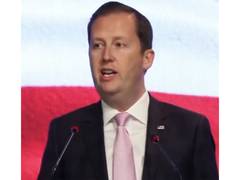
Addressing the US-India TRUST Initiative event titled ‘Advancing Partnership in Research and Innovation’, Sergio Gor highlighted the rapidly expanding dimensions of the Washington-New Delhi space trajectory, noting that bilateral connections “seem to know no bounds” across both civil and commercial sectors.
“The cosmos has always been an ultimate proving ground for human capability. And over the past year, the United States and India proved that we belong side by side. The successful launch of the NASA ISRO synthetic radar mission, NISAR, demonstrated how countries are leading together in earth observation and advanced space technology,” Gor said.
“When the United States leads, we invite trusted partners. We have seen over the last year and a half that India is that trusted partner. It’s something that we look to build upon,” Gor said, emphasizing that space cooperation remains a top priority for the US embassy and his entire team.
Highlighting major milestones in earth observation and advanced space technology, Gor pointed to the successful launch of the NASA-ISRO Synthetic Aperture Radar (NISAR) mission. With a USD 1.5 billion investment- marking the largest bilateral space initiative to date-the NISAR mission has revolutionized global mapping of ice and land, significantly advancing earth science.
“The 1.5 billion investment, the largest bilateral space initiative today, has revolutionized global mapping of ice and land, supporting a broad range of earth science,” Gor said
The Axiom-4 mission, saw an Indian astronaut journey into space for the first time since 1984, he said noting that the historic feat was actualized through a multi-agency collaboration involving NASA, ISRO, Axiom Space, and SpaceX, fueled by the landmark NASA-ISRO Strategic Framework for Human Space Flight Cooperation signed in 2025. Under this framework, ISRO astronauts received specialized training at NASA’s Johnson Space Centre.
“The NASA ISRO strategic framework for human space flight cooperation signed in 2025 made this possible, with ISRO astronauts receiving training at NASA’s Johnson Space Center. And there’s more ahead,” the US ambassador said.
Gor reiterated the US invitation to India, a signatory of the Artemis Accords, to accelerate humanity’s return to the moon and establish a sustained lunar presence.
“As a signatory of the Artemis Accords, we’ve invited India to join us in accelerating humanity’s
return to the moon, and this time to maintain a sustained presence. When the United States leads, we invite trusted partners. We have seen over the last year and a half that India is that trusted partner. It’s something that we look to build upon,” Gor said.
Over the last two decades, ISRO has launched 233 satellites in collaboration with US companies. Gor noted that India’s recent announcement to launch 15 new satellites, backed by a USD 2.8 billion investment, opens up massive frontiers for US space firms.
“The United States and India maintain one of the world’s most dynamic bilateral space partnerships spanning both civil and commercial sectors. Our cooperation holds strategic importance. It addresses emerging threats, advances peaceful use of space, provides counterbalance to China’s influence, and drives technological innovation and economic growth,” he said.
“India’s commercial space sector has grown significantly, with ISRO launching 233 satellites with US companies over the last 20 years. India’s recent announcement of plans to launch 15 new satellites, representing a 2.8 billion investment, creates new opportunities for US space firms,” he said.
“India’s 2024 foreign direct investment (FDI) guidelines now permit up to 100% FDI in the space sector here, further expanding opportunities for US companies to fuel India’s growth,” Gor stated.
The space connections between our two countries and government seem to know no
bounds. And once again, it’ll be an item that is a priority for us, for embassy and my entire team, the US envoy said.
Beyond the cosmos, Gor underlined that deep research collaboration between academic institutions, such as IIT Delhi, forms the bedrock of achievements spanning Artificial Intelligence (AI) and pharmaceuticals.
Through the US-India Science and Technology Endowment Fund, the India and the US are currently supporting over 20 binational research teams to commercialize cutting-edge advancements in AI, quantum computing, advanced materials, and critical minerals processing. (ANI)
(The article has been published through a syndicated feed. Except for the headline, the content has been published verbatim. Liability lies with original publisher.)