
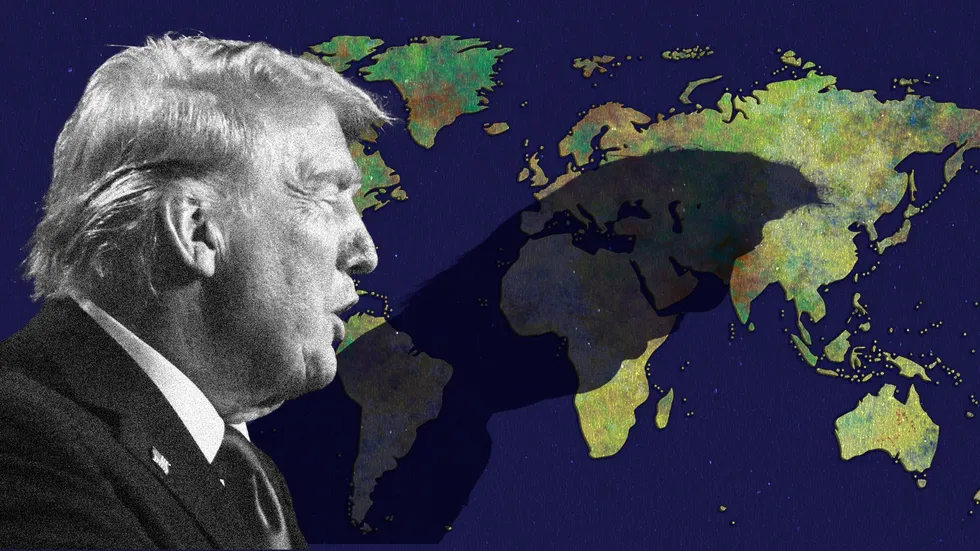
The US has engaged in territorial expansion beyond its continental limits for more than a century, solidifying its status as a global power through military occupation and strategic positioning. This week, President Trump’s assertions regarding Greenland and his depiction of Canada, Greenland, and Venezuela on the US map have ignited a new wave of debate on the global stage. His conditional commitments to NATO have revived patterns of imperial expansion while concurrently weakening the Western alliance system. The actions that Trump is poised to take will undoubtedly alter the landscape of global politics.
Understanding the historical trajectory of the US’ imperialistic endeavors illuminates the contemporary transition crisis facing transatlantic security. American territorial ambition extends from the Mexican-American War through Pacific acquisitions. That 1846-1848 conflict yielded 525,000 square miles, while the 1867 Alaska purchase added 665,384 square miles. The most transformative expansion occurred following the 1898 Spanish-American War, which fundamentally repositioned the US as a territorial empire. The Treaty of Paris transferred Puerto Rico, Guam, and the Philippines to American control for USD 20 million. The Philippine campaign proved devastating; three years of occupation resulted in approximately one million Filipino casualties.
Beyond Spanish territories, the US maintained military occupations throughout the Caribbean and Central America. Nicaragua endured occupation from 1912 to 1933; Haiti from 1915 to 1934; and the Dominican Republic from 1916 to 1924. The Platt Amendment imposed upon Cuba ensured perpetual American intervention rights, while Guantanamo Bay remained permanently under American control. These interventions, nominally justified as promoting stability, actually served broader strategic interests.
During World War II, American military presence expanded into Europe. The occupations of Greenland (1941–1945) and Iceland (1941–1946) established permanent strategic positions; the US retained an Icelandic base until 2006. By the Cold War era, American military infrastructure had become globally ubiquitous: approximately 750 bases across 80 or more countries, representing 70–80% of the world’s foreign military installations.
TRUMP’S VENEZUELA, GREENLAND AND CANADA CAMPAIGN: RESURRECTIONS OF EMPIRE
After capturing Maduro in Venezuela and claiming Venezuela’s resources and governance, Trump’s pursuit of Greenland resurrects historical territorial acquisition patterns within a contemporary alliance framework that explicitly prohibits such expansion. In mid-January 2026, Trump publicly demanded Denmark cede Greenland to the US, framing acquisition as essential to American national security. When Denmark rejected this demand, Trump escalated dramatically, threatening 10% tariffs on Denmark, Norway, Sweden, France, Germany, the UK, the Netherlands, and Finland starting February, escalating to 25% by June.
Most concerningly, Trump has clearly stated that he would not dismiss the possibility of the US withdrawing from NATO should the alliance be unable to meet his territorial goals. His approach has transformed NATO membership into a conditional proposition tied to Greenlandic acquisition, a demand that violates NATO’s founding principles. Trump’s strategic rationale invokes Russian and Chinese Arctic activity, claiming Greenland’s geopolitical position requires American control. Yet this framing obscures a more fundamental objective: territorial expansion and unilateral decision-making authority over alliance strategy. The administration explicitly prioritizes the Western Hemisphere and Indo-Pacific regions over European security, indicating that Europe no longer constitutes America’s primary strategic concern. His plans and claims to annex Canada also reflect the same issue.
NATO’S INSTITUTIONAL COLLAPSE RISK
Trump’s actions precipitate a profound institutional crisis extending far beyond Greenland or Canada now. NATO’s Article Five talks about collective defence provision, invoked only once, following September 11, 2001, and constitutes NATO’s existential foundation. Yet Trump’s repeated suggestions that the US might withdraw from NATO, or that Article Five commitments are conditional upon defence spending levels, introduce fundamental uncertainty regarding that commitment.
This credibility erosion operates on two critical levels. First, Trump’s rhetoric directly undermines NATO’s deterrent posture against Russian aggression. European security analysts unanimously warn that mere suggestions of American withdrawal weaken deterrence, embolden adversaries, and destabilize European security planning. German Chancellor Friedrich Merz has begun articulating German security autonomy independent of American guarantees, an extraordinary development signifying Europe’s recognition that American commitments may no longer be reliable.
Second, Trump’s threats against Greenland and Denmark create an institutional impossibility: NATO possesses no mechanisms for managing conflict between member states; Article Five applies exclusively to external attacks. If the US invades Denmark to seize Greenland, the alliance would face constitutional paralysis.
BURDEN-SHARING AS STRATEGIC SUBORDINATION
Trump’s demand that NATO members increase defence spending to 3% of GDP by 2035 must be understood within the context of conditional commitment. While European leaders historically viewed burden-sharing demands as legitimate concerns about equitable contributions, Trump’s formulation converts this issue into strategic subordination. Also, the smaller NATO members cannot efficiently convert GDP percentages into equivalent capabilities. All in all, because of Trump’s actions, NATO seems to be in a fractured state, and this indicates future geopolitical realignment among the nations including the present NATO members.
GEOPOLITICAL REALIGNMENT AND ITS IMPACT ON RUSSIA + CHINA
Trump’s assault on NATO credibility creates perverse incentives for strategic competitors. As NATO’s internal cohesion fractures under American pressure, Russia and China recognize opportunities for Arctic cooperation that would have been impossible within a unified Western security environment. If the whole situation is analysed from the game theory’s perspective, it demonstrates that external pressure from NATO, previously unifying, now promotes closer Russia-China alignment. Also, Trump’s Greenland fixation diverts critical attention from Ukraine, and strengthens Putin.
Thus, Trump’s actions violate the foundational commitments of both NATO and a rule-based order that the US always vouch for. While threatening to withdraw from an alliance built to present great-power competition authorizing military expansion, NATO requires European confidence that Article Five guarantees are unconditional. Trump’s conditioning of NATO membership on territorial demands and defence spending destroys that confidence. European leaders now face a dilemma: invest in defence autonomous from the US, or remain dependent on a security guarantee increasingly subject to presidential discretion.
What he has done this week will be transformative for global politics, mark my words! And, unless Trump’s stance changes significantly, NATO’s institutional future appears to be uncertain! I believe Putin is smiling this week.