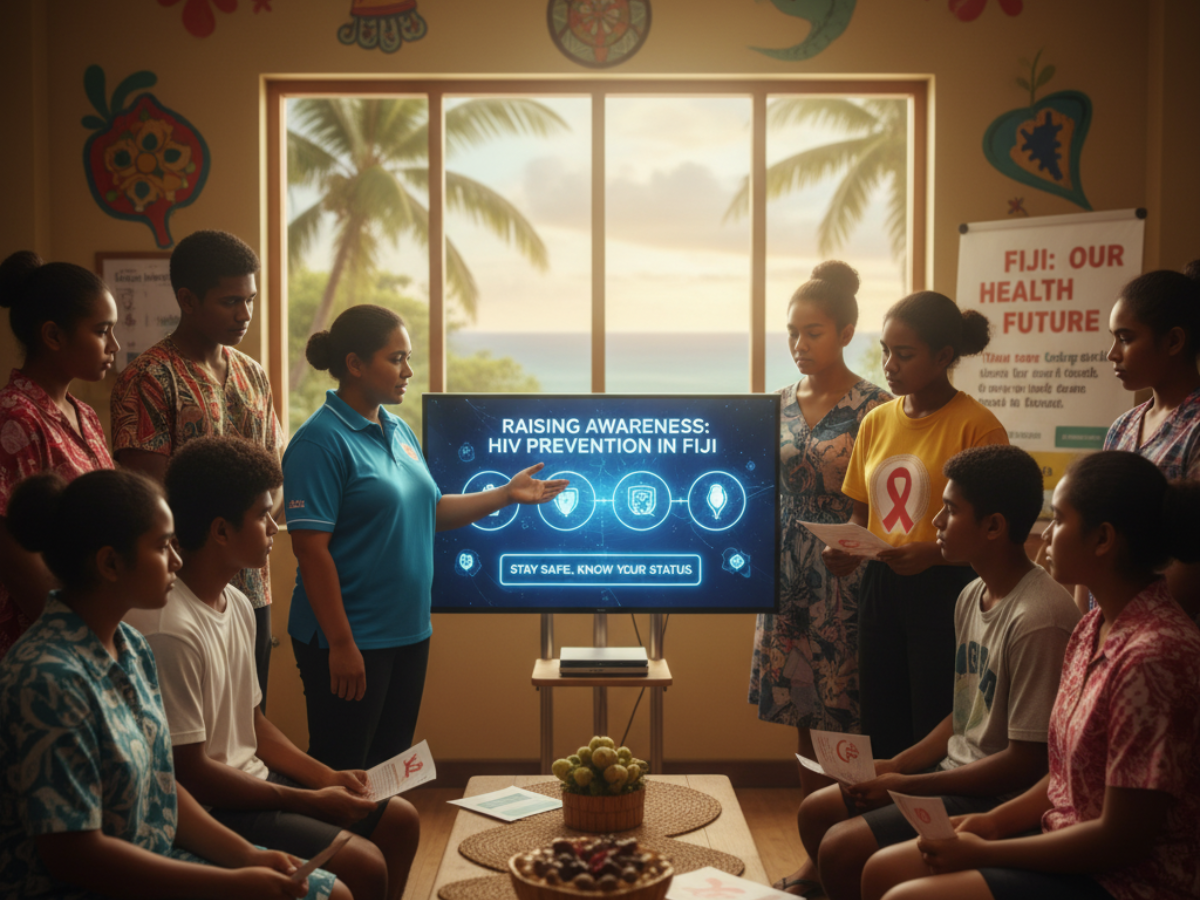
In small Pacific island country inhabited by less than one million people, HIV is swiftly becoming a threat. In the last decade, the scale of people living with HIV here has grown by exponential leaps and bounds with increasing younger people now coming with HIV. A former sex worker and project coordinator with Fiji’s Survivor Advocacy Network, Sesenieli Naitala, recounts meeting a ten-year-old child with HIV a dismal symbol of the dimensional reach of the epidemic.
Drug Use & Unsafe Practices Drive Infection Rates
An important aspect which accelerates the rate at which HIV is transmitted is the increase in potential risky behaviors among youth. Though the introduction of methamphetamines had already catalyzed a rising trend in the misuse of injections with a new phenomenon that has surfaced is bluetoothing.
This group consists of sharing blood after injecting methamphetamines, thus intensifying the possibility of infection. According to Kalesi Volatabu, the executive director of Drug Free Fiji with a group of youths sharing one needle and passing blood has also been witnessed.
ALSO READ: Breast Cancer Awareness Month: Prevention, Early Detection & Hope for Every Life
What is the Role of Methamphetamine in the Epidemic?
In the last 15 years, Fiji has become the most important transit point in the region for crystal methamphetamine the drug connecting a producer in Asia to markets in Australia and New Zealand. It is in this increase of availability of the drug that local communities have suffered the most.
The Younger users have added to the increasing pool of infectees and almost half of new HIV cases in 2024 would henceforth relate to the use of intravenous drugs to testify how intertwined the drug crisis and HIV epidemic really are.
ALSO READ: PCOS vs PCOD: What’s the Difference & Why It Matters for Women’s Health
Horrifying Statistics & Response from Government
From below 500 cases in 2014, the number of people living with HIV in Fiji has jumped to around 5900 by 2024. The New infections in 2024 alone hit 1583, a thirteen-fold increase over recent averages. Concern arises when one looks at 41 new cases that involved children aged 15 or younger as a result, in January, the health ministry of Fiji declared officially an HIV outbreak with a warning that new cases could exceed 3000 by the end of 2025.
Where the Educational & Resource Gaps Are?
Experts admit that gaps in education are part of the major causes of the epidemic. Naitala and Volatabu led organization efforts are ongoing to raise awareness in HIV risk and safe practices among people.
The experts like Jose Sousa-Santos from New Zealand cautioned that Fiji does not have adequate infrastructure in terms of health care personnel and availability of treatment in order to effectively contain the record-breaking crisis during these years. The health system of the country is in danger of collapsing under the weight of the epidemic with communities undergoing ruin as well.
ALSO READ: Why Rhode Island Is Called the Ocean State: History, Coastline & Fun Facts
Disclaimer: This article is for informational purposes only and does not replace professional medical advice or official health guidelines.