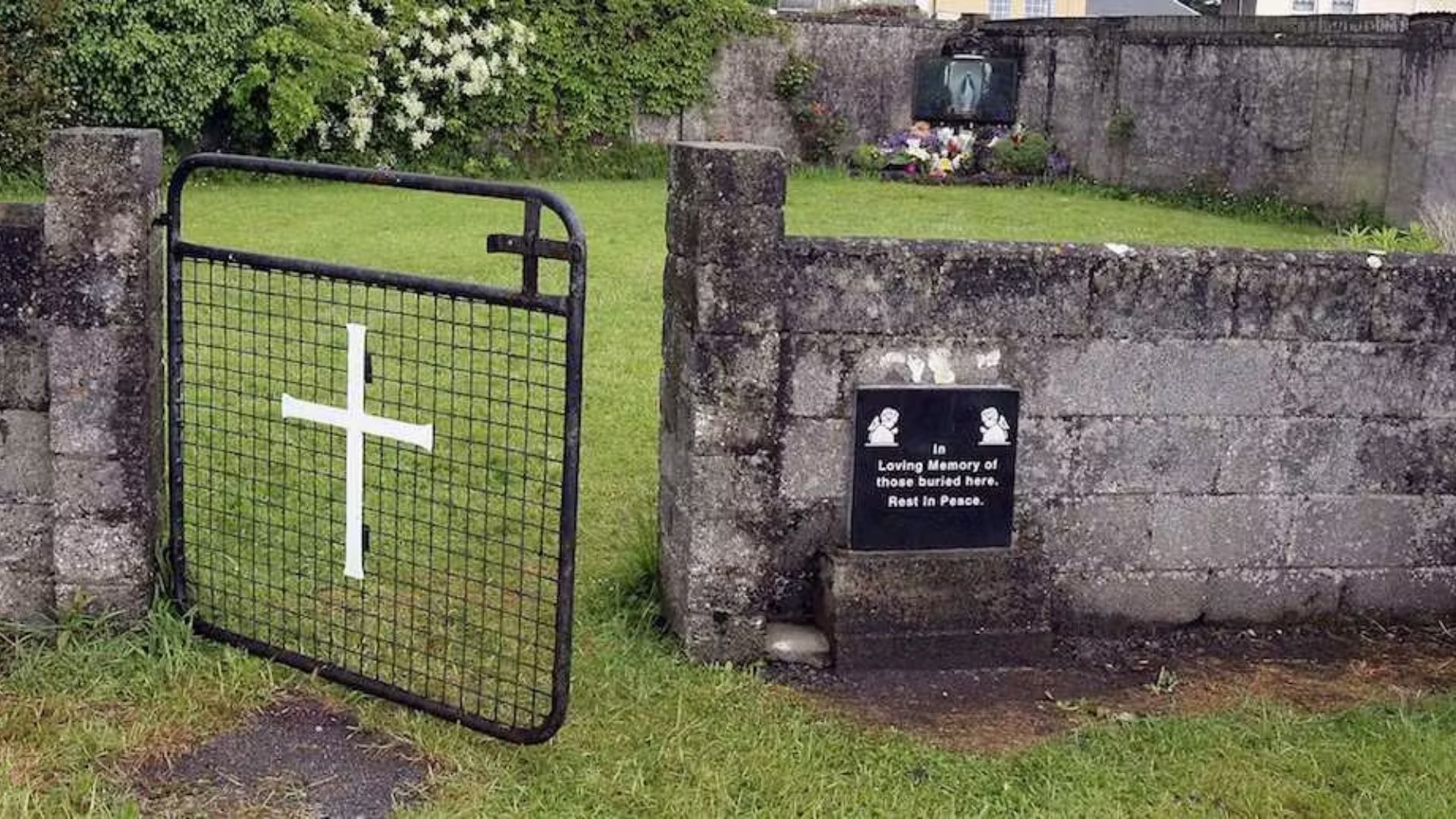
A large forensic excavation is underway in Tuam, County Galway, Ireland, to exhume the remains of around 800 infants and young children who are thought to be buried in an unmarked mass grave.
The dig, under way Monday, is a pivotal moment in Ireland’s grappling with the sorrowful history of church-controlled homes for unmarried mothers and their children.
The location, which is now a playground and housing estate, previously contained the Bon Secours Mother and Baby Home. Over the course of the following two years, groups of forensic archaeologists, anthropologists, and crime scene investigators, some of whom have traveled as far as Colombia, Canada, Australia, and the US will excavate and identify the remains that date back to the time when the institution functioned between 1925 and 1961.
The Tragic History of Tuam’s Children
Popularly known as St Mary’s, the Tuam Mother and Baby Home was one of a number of institutions in Ireland established to accommodate women pregnant out of wedlock, a state much frowned upon by Irish society and by the Catholic Church. Operated by the Bon Secours Sisters, the home also controlled the adjacent Grove Hospital.
Throughout its 36 years of existence, thousands of children and women resided there. Official death records show 796 children perished within the institution, all ranging from newborns to toddlers.
The first was Patrick Derrane, only five months old in 1925; the final one was Mary Carty in 1960. But only two were legally buried in a nearby cemetery. The lack of burial information or headstones for the others raised haunting questions.
Local Historian Finds the Truth
The truth only started to reveal itself in 2014, courtesy of local historian Catherine Corless. Raised in Tuam, she remembered how ‘home children’ were separated at school. Intrigued, she accessed death certificates from the Galway registrar’s office and was appalled to be presented with a list containing hundreds of names.
“A week or so later a suspicious member of staff phoned to inquire whether she actually wanted them all,” Corless recalled. The list accounted for 796 children. Cemetery records revealed no record of their burials.
Her investigation into maps of the old site revealed even more sinister hints: a 1929 survey identified an area as a ‘sewage tank’, whilst a 1970s version referred to it as a ‘burial ground’.
Corless subsequently discovered that in the 1970s, two lads had heaved up a shattered concrete slab and discovered bones underneath, hastily buried. Though some have speculated that these remains could be from the Famine period, Corless observed famine victims buried elsewhere with markers, speculating instead on a mass grave connected to the dwelling.
State Investigations
A 2017 government excavation test proved dire suspicions. Investigators found a vault containing 20 rooms with ‘substantial amounts of human remains’ of children between 35 weeks gestation and approximately three years old, dating to the time the house was in operation.
Chaired by Judge Yvonne Murphy, the Mother and Baby Homes Commission of Investigation went on to investigate who was behind such burials. An official state apology followed the Commission’s final report in 2021.
Taoiseach Micheál Martin stated: “We had a totally distorted approach to sexuality and intimacy, and young mothers and their sons and daughters paid a horrific price for that dysfunction.”
The Bon Secours Sisters, who operated the Tuam home, also made an admission: “We did not live up to our Christianity when running the Home.” They accepted the children were ‘buried in a disrespectful and unacceptable way’ and made an offer of compensation.
A Painful but Necessary Process
The new dig is directed by Daniel MacSweeney, a veteran at recovering remains from war zones. “This is a highly tricky procedure…actually a world-first,” he said, explaining the delicate, commingled remains. “They’re infinitesimally small. We have to recover the remains extremely, extremely cautiously, to maximise the chance of identification.”
The €6-13 million initiative will undertake DNA tests to try to identify as many children as possible, finally bringing them proper burial, dignity long withheld.
In the meantime, demands have increased for an investigation into the Grove Hospital, also formerly managed by the Bon Secours order, following accusations that further children could be interred there. Galway County Council has instructed archaeological monitoring of any ground movement.
As bulldozers roll in, Tuam is more than a construction site; it is Ireland’s brutal face-to-face encounter with a tragic history. The expectation now is that every child will at last be named, remembered, and buried with the dignity they were initially denied.