
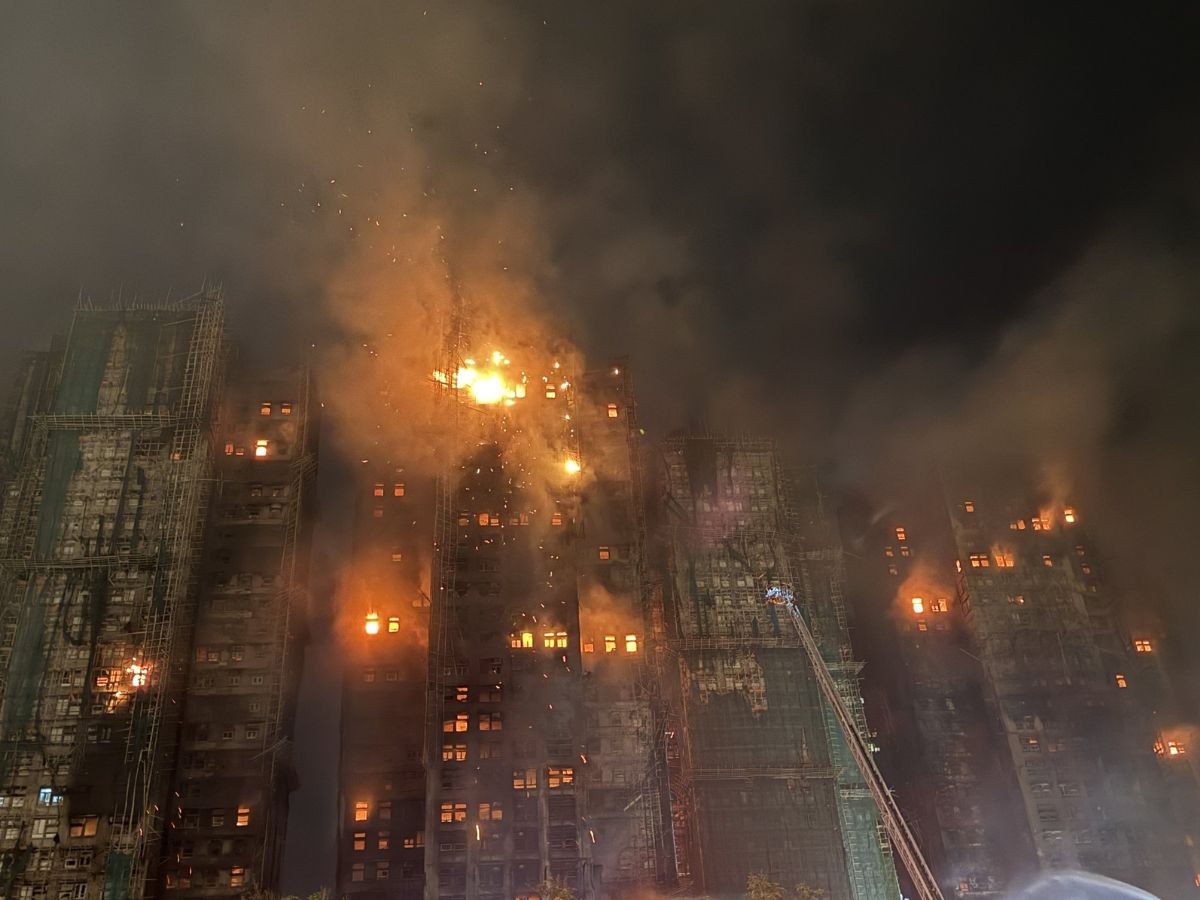
Hong Kong, known for its towering skyscrapers, is facing a tragic disaster after a massive fire broke out on Wednesday, November 26, at the Wang Fuk Court residential complex. The estate, which includes around 2,000 apartments across eight buildings, has so far claimed at least 44 lives, with hundreds more reported missing. Chinese President Xi Jinping offered his condolences and urged “all-out efforts” to minimise casualties and losses.
Hong Kong Fire Broke Out
The fire erupted at Wang Fuk Court, a large housing estate in Tai Po district, at 14:51 local time on November 26. The complex includes eight 32-storey buildings housing nearly 4,600 residents in 1,984 apartments. At the time, the buildings were under renovation and covered with bamboo scaffolding and protective netting. Derek Armstrong Chan, deputy director of Hong Kong Fire Services, said the scaffolding was already on fire when firefighters arrived, helping the flames spread to other blocks. Seven of the eight buildings were affected, forcing residents who could escape into temporary shelters.
Cause of Hong Kong Fire and Investigations
The exact cause of the fire remains unknown, but bamboo scaffolding likely accelerated the flames. Bamboo is widely used in Hong Kong due to its strength and light weight, but authorities had planned to phase it out following safety concerns, after 23 deaths since 2018 from scaffolding accidents. Gary Au Gar-hoe of the Hong Kong Institute of Engineers noted, “Besides the scaffolding, there was also debris inside like newspapers and other flammable items. Once these items burn, the entire blaze would strengthen.” Residents also reported unsafe conditions, such as construction workers smoking on site.
Police have arrested three construction officials on suspicion of manslaughter two company directors and a consultant. Eileen Chung, a senior police superintendent, said, “We have reason to believe that those in charge of the construction company were grossly negligent.” Authorities noted that some exterior materials may not have met fire-resistance standards and found that styrofoam inside the buildings contributed to the rapid spread. Temporary shelters have been set up for displaced residents.
The fire quickly went viral on social media, with reports of explosions inside the buildings. Hong Kong’s fire department has declared the blaze a level five fire the highest severity, marking the first level-five fire in 17 years. Firefighters have struggled to reach the upper floors due to extreme heat, where many residents remain trapped. Chan said, “The temperatures inside the buildings concerned are very high, so it’s quite difficult for us to enter the building and go upstairs and conduct firefighting and rescue operation.” A total of 128 firetrucks, 57 ambulances, and 400 police officers have been deployed.
Impact on Residents Due To Massive Fire in Hong Kong
The fire has left residents devastated. Shirley Chan described the tragedy as “truly heartbreaking,” saying, “A home gone, burnt. Anyone would be heartbroken. I can relate to that; it’s truly heartbreaking.” Jason Kong, 65, added that a neighbour was still trapped inside, expressing fear and despair over the destruction.
Hong Kong Chief Executive John Lee confirmed 44 deaths and 279 missing individuals. Among the dead is firefighter Ho Wai-ho, 37, who had served at Sha Tin Fire Station for nine years. At least two other firefighters were injured one with a leg injury, the other suffering from extreme exhaustion.
Is This the Worst Fire in Hong Kong?
With at least 44 deaths, the Wang Fuk Court fire is now considered the deadliest in Hong Kong’s history. Previously, the 1996 Garley building fire, which killed 41 people, held this grim distinction. Such large-scale fires are rare in Hong Kong, which has strict building regulations and a generally strong record of construction safety.
Also Read: Hong Kong’s Five-Alarm Tower Blaze Kills 44, Triggers Mass Rescue Operation