
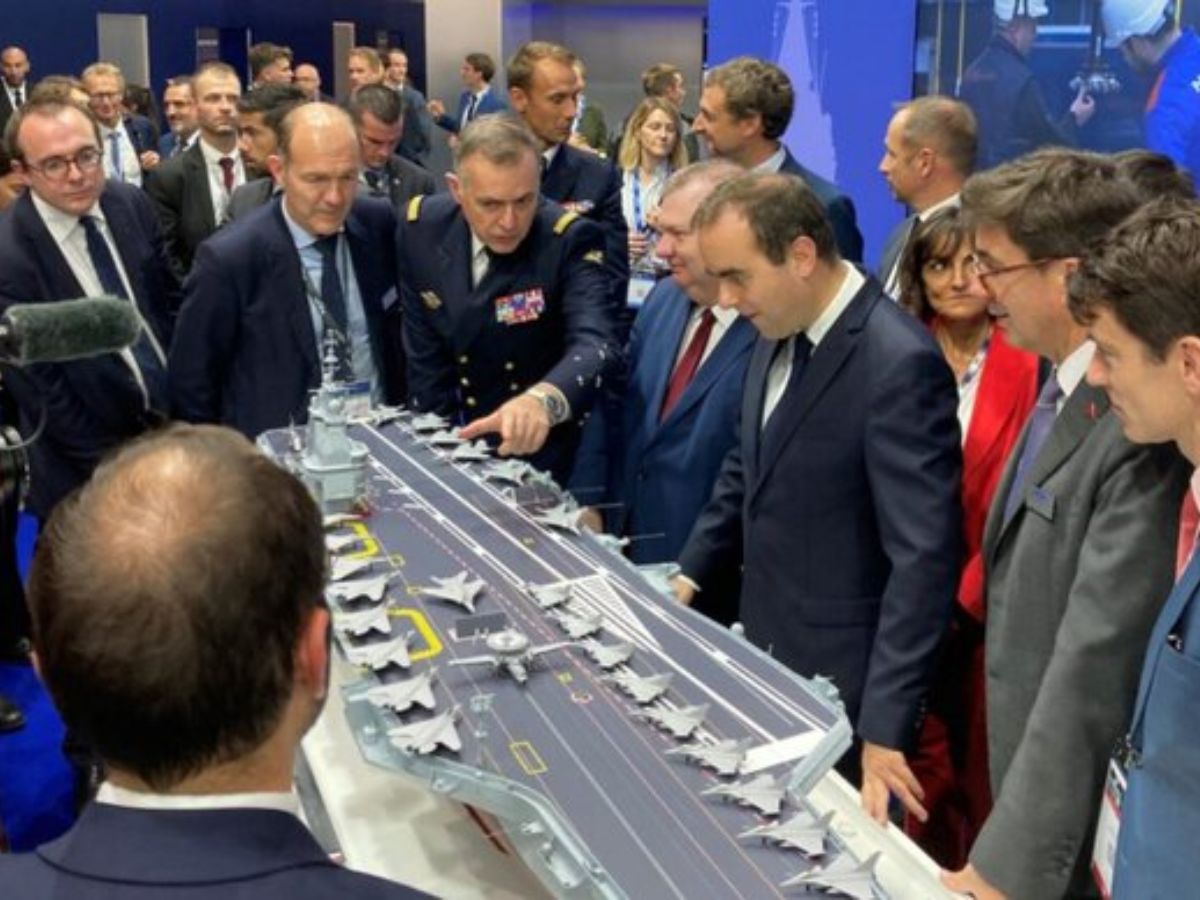
France is taking a major step to expand its military strength. President Emmanuel Macron has formally approved the construction of a new aircraft carrier for the French Navy. He announced the decision while addressing troops abroad, underscoring the shift in defence priorities as global tensions increase.
At the same time, Macron is moving ahead with a voluntary military service programme for young people, aimed at strengthening manpower in the armed forces. Both moves are part of a broader plan to modernise France’s security framework.
New Aircraft Carrier Approved for 2038
President Macron confirmed on December 21, 2025, that France will build a next‑generation aircraft carrier, known as the Porte‑Avions Nouvelle Génération (PA‑NG). The ship will replace the ageing Charles de Gaulle aircraft carrier and is scheduled to enter service by 2038.
Macron told soldiers that the decision reflects France’s need to remain strong at sea. “In this age of predators, we must be strong to be feared,” he said, signalling that naval power is central to national defence.
The building of the PA‑NG marks a key milestone in France’s military programming law, known as LPM 2024‑2030, which boosts defence capabilities and allocates billions in funding for equipment and personnel.
Experts say the new carrier will not only project power but also support European defence autonomy, especially as geopolitical stress continues around the world.
What is the Military Programming Law (LPM)?
France’s Military Programming Law (LPM 2024‑2030) outlines defence spending and capability upgrades over several years. Under this law, defence budgets have seen significant increases, allowing for procurement of new technology, warships, aircraft and support systems.
The law aims to keep France competitive and prepared amid shifting global security dynamics, including tensions linked to the war in Ukraine and broader strategic rivalries.
Voluntary Military Service for Youth
In addition to hardware upgrades, Macron is also rolling out a voluntary military service programme for young adults. The new service will begin in summer 2026 and last 10 months, offering young people a chance to serve their nation without compulsory conscription.
The programme targets youth aged 18–19 and will involve military training and duties, mostly within France. In the first year, around 3,000 volunteers will join, with ambitions to grow the number to 10,000 by 2030 and 50,000 by 2035.
Volunteers will receive training, accommodation, equipment, and a monthly stipend. Officials say this helps build a stronger connection between citizens and the armed forces while boosting manpower for national defence tasks.
Why is France Expanding Its Force?
Macron’s announcements come amid a rising global security environment. France aims to enhance its capacity to deter threats and secure its interests, particularly in strategic regions like the Mediterranean and beyond.
The aircraft carrier project and the expansion of human resources are complementary measures. The ship boosts France’s maritime reach and operational flexibility, while the voluntary service ensures a steady flow of trained personnel.
What This Means for France’s Military?
A modern aircraft carrier by 2038 will strengthen naval capabilities. The new service programme will foster military engagement among youth. Defence spending growth supports technology upgrades and force readiness. By investing in both technology and people, France is reshaping its defence model for future security challenges.
Economic and Industrial Impact
The aircraft carrier programme also supports the domestic industry. It involves hundreds of suppliers, especially small and medium enterprises, which stand to benefit from long-term contracts.
Naval and defence sectors expect job creation and technology transfer, making the project not just a military priority but also an economic stimulus.