
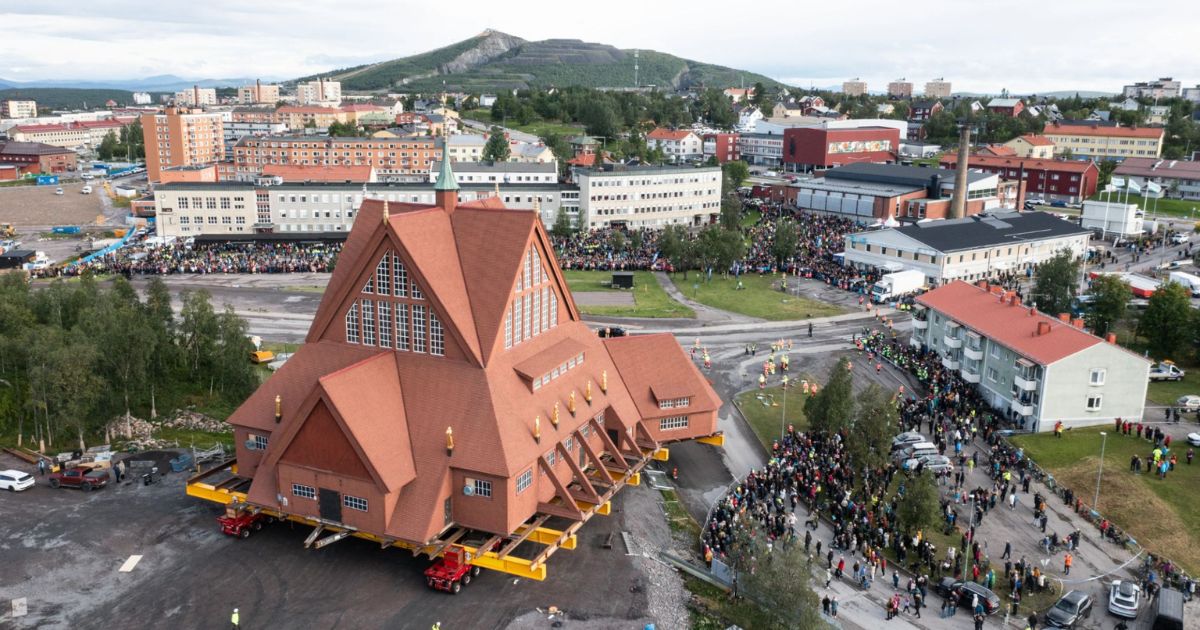
A Town on the Move
Deep in northern Sweden, a remarkable phenomenon is taking place. Kiruna Kyrka, a century-old, 672-tonne Lutheran church, has started its two-day commute to a new location. The move, years in the planning, is due to the fact that the whole Arctic town of Kiruna is being relocated to accommodate the growth of Europe’s largest underground iron mine.
The church, which was opened in 1912 and is Sweden’s most revered building, is having the 5km roll with great caution at the slow rate of half a kilometre an hour. Over 10,000 attendants, including King Carl XVI Gustaf, are expected to stand along the broadened roads to watch the spectacle, which has been described as one of the biggest cultural relocations in the world.
The relocation is part of a decades-long urban renewal scheme spearheaded by state-owned mining corporation LKAB. The mine, a keystone of Sweden’s economy, has progressively unbalanced the ground beneath Kiruna, prompting the centre of its town and dozens of cultural landmarks to be moved.
“The Big Church Move”
Nicknamed Den stora kyrkflytten (“the big church move”), the move is being streamed live throughout Sweden, with cameras along the route in what amounts to a new take on “slow TV.” For some, the event is a poignant farewell. The red wooden church, built by architect Gustaf Wickman in Sámi hut (lsvvu) style, is considered a national treasure. Its altarpiece, which was painted by Prince Eugen of Sweden, and its 2,000-pipe organ have been thoroughly dismantled and wrapped for transport.
The move should complete later this week, with the church opening in its new location at the end of next year. There will be a service and coffee meeting a bid to make the world’s largest church coffee event to celebrate its arrival. Popular Swedish pop singer Carola also appears, and the move is as much about culture as it is about logistics.
The bell tower, a freestanding building, will come next week.
Cultural Preservation vs. Cultural Loss
But whereas LKAB frames the church relocation as evidence of its dedication to preserving heritage, critics say it serves to mask more profound losses. The Sami community, whose territory runs across the country, worry the mine expansion will divide reindeer pastures and erode their way of life.
Karin K Niia, a reindeer herder and Sámi community leader, downplayed the church relocation as a “big show.” She cautioned that the relocation, symbolic as it is, conceals the loss of biodiversity, water sources, and Indigenous way of life brought about by mining. “It is hard to watch,” she said, “knowing the impact this has on reindeer, wildlife, and our way of life.”
LKAB has justified its action, with senior vice president Stefan Hamalainen emphasizing that the move is part of a broader scheme to reimburse residents and pursue “constructive solutions” for affected communities. Chief executive Jan Mostrom acknowledged the church relocation in itself cost more than half a billion kronor (£39m) but maintained it was unavoidable. “Kiruna city centre without the church, I can’t see it so there are no alternatives,” he stated on the live broadcast.
ALSO READ: Deadly Shots In Orebro: Sweden Gang Ties Suspected Near Mosque, City On Edge
A Historic Event
Kiruna’s rebuilding is to carry on until 2035, with 23 cultural monuments to be moved. Though most bemoan the disruption, others regard it as an extraordinary illustration of a community adjusting to industrial demands without losing its identity completely.
For the time being, Kiruna’s beloved church’s slow-motion migration has been a national spectacle, merging engineering, history, and culture. As the wooden monument inches along its painstakingly laid route, it represents continuity and change a town advancing while grasping its dearest past.