
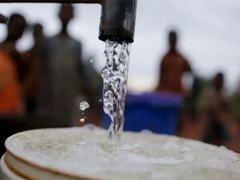
Karachi [Pakistan], May 27 (ANI): As Pakistan marked Eid al-Adha on Wednesday, millions of residents in its financial hub Karachi continued to grapple with an escalating water crisis that has entered its second month, exposing deep infrastructure failures and intensifying public frustration over the city’s deteriorating urban services.
According to Dawn, prolonged supply disruptions have left large parts of the metropolis dependent on expensive private tankers at a time when water demand traditionally surges for religious rituals, sanitation and animal care during the Bakrid festival.
The crisis, which began in late March, has been driven by repeated power outages, ruptured transmission lines, underground leakages and operational failures at major pumping stations linked to the Karachi Water and Sewerage Corporation (KWSC).
As reported by Dawn, residents in densely populated districts, including Lyari, Orangi, Korangi and Malir, have endured dry taps for weeks, while tanker waiting periods have stretched up to 10 days. Prices for private water tankers have meanwhile doubled across several neighbourhoods, placing additional pressure on low-income households already struggling with inflation and rising utility costs.
KWSC Chief Executive Officer Ahmed Ali stated that efforts were underway to maintain normal supply during Eid, attributing many disruptions to electricity failures caused by K-Electric. However, residents across Clifton, DHA, Gulshan-i-Iqbal and North Nazimabad reported severe shortages despite official assurances, highlighting the widening disconnect between civic administration and public experience.
The water shortage has also triggered political criticism within the Sindh Assembly and Karachi Metropolitan Corporation, where opposition parties have accused provincial authorities of failing to modernise the city’s ageing infrastructure despite recurring crises. Karachi currently receives around 650 million gallons of water daily against an estimated demand exceeding 1,250 million gallons, underscoring the scale of the structural deficit.
Beyond the immediate hardship, the crisis reflects broader governance and climate-related challenges confronting South Asian megacities, where rapid urban expansion, weak infrastructure planning and recurring power instability continue to undermine essential public services during periods of peak seasonal demand. (ANI)
The article has been published through a syndicated feed. Except for the headline, the content has been published verbatim. Liability lies with original publisher.