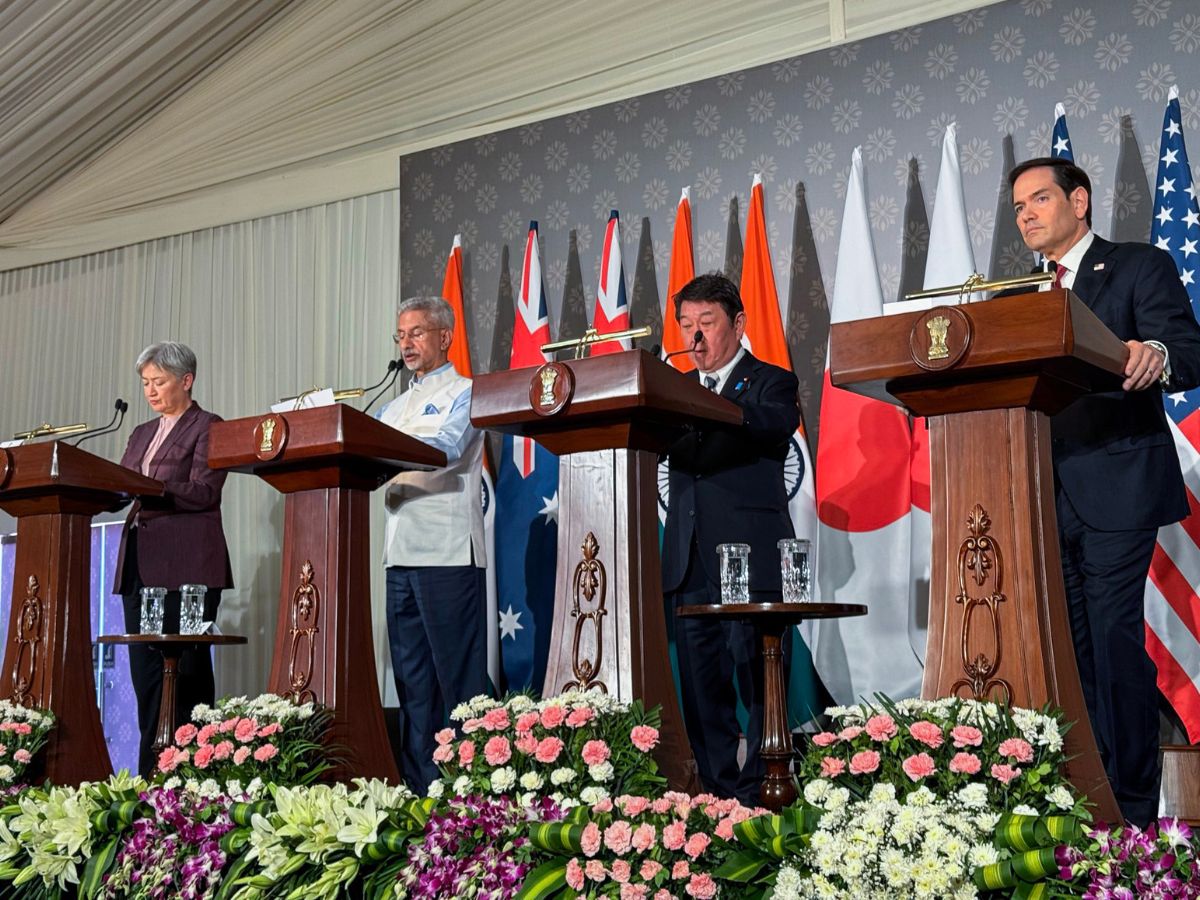
Elevating counter-terrorism to a central baseline of their strategic alliance, the Quad nations on Tuesday explicitly targeted cross-border militancy and its state financiers, alongside unveiling expansive frameworks for Indo-Pacific maritime surveillance, digital infrastructure, and supply chain security. The security-heavy agenda dominated the 11th Quad Foreign Ministers’ Meeting, hosted by EAM S Jaishankar at the historic Hyderabad House, which brought together US Secretary of State Marco Rubio, Australian Foreign Minister Penny Wong, and Japanese Foreign Minister Toshimitsu Motegi to present a highly coordinated, resilient regional architecture.
Addressing a special media briefing after the high-profile meeting here, Additional Secretary in the Ministry of External Affairs, Nagaraj Naidu, outlined the core security paradigms discussed by the leaders, highlighting how the four-nation grouping is actively intensifying its collective defence frameworks against asymmetric threats.
The senior diplomat underscored that while maritime and digital connectivity remain vital parameters of the alliance, the containment of transnational security threats remains a fundamental priority for the partner nations.
“Counter-terrorism is a significant pillar of Quad cooperation. The ministers strongly condemned terrorism in all its forms and manifestations, including cross-border terrorism. The joint statements specifically condemned the terrorist attack in Pahalgam in April 2025 and reiterated the need for decisive international action against terrorist entities and financial sponsors,” Naidu said.
In a robust and definitive collective stance against these transnational security threats, the Quad nations on Tuesday issued a scathing condemnation of the recent major terror strikes in Jammu and Kashmir and Sydney, while emphatically renewing their pledge to safeguard a free and open Indo-Pacific.
The unified front came to light via a joint statement released following the conclusion of the high-level Quad Foreign Ministers’ Meeting in the national capital, where the four-nation alliance made it clear that it “unequivocally” condemned terrorism in all forms, including cross-border terrorism.
The security declaration drew direct focus to regional vulnerabilities by explicitly referencing the April 22 terror attack in Pahalgam in Kashmir and the Bondi Beach attack in Australia in December last year.
“We unequivocally condemn terrorism in all its forms and manifestations, including cross-border terrorism and the horrific terrorist attacks perpetrated at Pahalgam in India on 22 April 2025, and Bondi Beach in Australia on 14 December 2025. We call for decisive and sustained international efforts to combat terrorism in accordance with international law, including action against globally proscribed terrorists and terror entities and their proxies, affiliates, sponsors and financiers,” the joint statement read.
The comprehensive document underscored the absolute necessity of orchestrating “decisive and sustained international efforts” against globally banned terrorists, terror groups, their affiliates, financiers and sponsors.
Turning their focus towards modern warfare and security challenges, the member states voiced deep apprehensions regarding the evolving threat matrix, where extremist groups exploit emerging technologies for terrorist purposes. To counter this, they vowed to build deeper operational synergies with international and regional partners to strengthen counter-terrorism efforts.
“We are committed to working together with our international and regional partners in a comprehensive manner to strengthen their capacity to prevent, detect and respond to threats posed by terrorism, violent extremists who engage in violent, criminal, or terrorist acts, and by the use of emerging technologies for terrorist purposes,” the statement added.
The specific incorporation of the Pahalgam terror attack stands out as one of the most assertive formulations ever adopted by the grouping regarding security threats targeting India. The move highlights New Delhi’s successful diplomatic push to elevate the challenge of cross-border militancy to the forefront of premier global architectures.
Articulating India’s firm posture during the joint press interaction, EAM S Jaishankar pointed out that the partner democracies had channelled substantial focus towards dismantling terror networks during their deliberations.
“There must be zero tolerance for terrorism, and nations subject to terrorist attacks have the right to defend themselves,” Jaishankar asserted.
Expanding their strategic oversight beyond counter-terrorism, the alliance re-anchored its foundational vision for a “free and open Indo-Pacific”, while logging strong opposition to any unilateral or coercive actions aimed at changing the status quo in the region.
The ministers also cast a sharp spotlight on escalating frictions within the South China Sea and East China Sea, specifically red-flagging hazardous maritime manoeuvres, including blocking, ramming, and the unsafe use of water cannons.
Surveying global trade vulnerabilities, the Quad stressed the paramount importance of maintaining the uninterrupted flow of global commerce through the Strait of Hormuz and the Red Sea. In a direct warning against maritime blockades, the leaders rejected any measures inconsistent with international maritime law, including the imposition of tolls on shipping routes.
The ministerial declaration wrapped up by flagging emerging non-traditional security crises across Southeast Asia, expressing sharp concern over cybercrime, online scam centres, and transnational organised crime, while simultaneously reinforcing their enduring backing for ASEAN centrality and regional stability initiatives.
The explicit focus on the Pahalgam terror attack recalls the profound shock of April 22, 2025, when terrorists struck the tourist town of Pahalgam in Jammu and Kashmir, entering a village and killing 26 civilians. Known as a tourist spot with scenic beauty, Pahalgam was rendered in blood as Pakistan-backed terrorists killed several innocent people.
In the cross-border communal attack in Pahalgam, the assailants reportedly questioned the victims about their religion before killing them, leaving families grappling with loss even a year later.
As India mourned the loss, what followed was decisive action by the Indian armed forces in the form of Operation Sindoor. Indian armed forces struck terror bases in Pakistan and Pakistan-occupied Jammu and Kashmir (PoJK).
In the aftermath of the terror attack, India launched ‘Operation Sindoor’ on 7 May 2025, targeting terror infrastructure across Pakistan and Pakistan-occupied Jammu and Kashmir (PoJK). According to official details, Indian armed forces destroyed nine major terror launchpads linked to Lashkar-e-Taiba, Jaish-e-Mohammed, and Hizbul Mujahideen and eliminated over 100 terrorists during the operation.
What followed were drone attacks and shelling by Pakistan, which led to a four-day conflict between the two neighbouring countries. India showed formidable defence and conducted retaliatory strikes, destroying radar installations in Lahore and radar facilities near Gujranwala.
Inflicted with heavy damage, Pakistan’s Director General of Military Operations (DGMO) called the Indian DGMO, and a ceasefire was agreed on 10 May.
Furthermore, Operation Mahadev was another major joint success of the Army and security forces last year, as they tracked down and eliminated three terrorists involved in the Pahalgam terror attack.
Among non-military actions, India terminated the Indus Waters Treaty and all bilateral trade with Pakistan. (ANI)
‘The article has been published through a syndicated feed. Except for the headline, the content has been published verbatim. Liability lies with original publisher.’