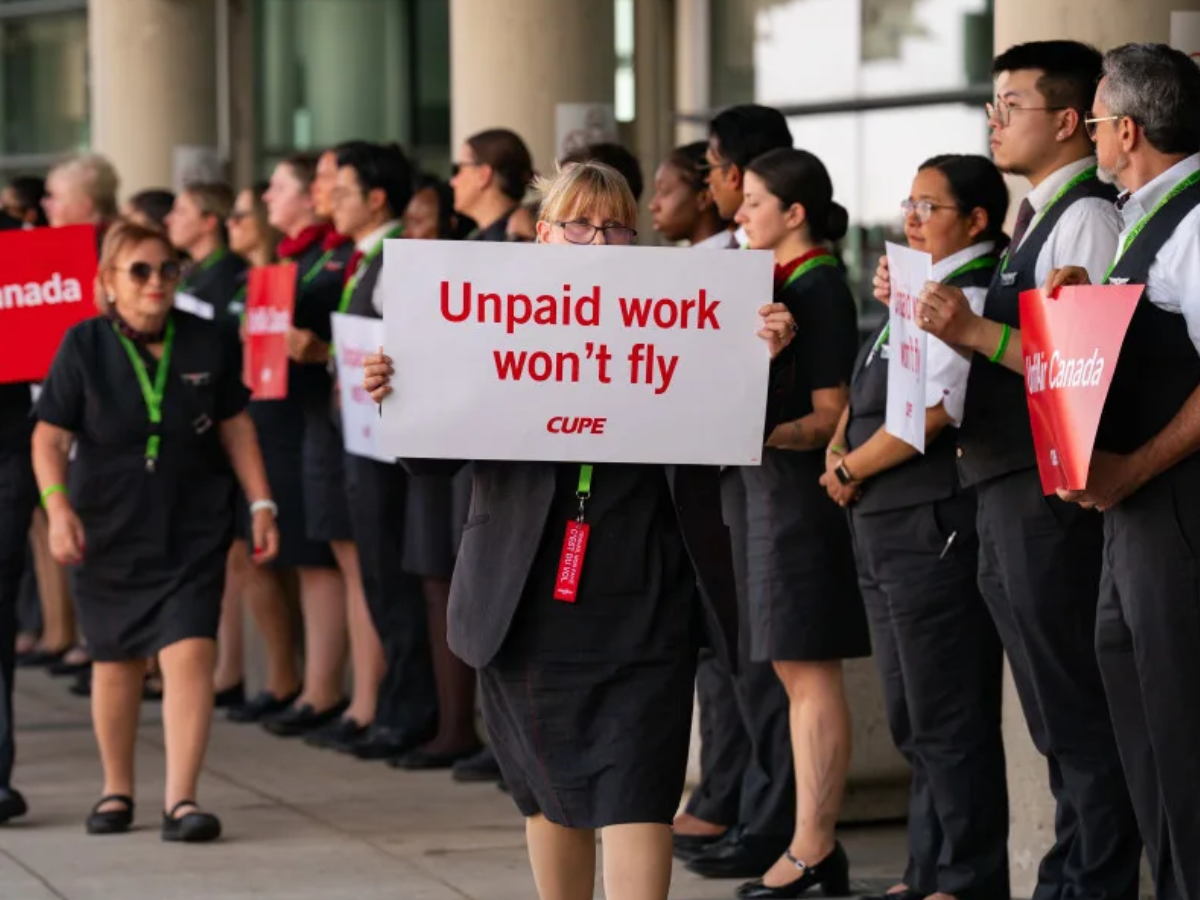
Air Canada flight attendants staged a walkout last week with an effective slogan: “Unpaid work won’t fly.” The protest was aimed at a long-running North American airline industry custom failing to pay for time spent by flight attendants on the ground before takeoff. For many years, the unpaid “ground work” has encompassed essential activities such as boarding passengers, cabling cabins, and performing pre-flight safety checks.
The strike, although short-lived, had widespread interruptions throughout peak summer travel. By Tuesday, a tentative agreement between Air Canada and the Canadian Union for Public Employees (CUPE) had momentarily placated the rough seas. But there are many questions still lingering about how far-reaching the changes might be.
What the Tentative Deal Promises
Though complete details have yet to be made public, sources indicate that the deal contains a multi-year wage increase and for the first time partial compensation for boarding duties and pre-flight inspections. CUPE had celebrated the result as “historic,” stating that unpaid work was finally “over.”
However, some of the flight attendants are unconvinced. Reuters reported that employees are torn on whether the ground pay proposed would sufficiently remedy wage disparities, especially among junior workers. The agreement still has to be voted on by membership, and its future is uncertain.
A Broader Industry Issue
Air Canada flight attendants are not unique in the battle against unpaid hours. Cabin staff at other Canadian airlines, such as Air Transat and WestJet, also do not receive ground pay. In the United States, United is among airlines continuing to omit pre-flight tasks from pay although contract negotiations are ongoing.
McGill University aviation analyst John Gradek cautions the Air Canada agreement might trigger a “tsunami” throughout North America. If pay on the ground is normalized at Canada’s largest carrier, others could be compelled to follow suit in order to compete.
Why Airlines Didn’t Pay Before
Airlines used to excuse the pay disparity on the grounds that it was simpler to keep tabs on hours from gate departure to gate arrival. Boarding time was unpredictable based on delays and loads of passengers, making payroll more complicated. In compensation, airlines tended to pay higher hourly flight wages although critics claim total wages were still low, particularly in expensive city centers.
Air Canada maintains that half of its flight attendants made over C$54,000 last year, senior staff reaching into the C$70,000s. But attendants such as Leslie Woolaver contend that they work the equivalent of a second full-time job in uncompensated hours. CUPE polls indicate attendants spend about 40 hours per month in uncompensated labour.
The Covid-19 pandemic changed the conversation. New safety rules, masking policies, and complex boarding procedures significantly increased pre-flight responsibilities. “Eventually they said: ‘No. This has to change,’” said York University labour professor Steven Tufts.
In 2022, Delta Airlines became the first in North America to pay for ground work, with American Airlines and Alaska Airlines following soon after. Air Canada’s tentative agreement could now cement this shift.
What Comes Next
If approved, the agreement may be a breakthrough not just for flight attendants but for Canadian labour rights more generally. The union defied a federal back-to-work order, winning broad public support for workers seeking fair compensation.
As Prof Gradek succinctly described it: “This was a master class of negotiation by the union.” Whether or not Air Canada attendants view the agreement as a victory, one thing is certain: unpaid labor is no longer flying low.