Canada’s skies became stormy on Saturday after thousands of Air Canada flight attendants went on strike regarding wage differences, compelling the airline to suspend all 700 of its flights on a daily basis. The abrupt shutdown stranded over 100,000 passengers, triggering mayhem in airports across the country.
Government Intervention Amid Travel Disruption
In a quick action, Labour Minister Patty Hajdu announced that the federal government had directed the Canada Industrial Relations Board (CIRB) to order binding arbitration and break the strike. “We cannot have Canadians sitting on the tarmac for days,” Hajdu told a news conference, citing that Air Canada would need four to five days to resume full operations once flights had restarted.
Binding arbitration, normally approved by the CIRB, would force both the airline and Canadian Union of Public Employees (CUPE) to abide by an arbitrator’s ruling. Although Air Canada embraced the intervention, the union opposed it vociferously, blaming the government for taking the side of corporate interests at the expense of workers’ rights.
Pay Dispute at the Core
The carrier proposed a 38 percent increase in overall compensation over four years, with a 25 percent increase in the first year. However, CUPE turned down the agreement, citing that attendants are compensated only when the planes are in motion not when boarding passengers, working on the ground, or standing idly by between flights.
Union official Wesley Lesosky contended the proposal is below adequate compensation, particularly with a 30 percent boost within five years as Air Transat achieved under its 2023 contract, which made its attendants Canada’s highest-paid in the airline sector. CUPE is looking for complete pay for complete work, not half measures at discounted rates.
ALSO READ: Air Canada Shutdown: Thousands Stranded in Strike Fallout
Airports Become Picket Lines
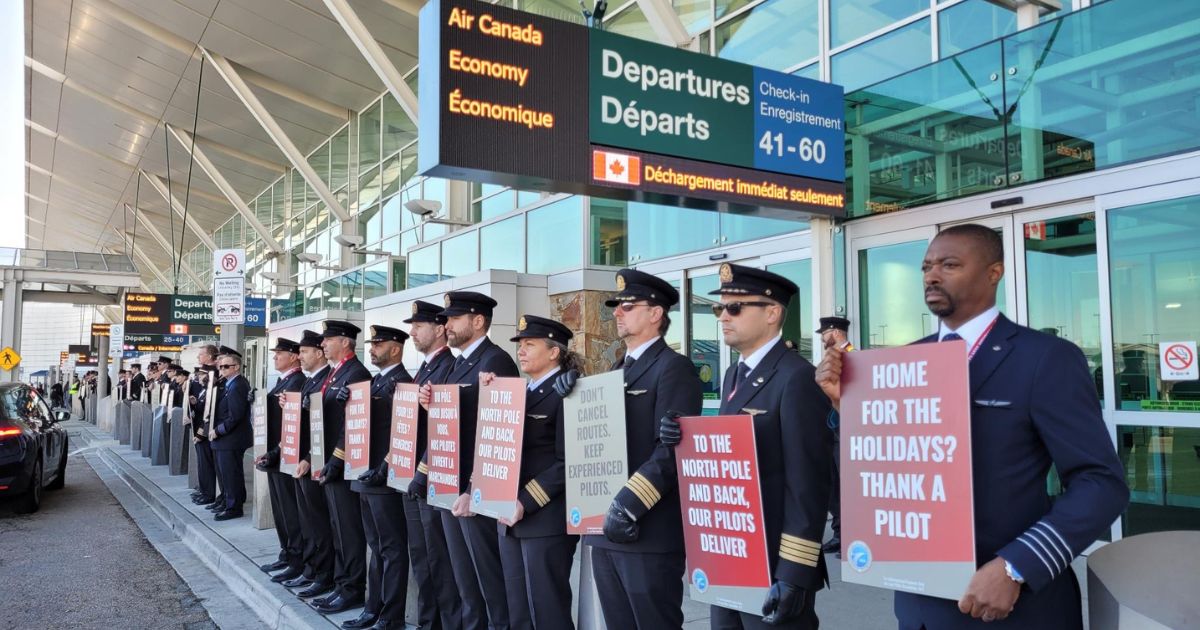
Hundreds of flight attendants protested loudly, carrying placards and demanding solidarity at Toronto Pearson International Airport, Canada’s busiest. Scenes were repeated in Montreal, Calgary, and Vancouver as CUPE organized members to demonstrate solidarity.
Air Canada, which has Montreal as its headquarters, reported that the strike halted flights on its mainline operations and its low-cost subsidiary, Air Canada Rouge. Regional partners such as Jazz and PAL Airlines kept flying, though cancellations did affect almost 130,000 passengers per day.
For most passengers, the strike was frustration and confusion, with long queues at terminals and rebooking possibilities restricted. For the union, the battle is part of a larger campaign for equal pay and working conditions for Canada’s airlines workers.
With talks still at an impasse, the CIRB ruling on binding arbitration will decide if Canada’s flight attendants take to the skies again or if the turbulence persists on the ground.