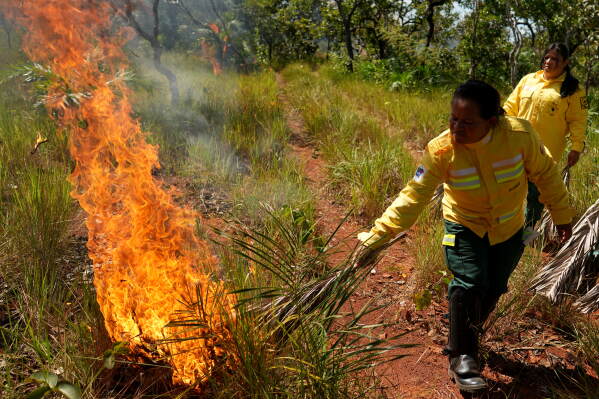
Fire began crackling like approaching rain on a recent morning in the Xerente Indigenous Territory in Tocantins in northern Brazil. But the Indigenous residents weren’t afraid and didn’t rush to put it out.
The flames were intentional as part of a wildfire prevention effort planned by the Xerente in coordination with environmental officials before the peak dry months of August and September.
The Xerente live in the Cerrado, a savanna in central and northern Brazil. Every year, villages face the threat of large-scale forest fires, a danger likely to worsen with the arrival of El Nino, a phenomenon that prolongs drought and pushes regional temperatures higher.
After decades of experiencing prejudice, Indigenous leaders now coordinate with the government to apply ancestral knowledge to prevent large wildfires.
During the action, a joint brigade of IBAMA, Brazil’s environmental protection agency, and trained Indigenous people moved into the savanna. On the ground, part of the team used the traditional technique of igniting fires with drip torches or dry palm leaves. A smaller group dropped incendiary spheres from a government helicopter to target-mapped areas.
If a fire threatened to get out of control, crews intervened immediately. The result was a patchwork of burned areas across the savanna that should help protect the ecosystem in the months ahead. “They know the region, the climate, the vegetation, and the best times to set fires. We began seeking traditional knowledge, learning from them and adapting it to our objectives, aligning with their use of fire,” said Marco Borges, an IBAMA agent coordinating fire prevention in Tocantins. “We’ve learned they are actually our best teachers.”