346
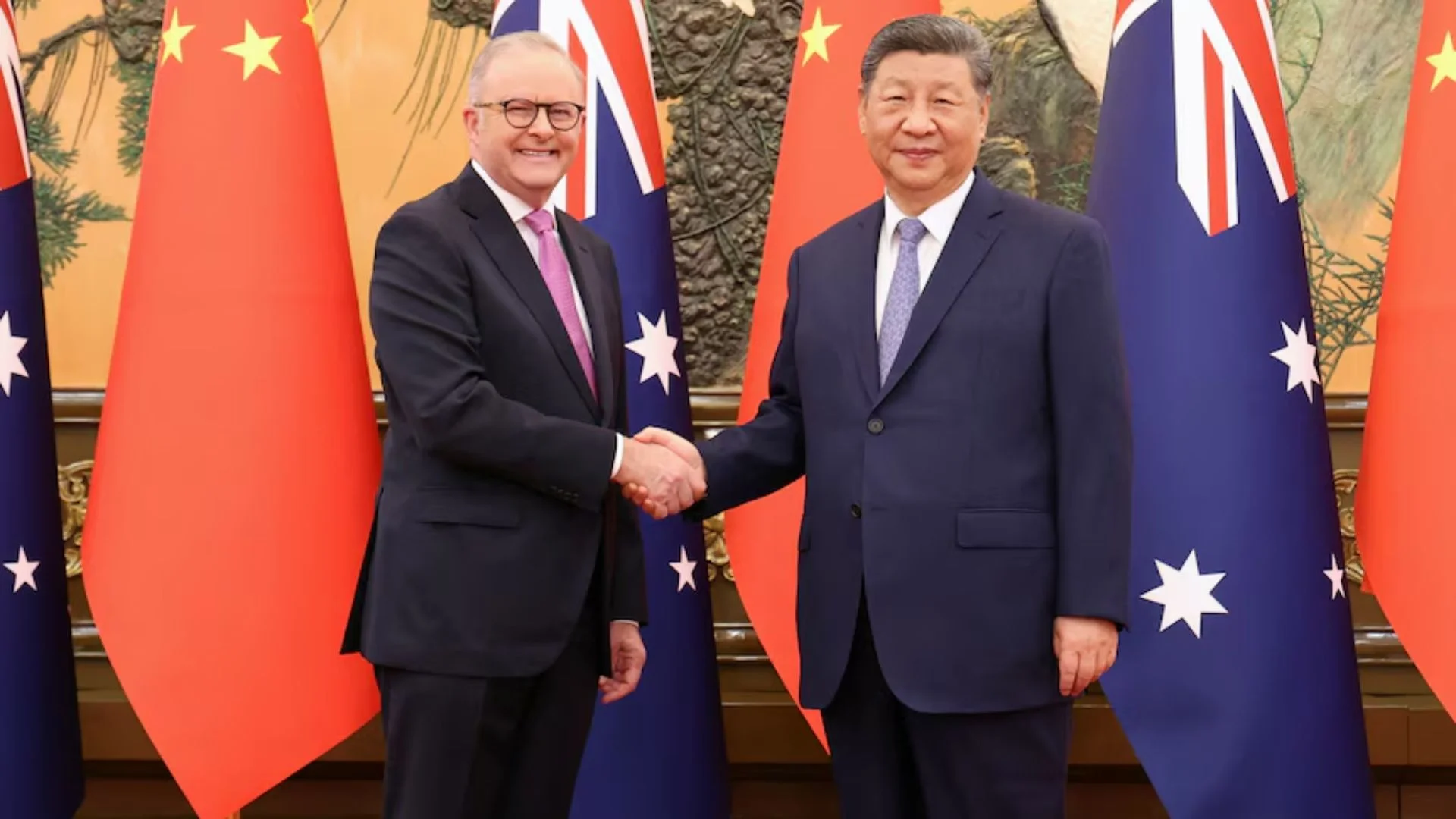
A month since US President Donald Trump suddenly cancelled his meeting with Australian Prime Minister Anthony Albanese, Australia was greeted by a top-level diplomatic welcome by China this week, indicating an ongoing thaw in bilateral relations.
Albanese had two hours of talks with Chinese President Xi Jinping at the Great Hall of People in Beijing, preceded by a formal lunch to which his fiancee, Jodie Haydon, also attended. He also had talks with Premier Li Qiang, co-chaired a business roundtable with almost 30 Chinese and Australian business leaders, and attended a state banquet where an Australian band played national favorites, including Midnight Oil’s “Power and the Passion.
The six-day tour, which took him to Shanghai and Chengdu, exemplifies Canberra’s tightrope walking as it tries to hold on to its security partnership with the United States while ensuring stable economic ties with China, its biggest trading partner. Taiwan and Beijing’s increasing naval presence close to Australian waters were among the sensitive subjects that were largely side-stepped on the visit.
James Laurenceson, Australia-China Relations Institute director, added that Australia’s effort to steer between taking sides with the US and China reflects the wider dilemma confronting many nations in the region. “The economic benefit of relations with China and security dependence on the US are too great to compel a zero-sum decision,” he stated.
Though the controversial issues of China’s naval drills along the coast of Australia and the contentious lease of Darwin Port to a Chinese company are still pending resolution, neither was brought up in the top-level talks, Albanese said. He reiterated Australia’s stance on Taiwan that Canberra endorses the preservation of the status quo, but did not confirm that he had made any opposition towards Taiwanese independence, as alleged by the Chinese side.
Chinese scholar Chen Hong explained that Australia is likely to maintain its partnership with the US but also pursue its own interests. He added that the “America First” strategy of the Trump administration had encouraged conventional allies like Australia to question how tightly they will stick with Washington.
In the meantime, the US is also increasing its diplomatic efforts in the area. A senior official from the Pentagon came to Sydney to talk about the US-Australia partnership and the AUKUS submarine agreement, which is being reviewed by the Trump administration.
This comes despite indicators of enhanced relations. Security tensions continue to prevail. China’s military conducted a February naval exercise off Australia that compelled the diversion of almost 50 commercial flights. Defence negotiations resumed earlier this year but were not included in the joint communique during Albanese’s visit.
But both agreed to increase cooperation on law enforcement matters like counter-narcotics and cybercrime a sector where Beijing and Canberra look to establish mutual trust despite ongoing strategic differences.