
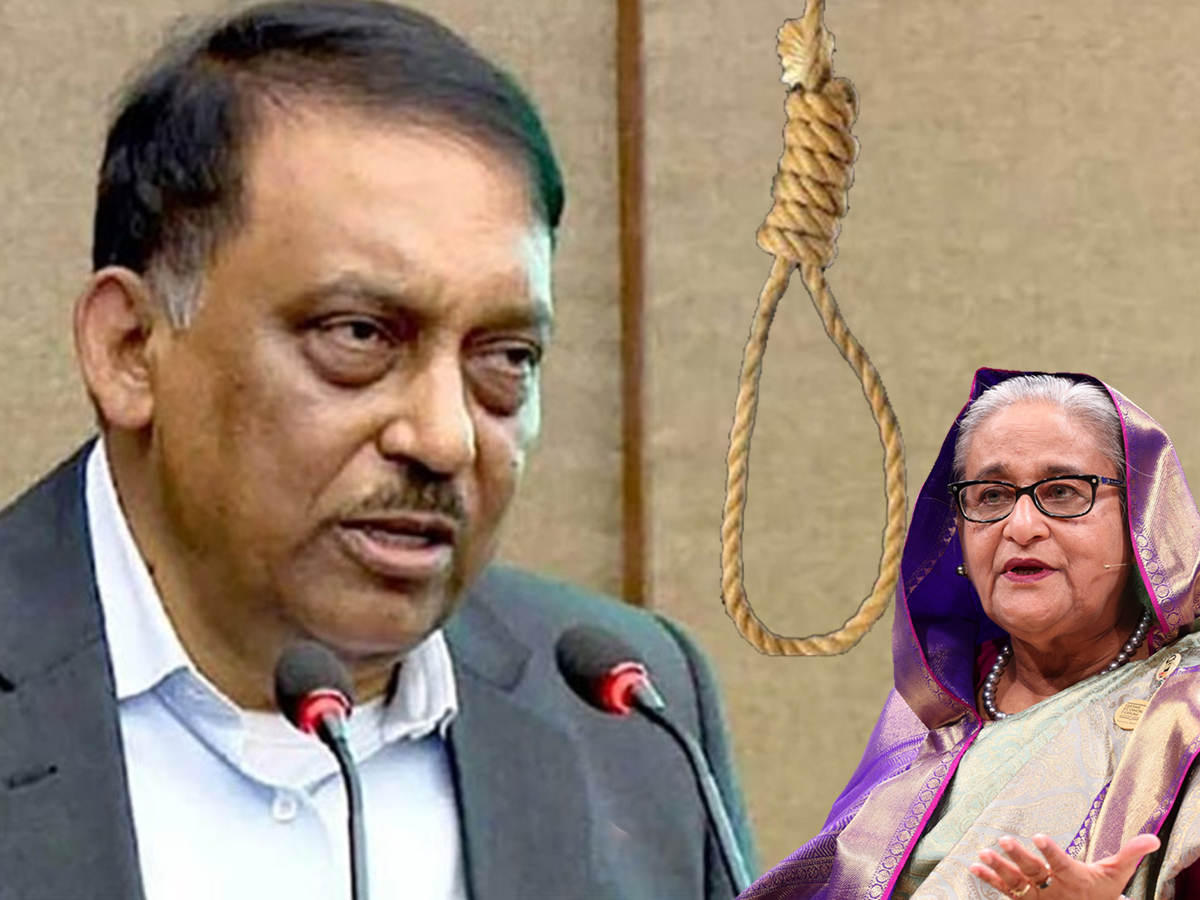
Bangladesh entered a defining moment on Monday as the International Tribunal Court (ICT) delivered its most severe judgment against two of the country’s most powerful former leaders, along with the IG Police, Chowdhury Abdullah Al-Mamun, of that time in Bangladesh. The court sentenced former Prime Minister Sheikh Hasina and former Home Minister Asaduzzaman Khan Kamal to death for “crimes against humanity” linked to last year’s massive student-led protests. These protests triggered a nationwide uprising that eventually forced the Awami League government from power.
The tribunal announced its verdict after months of hearings, digital evidence submissions, and testimonies from survivors and witnesses. Both Hasina and Kamal were tried in absentia because they fled Bangladesh shortly after the government collapsed. Hasina has lived in exile in India, while Kamal also remains a fugitive.
The court also ruled on the charges against ex-police chief Chowdhury Abdullah Al-Mamun. Unlike Hasina and Kamal, he avoided the death penalty and received a five-year prison sentence. Judges issued notices asking Hasina and Kamal to appear and contest the charges, stating that their absence may indicate alleged guilt.
Who Is Asaduzzaman Khan Kamal? The Former Home Minister of Bangladesh
Asaduzzaman Khan Kamal is a former freedom fighter who participated in the 1971 Liberation War. He built a long political career and served three consecutive terms as Bangladesh’s Home Minister. Over the years, he held various parliamentary positions and worked in several public-service roles. His influence grew during Sheikh Hasina’s tenure, as he oversaw the country’s internal security structure.
Kamal now faces several serious allegations, including murder, abuse of power, and corruption. Bangladesh’s Anti-Corruption Commission is investigating accusations that he accumulated wealth illegally, including assets allegedly linked to misuse of authority. These charges intensified after the uprising that toppled the Awami League government.
What was the Role of Kamal During the Bangladesh Protests?
During the 2024 student-led agitation, Kamal played a central role as the Home Minister. He supervised police operations, approved large-scale security deployments, and oversaw decisions on crowd control. Under his watch, security forces used drones, tear gas, rubber bullets, and firearms to try to contain the protests.
Rights groups accused him of authorising excessive force at several protest hotspots, including university campuses and major intersections across Dhaka. Witnesses told the tribunal that police acted under direct orders from senior officials, including Kamal. The court reviewed videos, digital evidence, and chain-of-command documents before concluding that he shared responsibility for the violence.
Kamal Dismisses Charges as Political Revenge
In an interview with CNN-News18, Kamal rejected all allegations and accused the current regime of using the verdict to settle old scores.
“Everything is fake; it is a conspiracy hatched to take revenge for what happened in 1971,” he said.
He argued that the proceedings lacked fairness and transparency. Kamal claimed that the chief justice did not attend court for 15 days and still prepared the full judgment. He described the trial as “pure drama.” He also questioned the evidence presented during the hearings.
“In the digital arena, Artificial Intelligence (AI) can be used to alter anything. There is no physical evidence. How can someone be convicted based on digital evidence?” Kamal said.
He insisted that the case depends on digital material that could easily be manipulated, making the verdict unreliable.