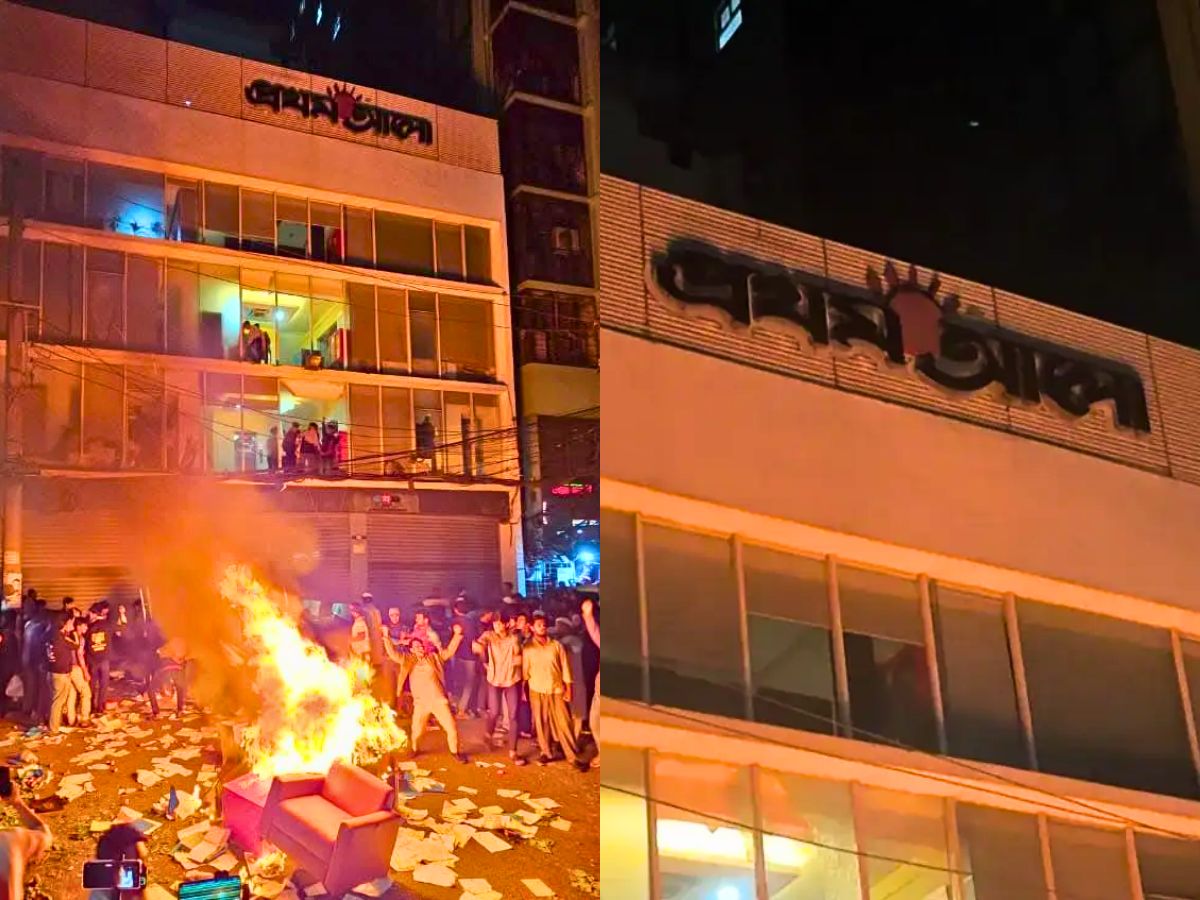
Dhaka erupted in violent protests following the death of student leader Sharif Osman Hadi, forcing two of the country’s biggest newspapers to stop operations. Angry crowds stormed and set fire to the offices of Prothom Alo and The Daily Star late Thursday night, disrupting print and online services.
Officials and staff said the attacks were sudden and intense, pushing media houses to halt publications until further notice. Hundreds of demonstrators clashed with security forces, raising concerns about press freedom and public safety.
Prothom Alo Office Set on Fire Amid Unrest
The chaos began shortly after news of Hadi’s death spread, drawing large crowds to Dhaka’s streets. The protesters moved toward the Karwan Bazar area, where the Prothom Alo building stands.
Scary visuals of Daily Star Newspaper building in Dhaka when it was set afire. Over 30 journalists were stranded in the building. All rescued now by Bangladesh Army. pic.twitter.com/fLxRIliEbX
— Aditya Raj Kaul (@AdityaRajKaul) December 18, 2025
Witnesses said dozens of youths stormed the office, vandalising several floors before igniting fires around midnight. Papers, furniture, and documents were pushed outside and set ablaze, forcing staff to evacuate quickly.
The paper later announced that both print and digital editions were suspended due to the extensive damage and threats to personnel safety.
The Daily Star Office Also Attacked
After the first blaze at Prothom Alo, protesters marched to The Daily Star office near Farmgate. There, they smashed windows, disrupted infrastructure, and started another fire around 12:30 a.m.
Inside the Daily Star building, journalists and staff were overcome with smoke as the blaze spread through the first floor. Many were trapped and struggled to breathe. One reporter, Zyma Islam, wrote on social media: “I can’t breathe anymore. There’s too much smoke. I am inside. You are killing me.”
Bangladesh Protest: Rescue of Journalists During Fire
Fire services and Bangladesh Army personnel eventually reached the Daily Star building. Firefighters controlled the flames by early morning, and staff were evacuated safely by around 4:30 a.m.
Over 30+ stranded Journalists and staff of Daily Star newspaper rescued by Bangladesh Army and Fire Brigade using a Sky ladder in Dhaka. All of them had taken shelter at roof top after Radical mobsters set the building afire after launching a major attack. Major tragedy averted. pic.twitter.com/hW0hjZq2Yn
— Aditya Raj Kaul (@AdityaRajKaul) December 18, 2025
Authorities used cranes and coordinated rescue efforts to get the trapped journalists down from the roof amid heavy smoke and debris.
What Sparked the Bangladesh Protests?
The wave of violence followed the shooting death of Sharif Osman Hadi, 32, a well-known student leader and spokesperson for the Inqilab Mancha movement. His supporters blamed political rivals and demanded justice for his killing.
Protests quickly spread across Dhaka and other cities, with demonstrators loudly expressing anger over political leadership, police response, and what they see as systemic failings.
Bangladesh Protest: Impact on Press Freedom & Safety
The attacks have raised alarm among journalists and free-speech advocates. Media houses are now forced to rethink security as the violence threatens reporters’ lives and the broader role of the press in Bangladesh.
Several news outlets are calling for stronger protection for journalists and condemnation of the violent acts. The Dhaka Union of Journalists (DUJ) emphasised the need for accountability and safety measures for press workers.
Bangladesh Protest: Public Reaction & Government Response
The interim government has urged calm and pledged investigations into the attacks, while some local leaders have noted the turmoil as an indicator of deeper political tensions ahead of elections.
Security forces remain deployed in key areas, and officials are closely monitoring evolving protest patterns, even as media houses regroup and assess damage to their infrastructure and staff wellbeing.