Thailand and Cambodia have renewed tensions that were followed by military confrontations and alarming threats of large-scale war. Following the incident where a Thai soldier lost a leg after being caught in a landmine explosion along the contested border, a battle erupts along several points. Thailand escalated soon by opening an air attack on Cambodian forces.
Thailand responded to increasing hostilities by shutting all border crossing points with Cambodia. With the worsening scenario, a valid question arises- who benefits from the military advantage in case of an all-out confrontation? A comparative analysis reveals Thailand possesses a commanding lead regarding soldiers, air power, equipment, and naval capabilities.
Thai Army Is Bigger, Better Equipped
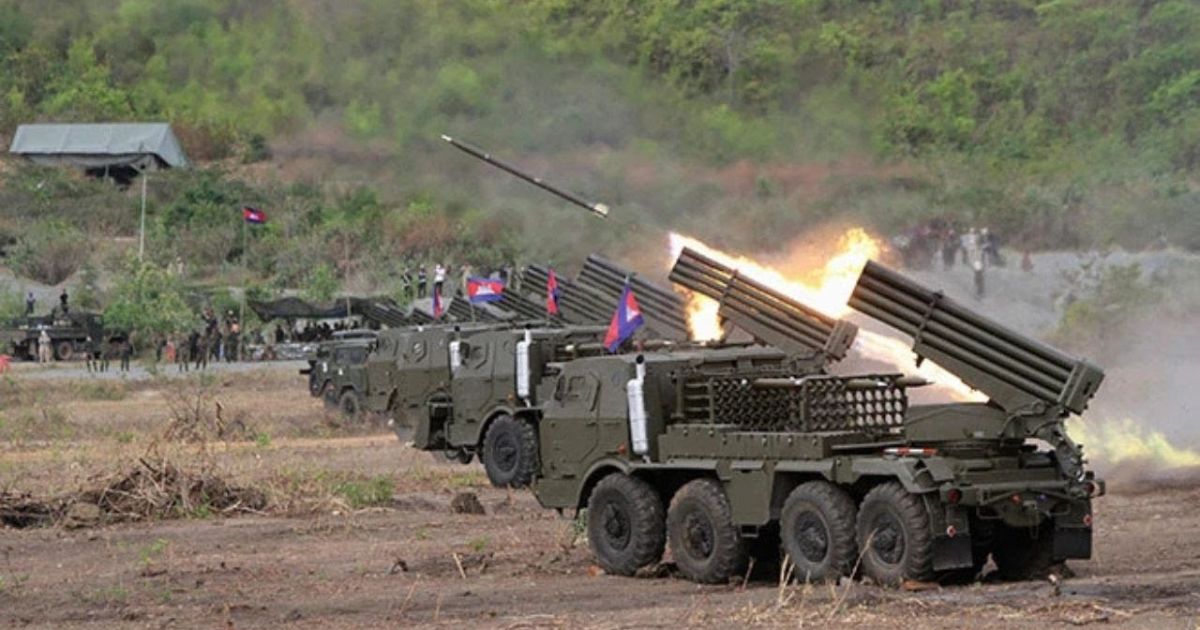
Thailand boasts a population of 71 million and a robust GDP of $610 billion. Its army outnumbers Cambodia’s 125,000 troops with 361,000 active-duty soldiers in its overall military. The Royal Thai Army alone has 245,000 soldiers. It fields 240 tanks, including M60S and Stingrays. The army also fields hundreds of armoured personnel carriers like Strykers, M113S, and BTR-3s. For artillery, it uses M198 howitzers, CAESAR systems, and multiple rocket launchers (MLRS).
This vast land power provides Thailand with a commanding upper hand on the battlefield. The army is professional, battle-hardened, and modern with considerable training and strategic sophistication.
Thailand’s Air Force Rules the Skies
Air superiority is another field in which Thailand has a commanding lead. The Royal Thai Air Force possesses 60 advanced fighters, including American F-16s and Swedish JAS 39 Gripens. Support aircraft consist of C-130 Hercules transport aircraft, Saab 340s, and helicopters such as the Bell 212 and UH-60 Black Hawk.
Thailand has the potent STARStreak missile, capable of fighting against drones, jets flying at low levels, and helicopters. It also uses the Gripen Erieye airborne radar system and mobile SAMs. Thailand has seven operational airbases that give it excellent air mobility and defence coverage.
Royal Thai Navy Adds Strategic Depth
Thailand’s naval power is the second most important factor. Seven frigates, seven corvettes, and up to 40 patrol boats are managed by the Royal Thai Navy. It also operates coastal patrol boats and naval aviation helicopters such as the S-70B and AS365.
A S26T Chinese submarine is ordered as well. Although small in number, the navy is modern and well-equipped with deep-sea facilities and a professional marine corps.
Cambodia Falls Behind on All Fronts
Cambodia, with a population of 17.4 million and a GDP of $42.3 billion, is well behind in military capability. It spends around $720 million every year on defence, around 1.5 to 2 percent of GDP. The Royal Cambodian Armed Forces heavily depend on old Soviet and Chinese equipment. It does not have modern tanks, artillery weapons, and fighter aircraft.
Cambodia has a minuscule air force with some Mi-17 helicopters. The navy has a dozen tiny patrol vessels. Cambodia lacks submarines and large ships. Despite China’s financing of base construction at Ream Naval Base, Cambodia is technically under strength.
Thailand Has the Upper Hand
In any extended fight, Thailand is ahead on all three military fronts—land, air, and sea. Its strategic alliance with the US provides it with additional global clout. Cambodia might have the backing of China, but that doesn’t translate into battlefield capability.
The present eruption, touched off by a devastating landmine blast, highlights just how inflammable this border is. But militarily, Thailand is way ahead—armed, organized, and prepared.