
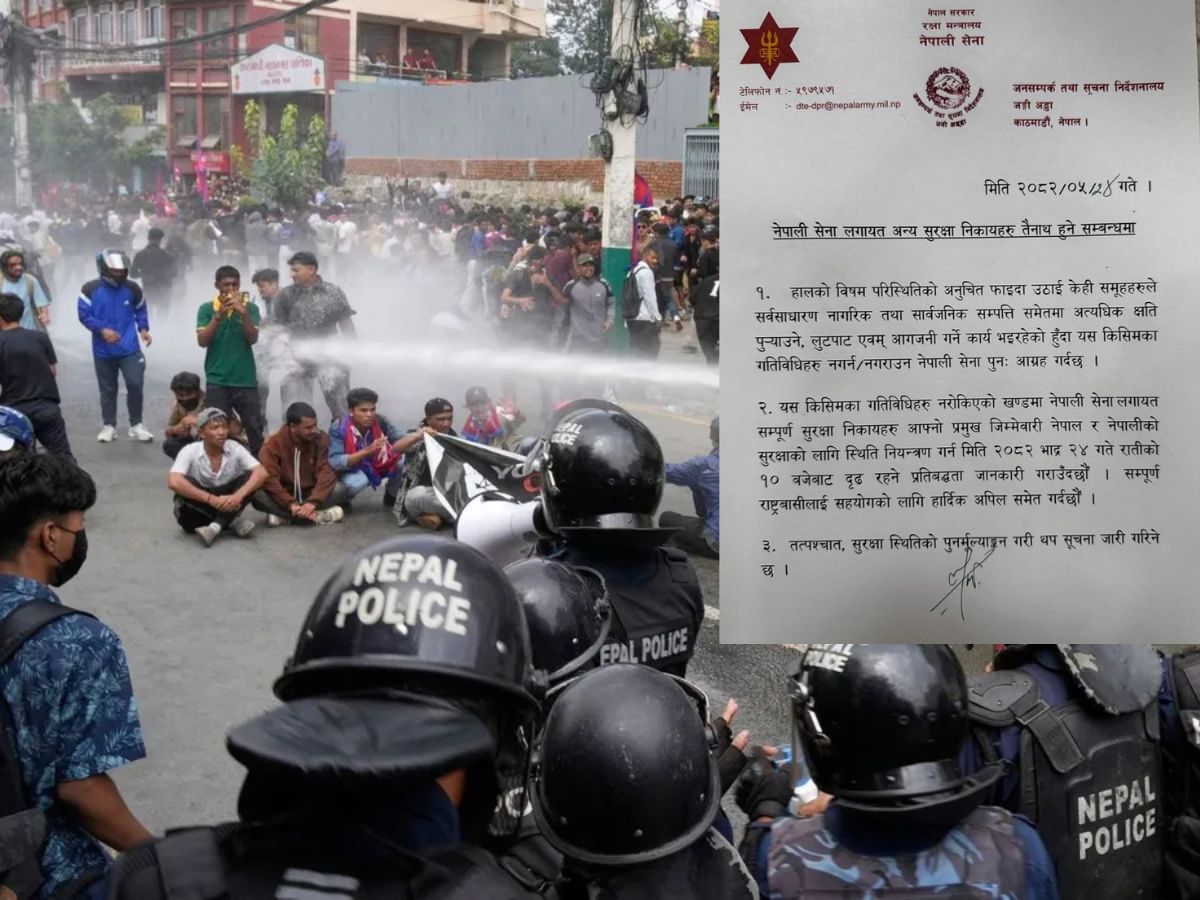
The Nepal Army has officially taken command of all security activities in an effort to prevent the country from devolving into anarchy. This dramatic intervention follows a devastating 27 hours of violent protests, looting, and arson that erupted across Kathmandu and other regions shortly after Prime Minister K. P. Sharma Oli tendered his resignation. The army’s takeover, which goes into force at 10 p.m. on Tuesday, represents a significant turning point in the political crisis facing the country.
What Triggered the Nepal Unrest?
The immediate catalyst for the widespread violence was the resignation of Prime Minister K. P. Sharma Oli. His departure created a sudden power vacuum, plunging the country into a state of political uncertainty.
Although it is thought that political factions were responsible for the majority of the protests, things quickly got out of hand. The Nepal Army, in an official statement, accused certain groups of “taking undue advantage of the difficult situation and causing severe damage to citizens and public property.”
Also Read: Nepal: Is Chinese Toolkit Active Behind Corruption and Mis-governance?
How Did the Violence Escalate?
For over a full day, Nepal witnessed unprecedented scenes of chaos. Reports detailed:
- Widespread arson targeting public and government buildings.
- Looting of businesses and stores.
- Violent clashes between demonstrators and remaining security forces.
- The alarming looting of weapons from security agencies, raising the stakes from civil unrest to armed potential insurgency.
The scale of the damage and the boldness of attacking security installations forced a military response beyond the capabilities of standard police forces.
Nepal Army’s Ultimatum
Recognizing the severe threat to national stability, the Nepal Army issued a stern public warning on Tuesday night. In a statement released in the name of spokesperson Brigadier General Rajaram Basnet, the army set a firm deadline: 10 pm.
The statement urged, “The Nepali Army once again urges that such activities not be carried out as some groups are taking undue advantage of the adverse situation and causing excessive damage to ordinary citizens and public property, engaging in looting and arson.” It explicitly warned that if these activities did not cease, all security agencies, including the army, would be deployed to take full control of the situation.
Also Read: Who is Sudan Gurung? NGO Leader Leading Nepal’s Gen Z Protests in Nepal
What Does “Army Taking Control” Mean?
The Nepal Army has moved from a supporting role to the primary agency responsible for reestablishing order as of Tuesday at 10 p.m. This implies:
- In addition to police, military men are now present on the streets.
- In order to prevent violence, safeguard public property, and maintain public safety, they are permitted to employ whatever force is required.
Recovering the stolen weapons is one of the main goals. Brigadier General Basnet explicitly stated, “We have asked them to return the weapons by 10 pm,” indicating that operations to seize these arms are now a top priority.
Alongside the show of force, there was also an appeal for dialogue. Earlier on Tuesday evening, Chief of the Army Staff Ashok Raj Sigdel addressed the nation. In his speech, he specifically requested the Gen-Z protestors to come to the negotiation table. This indicates an awareness of the diverse groups involved in the protests and an attempt to isolate violent actors from broader youth movements with legitimate grievances.
Also Read: Israel Targets Hamas Chiefs in Qatar, Jeopardizing Ceasefire Talks
What Happens Next for Nepal?
The nation now stands at a precipice. The army’s takeover raises concerns about the future while also offering the prospect of a return to normalcy. The immediate goal is to end the violence and retrieve stolen weapons. However, the underlying political crisis that sparked the unrest remains entirely unresolved. The resignation of PM Oli demands the formation of a new government, a process that will be incredibly challenging amidst a climate of fear and military enforcement.