
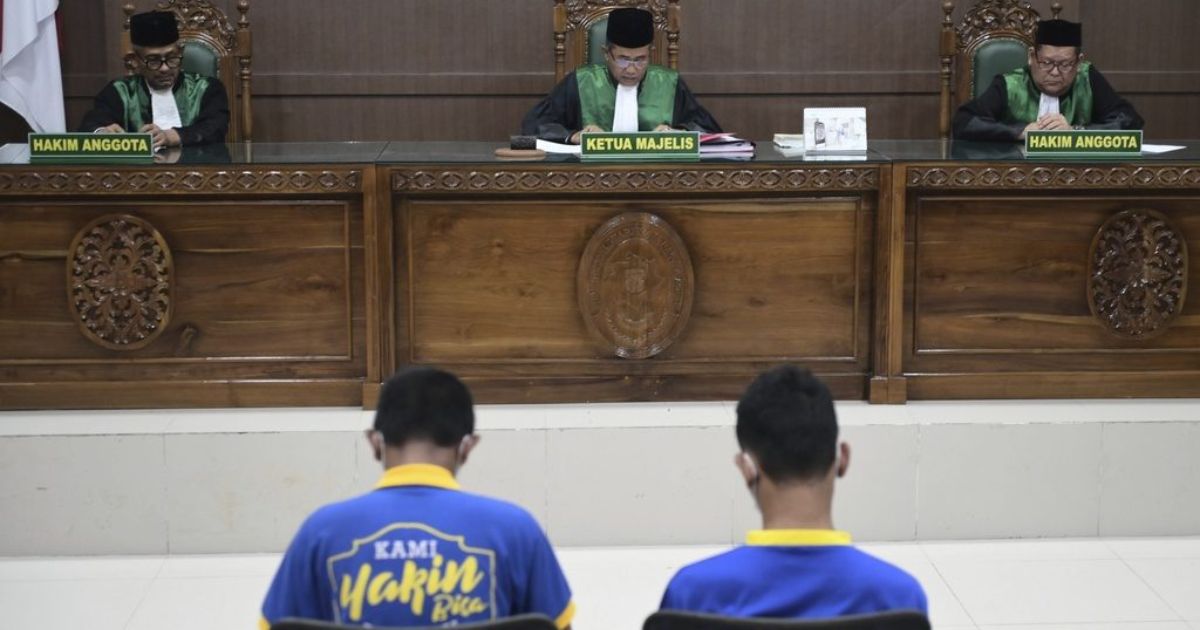
An Indonesian Sharia court in the conservative province of Aceh has convicted two men of 80 lashes each for being found kissing in a public park, which showed the enforcement of Islamic laws in the area.
Arrest and Trial Behind Closed Doors
The men, aged 20 and 21, were arrested in April at Taman Sari city park after locals reported seeing them enter the same bathroom. Religious police, patrolling the area, broke into the facility and found the pair kissing and hugging. Authorities considered the act a sexual offense under Aceh’s version of Sharia law.
Their trial took place in the Islamic Sharia District Court in Banda Aceh behind closed doors, the usual procedure for adultery or sexual misconduct cases. Judges are allowed to restrict access to the proceedings, and the court is only opened for delivery of the verdict. Monday’s sentencing was the fifth such punishment in Aceh for homosexuality under the local law adopted in 2015, which was a concession made by the government to put an end to a protracted separatist insurgency.
Aceh’s Special Legal System
Aceh is the sole Indonesian province permitted to implement Sharia law, a system which stands independently of Indonesia’s national criminal code. Homosexuality is not illegal under Indonesia’s national code, and the central government cannot revoke Sharia laws in the province.
Other prison terms have included comparable public caning sentences in Aceh. The last time was in February, when two men, 24 and 18 years old, were publicly caned in Banda Aceh’s Bustanussalatin city park. The five masked enforcers administered medical breaks every 20 lashes. Amnesty International criticized the punishments as a “horrifying act of discrimination” that underlined the human rights abuses involved in punishing individuals for their sexual orientation.
Human Rights Issues
Human rights organizations contend that adult consensual sexual relations should never be criminalized, and that criminalization is a violation of fundamental human rights. Montse Ferrer, Amnesty International’s deputy regional director, stated, “No one should be punished because of their real or perceived sexual orientation.”
Aceh’s persistent practice of public caning of homosexuals elicits international condemnation and highlights the conflict between regional religious law and global human rights norms. As the cases reach international attention, they enflame continued controversy regarding the balance between regional autonomy, local tradition, and universal human rights.
ALSO READ: Graduates Of Jihad: Taliban Turns Rehab Centres Into Radicalisation Hubs