
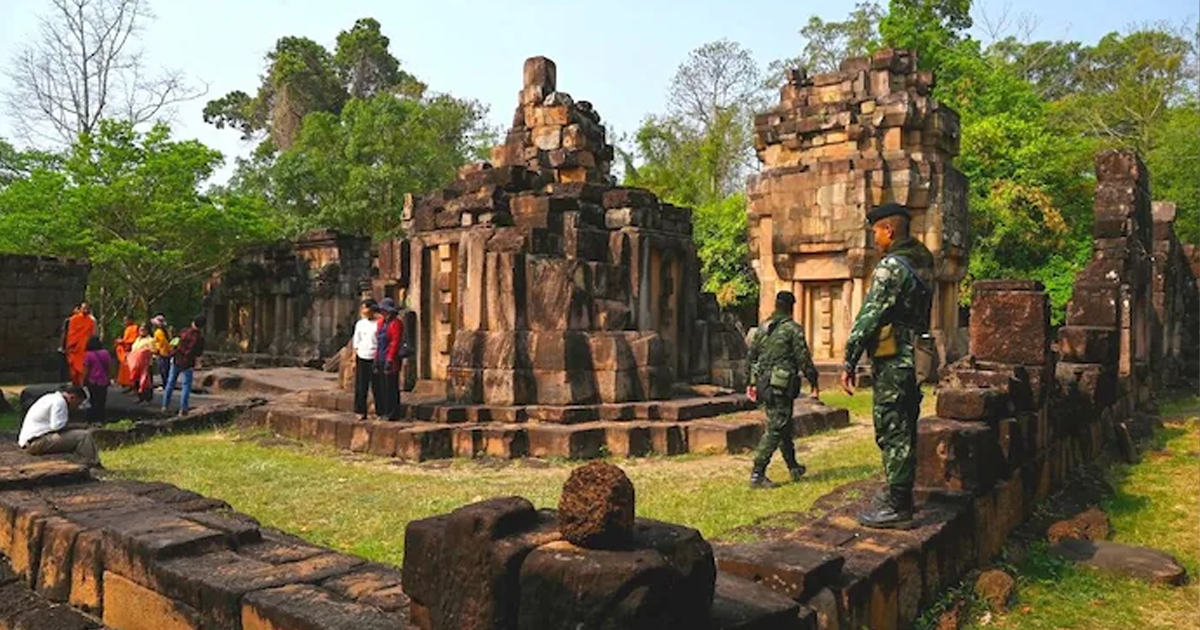
A long-standing border conflict between Cambodia and Thailand turned fatal once again on Thursday, with intense fighting breaking out near the ancient Ta Muen Thom temple. The fighting represents the worst escalation in more than a decade, killing at least 12, wounding dozens, and displacing thousands who lived close to the border.
The renewed fighting revolves around Ta Muen Thom and Preah Vihear, two Hindu shrines devoted to Lord Shiva, within the Dangrek Mountains, not far from the disputed border area. Preah Vihear temple, 900 years old, sits perched atop a 525-metre cliff in Cambodia and has been a revered site for both countries for centuries. Roughly 95 kilometers west of it is Ta Muen Thom, a 12th-century shrine that has turned into the newest hot spot.
The Thai government stated that fighting started early Thursday in Thailand’s Surin Province when Cambodian soldiers reportedly deployed reconnaissance drones close to Thai military outposts. Thai troops reportedly tried to calm the situation, but intense firing erupted after 08:20 local time.
Thailand accused its military of defending itself after Cambodian troops employed rocket-propelled grenades (RPGs). Cambodia, on the other hand, blamed Thailand for infringing on its sovereignty.
To counter the rising violence, Thailand increased its threat level to “Level 4” and closed all border checkpoints. The authorities evacuated some 40,000 civilians from 86 villages in the area.
Temples at the Heart of a Century-Old Dispute
The dispute over Preah Vihear and surrounding temples has its origins in colonial border markings. In 1962, the International Court of Justice (ICJ) sided with Cambodia, calling on Thailand to pull troops back and restore any temple artifacts removed since 1954.
The named-ICJ relied on a 1907 map hand-drawn by French colonial officials, situating Preah Vihear inside Cambodian borders. While Thailand claimed the name Siam at the time and initially approved the map, it now asserted that the map was deceptive and that it understood that the border ran along natural lines of watershed-ness. The ICJ did not agree.
In 2013, Cambodia’s sovereignty, including the temple’s surrounding area, was reaffirmed by the ICJ, and it called for the unconditional withdrawal of the Thai army.
Ta Muen Thom: A Flaring Flashpoint
The fighting today has centered on Ta Muen Thom, a distant but historically important Khmer temple group consisting of Ta Muen, Ta Muen Tot, and Ta Muen Thom proper. The temple, in a departure from the usual Khmer orientation, is oriented south and contains in its sanctum a naturally occurring Shivling.
Because it is situated along the disputed border, Ta Muen Thom is often the target of conflict. This past February, a viral video of Cambodian soldiers singing their national anthem at the temple allegedly precipitated a standoff with Thai troops.
The origin of the conflict lies in treaties between Siam and France during 1904-1907. Though the French sought to adhere to watershed lines, they exempted culturally significant regions such as Preah Vihear from the rule, warping the boundary.
Historians contend that maps used during colonial times imposed a Western notion of boundaries upon Southeast Asian politics, which had traditionally been based more on shared spaces than defined borders.
The 2008 designation of Preah Vihear as a UNESCO World Heritage Site reopened tensions. Thai Foreign Minister Noppadon Pattama resigned following his support for Cambodia’s application, and clashes that followed resulted in casualties for both parties.