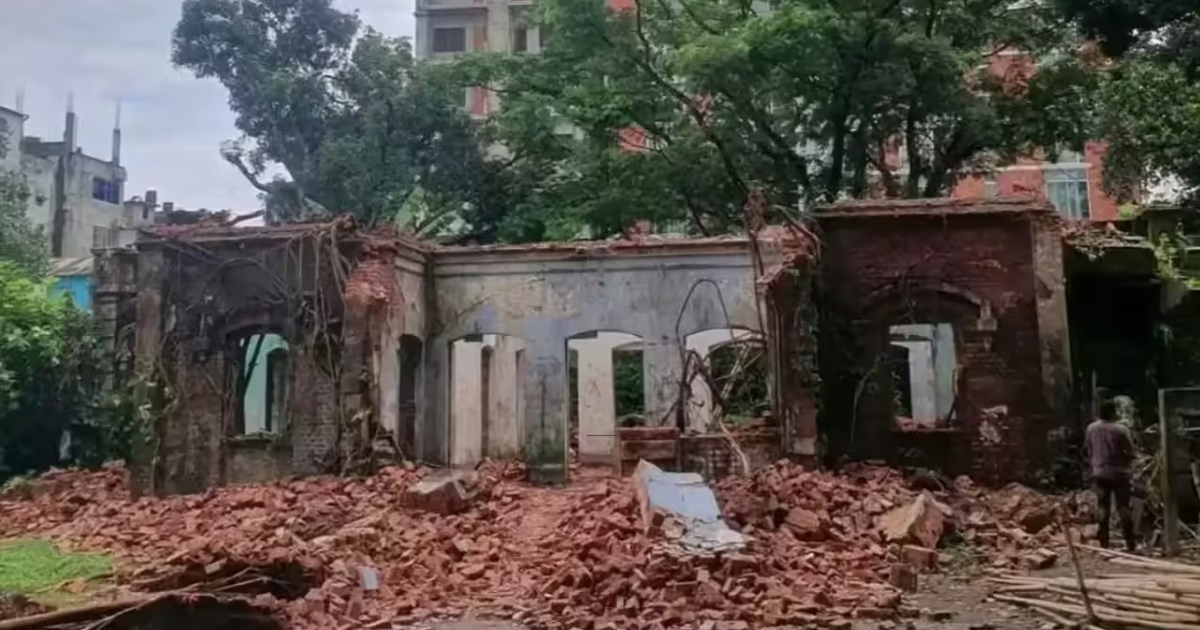
Bangladesh’s interim administration has formally halted the demolition of Satyajit Ray’s ancestral home, a legendary filmmaker and writer. The move comes following a recent expression of deep regret from India over the planned demolition and an offer to help restore the century-old house for its gigantic cultural importance.
The hundred-year-old structure, in Mymensingh, was owned by Upendra Kishor Ray Chowdhury, Satyajit Ray’s grandfather, and a famous literary man. The house has stood idle in a decaying state for years, left to languish for more than a decade. Officials mentioned its deteriorating condition as the main reason for recommending that it be demolished.
“The house has remained vacant for the last 10 years. Shishu Academy operations have been going on from a rented house,” Md Mehedi Zaman, the district Children Affairs Officer, told The Daily Star, a Bangladeshi daily newspaper.
Nonetheless, India’s External Affairs Ministry requested Bangladesh to think twice. In a statement released on Tuesday, the ministry termed the building “a landmark” and “a symbol of the Bangla cultural renaissance,” underlining its significance in the mutual cultural past of India and Bangladesh.
“Considering the landmark nature of the building, representing Bangla cultural renaissance, it would be more desirable to reconsider demolition and explore possibilities for its restoration and reconstruction into a museum of literature and a beacon of the common culture of India and Bangladesh,” the ministry stated.
The Indian government went further and pledged its commitment: “The Government of India would be happy to provide cooperation for the purpose.”
This move has yielded a positive reaction from the Bangladeshi side and resulted in a temporary stoppage of the demolition process and ongoing negotiations for restoration.
India’s appeal also indicates the larger diplomatic initiative to save cultural heritage that unites the two countries. By turning the building into a museum, both governments would be able to share their shared literary and artistic heritage, particularly through the Ray dynasty’s legacy.
The suggested restoration of the building is increasingly being viewed not merely as a conservation project but as a cultural revival, paying tribute to an inheritance that influenced the subcontinent’s artistic and literary heritage.