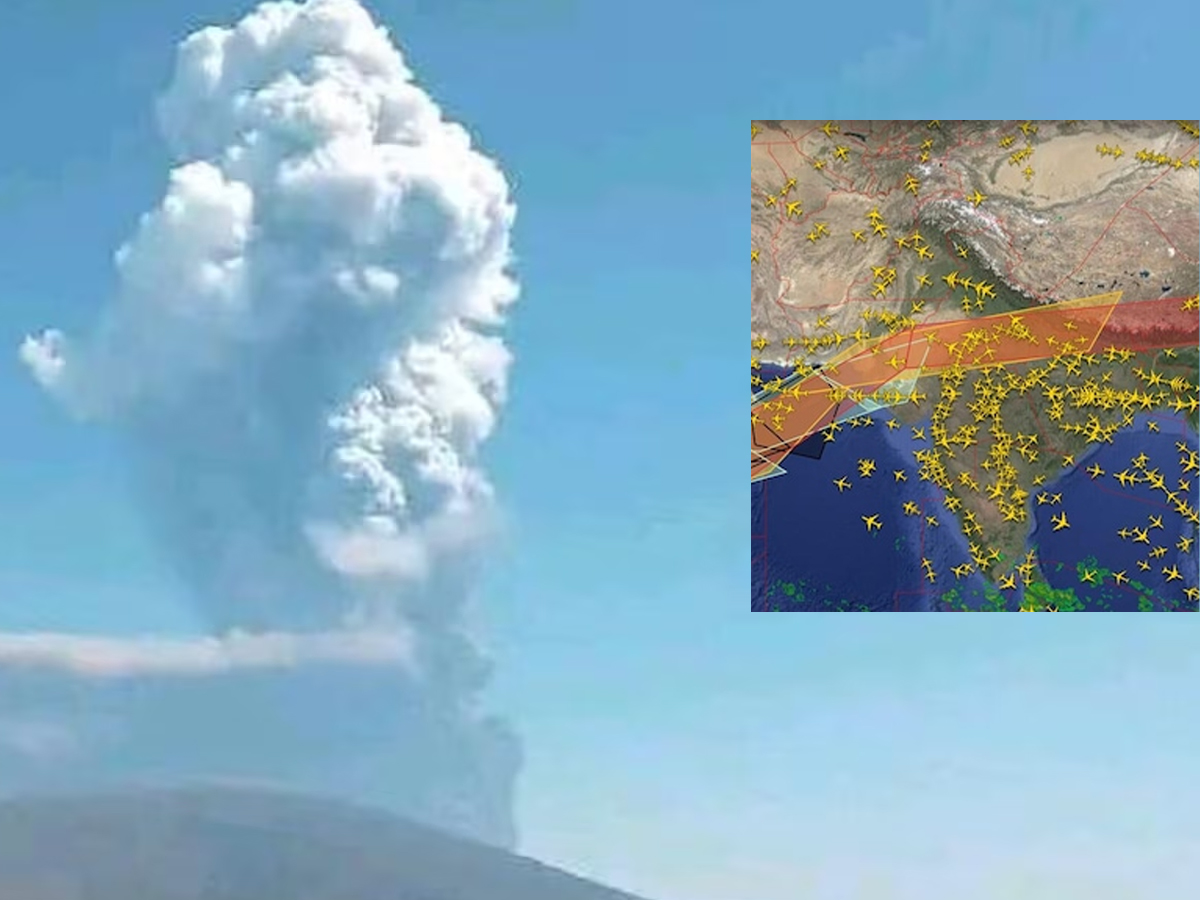
A giant ash cloud from Ethiopia has drifted over India and is expected to clear the country by Tuesday evening. The eruption of the Hayli Gubbi volcano in Ethiopia sent volcanic ash high into the sky. The cloud travelled across Yemen, Oman, and the Arabian Sea before reaching western India.
According to the India Meteorological Department (IMD), the plume moved over Gujarat and Rajasthan on Monday evening. By midnight, it soared over Delhi and northern India. The IMD added that the cloud will reach eastern India before leaving for China.
Ash Drifting at 8–15 km Altitude
“We are expecting that the cloud will clear up from the Indian region by Wednesday. These are ash particles mainly, which are moving at a height of 8 km to 15 km. So the main impact is on aviation and aircraft operations over Delhi, Kolkata, and Mumbai. We have been issuing those warnings. There is no impact on the surface or the weather. There is no concern of exposure either because at that height, the wind speed is around 100 kmph to 150 kmph, so the particles move away. … But if a western disturbance were impacting us and there was rain, these particles would have settled,” explained Mohapatra, director general, IMD.
He added, “The ash cloud is moving towards China through east and northeast India.”
Impact on Flights
The ash cloud’s altitude and path caused immediate concern for aviation. Flights from and to major Indian cities faced delays and cancellations. Aviation authorities issued alerts to airlines, advising them of affected altitudes and routes. While surface-level air quality remains unaffected for now, plane operations remain the biggest concern.
Because the ash is at a high altitude (between 8 km and 15 km), the IMD says it poses little threat to ground-level air quality and weather. No significant exposure risk is expected for people on the ground. The IMD also noted that without rain or a western disturbance, the particles will not settle and cause issues on the surface.
What’s Next and Weather Forecast
With the plume drifting away, attention turns to the weather elsewhere in India. The IMD says heavy rain is likely in southern states: Tamil Nadu till November 30; Kerala and Mahe around November 26; coastal Andhra Pradesh, Yanam, and Rayalaseema between November 29 and December 1; Andaman & Nicobar Islands until November 29. Minimum temperatures across north-western regions remain low.
The eruption of a long-dormant volcano hundreds of kilometres away, creating airspace issues in India, underlines how global weather, geology, and aviation are interlinked. It also shows how upper-atmosphere phenomena can affect travel and safety, even if surface weather stays calm.