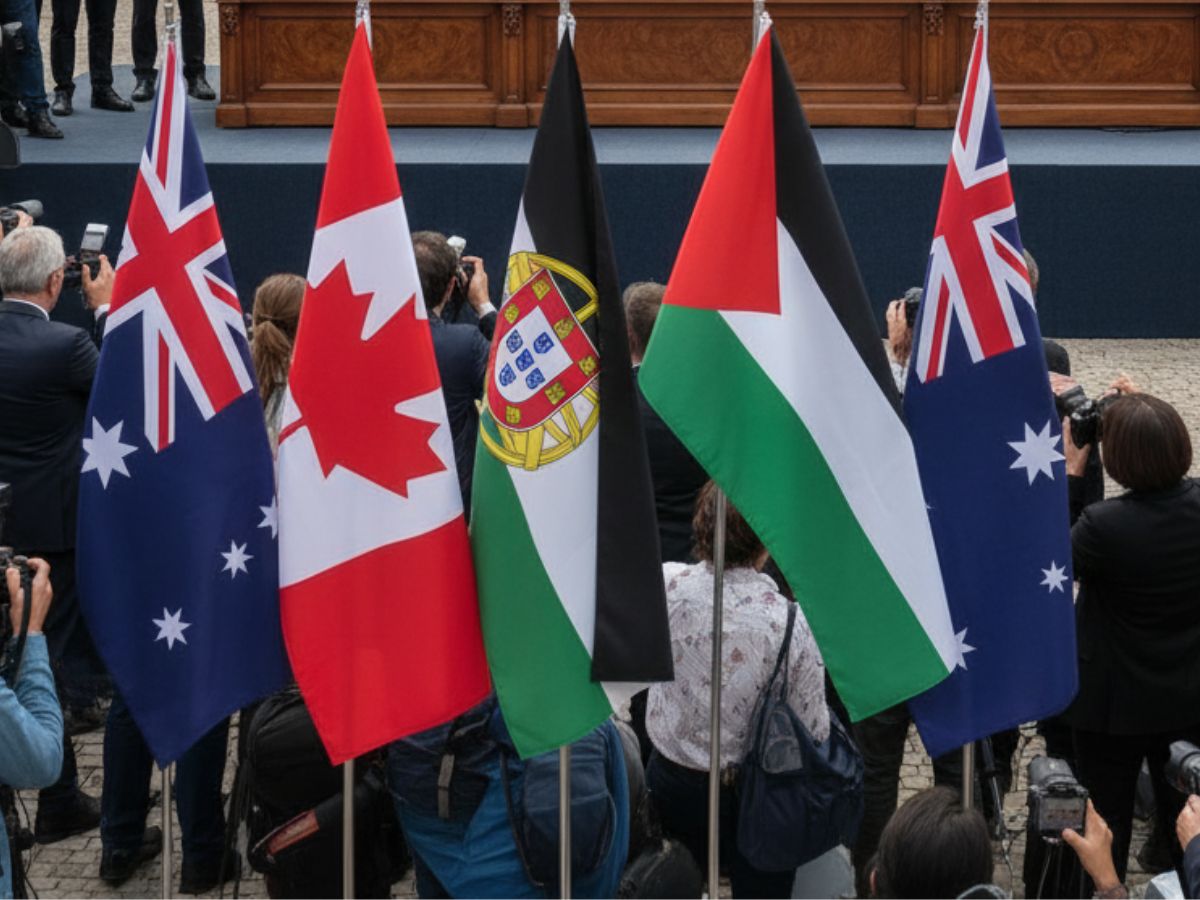
Portugal has formally recognised Palestinian statehood, joining Britain, Canada, and Australia in a coordinated diplomatic move that significantly increases pressure on Israel over the war in Gaza. The decision, announced on Monday, places four major American allies directly at odds with the Trump administration and signals a powerful Western shift in support of the two-state solution.
The declarations, which were made immediately before the UN General Assembly in New York, are intended to start an irreversible momentum in the direction of Palestinian statehood. France has also indicated it will vote in favor of recognition at the UN this week, a move that would align it with nearly 150 other member states.
What Was Portugal’s Justification for the Move?
Portuguese Foreign Minister Paulo Rangel framed the decision as a logical and necessary step for regional peace. Addressing reporters in New York, he stated, “Recognizing the State of Palestine is (…) the fulfillment of a fundamental, coherent, and widely accepted policy.”
He emphasized that “Portugal advocates the two-state solution as the only path to a lasting peace,” one that promotes peaceful coexistence between Israel and Palestine. This language underscores the European view that recognition is a tool to salvage a political process, not just a symbolic gesture.
How Did Palestine Respond to the Recognition?
The Palestinian Foreign Ministry welcomed Portugal’s decision with open arms, calling it a “courageous step consistent with international law and United Nations resolutions.”
In an official statement, the ministry affirmed its determination to build stronger bilateral relations with Portugal. In addition, it made a clear call to action for other countries that have not yet recognized Palestine, asking them to “take this step in order to secure the two-state solution” and to work toward an immediate ceasefire and a legitimate political process to end the occupation.
Does Palestine Qualify as a State Under International Law?
The concept of statehood is measured against criteria set out in a 1933 treaty, which includes having a permanent population, a defined territory, a government, and the capacity to conduct international relations.
Legal experts argue that Palestine meets these conditions at a basic level. It has a permanent population and a territory broadly recognised as the West Bank, Gaza, and East Jerusalem—lands seized by Israel in 1967.
Parts of the West Bank fall under the Palestinian Authority’s control, with the PLO recognised worldwide as its representative body. However, internal divisions, most notably Hamas’s control of Gaza, significantly limit its unified authority and governance.
Also Read: DNI Gabbard, Under Fire for Secretive Purge, Joins Trump at Charlie Kirk’s Emotional Tribute
What is the Real-World Impact of This Recognition?
According to Professor Zinaida Miller, an expert in law and international affairs, recognition by foreign governments does not instantly resolve internal disputes or end the occupation. However, it establishes direct diplomatic relations and sends a potent political message.
“It acknowledges the Palestinian right to self-determination and rejects the positions and actions of the Israeli government that undermine that right,” she explained. The cumulative effect of these recognitions from key Western nations is to politically isolate Israel and legitimize the Palestinian claim to statehood on the world stage, creating new facts that any future peace process must address.