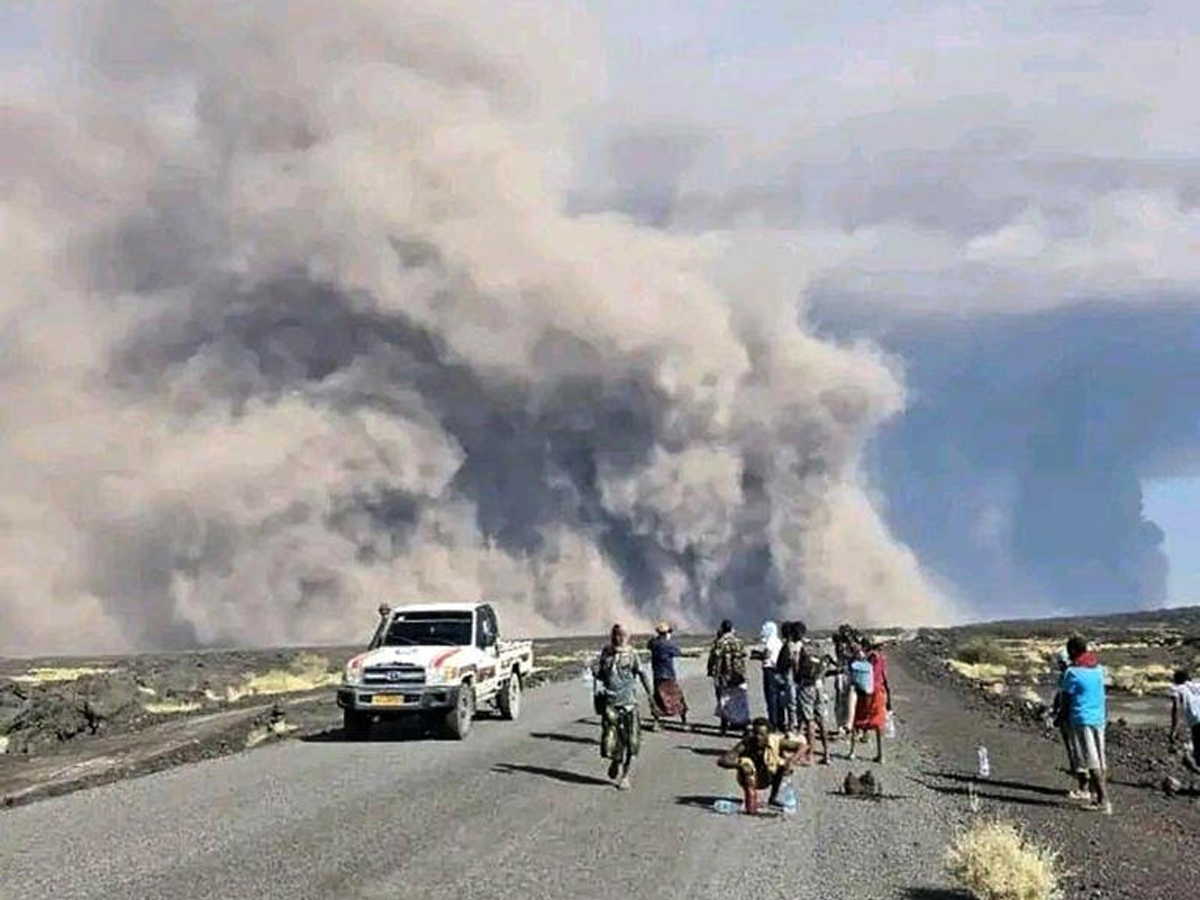
A remote Ethiopian volcano that had shown no signs of activity for thousands of years erupted in a sudden blast on Sunday. The Hayli Gubbi volcano in the Afar region sent a giant tower of ash into the sky and coated nearby villages in thick dust. The eruption shocked residents, many of whom had never heard of the volcano erupting in their lifetimes.
The ash plume rose up to 15 kilometres, and it drifted across the Red Sea and moved toward Yemen and Oman, raising concerns for both aviation and public health. Videos taken from Afar showed the sky turning dark in minutes as the ash spread over the region.
Villages of Afdera Blanketed in Ash
The village of Afdera faced the worst impact. Ash settled on homes, roads, and grazing fields. Local officials confirmed that the eruption caused no deaths. But they warned that the real threat now lies in the coming weeks.
Livestock herders depend heavily on grazing land. With fields covered in ash, feeding animals has become difficult. The region, known for its harsh climate, cannot afford such damage for long.
🔴 Ethiopia’s Hayli Gubbi volcano ERUPTS after 10,000 years!
A massive 15 km ash plume is drifting across the region toward Yemen & Oman… and now headed towards North India .
Multiple flights impacted, Govt issues advisory to airlines for potential flight hazards.… pic.twitter.com/NmRTD9Uono
— TridentX ᴵⁿᵗᵉˡ (@TridentxIN) November 25, 2025
A local administrator, Mohammed Seid, described the situation and said, “While no human lives and livestock have been lost so far, many villages have been covered in ash, and as a result, their animals have little to eat.”
He said the economic loss could be severe if grazing lands do not recover quickly.
“It Felt Like a Sudden Bomb”
Eyewitnesses recalled the moment the volcano came to life. People reported hearing a loud, deep rumble before the ground began shaking.
One resident, Ahmed Abdela, said the blast stunned everyone around him, “It felt like a sudden bomb had been thrown with smoke and ash.”
⚠️ Ethiopia: The Hayli Gobi volcano erupted today for the first time in ten thousand years and sent ash up to a height of 15 km.🔥🔥 pic.twitter.com/aiPVhhO4rr
— Dr. Fundji Benedict (@Fundji3) November 24, 2025
Many villagers woke up to their doors rattling and a thick cloud rising above the mountains. Some initially believed it was an earthquake or an explosion.
A Once-In-Millennia Eruption
Scientists say Hayli Gubbi is not known for modern eruptions. In fact, there are no clear historical records of any previous activity in recent human history. The volcano last erupted thousands of years ago, making this event extremely rare.
Experts believe the eruption may help them understand the complex tectonic activity in the East African Rift, an area where the African continent is slowly splitting apart. Volcanic activity is common in the region, but such a powerful eruption from a long-silent volcano is unusual.
Flight Disruptions and Ash Alerts
Aviation authorities issued alerts soon after the eruption. Pilots were asked to avoid the region because volcanic ash can damage aircraft engines. Several flights were diverted or cancelled as the ash cloud drifted into international air routes.
Meteorological agencies continue to track the movement of the ash plume and monitor the sulfur dioxide released during the eruption.
For the Afar community, the biggest worry now is recovery. As grazing lands remain buried under ash and animals struggle to feed, residents fear the long-term effects more than the eruption itself. Authorities remain on alert as the volcano continues to release ash and steam.