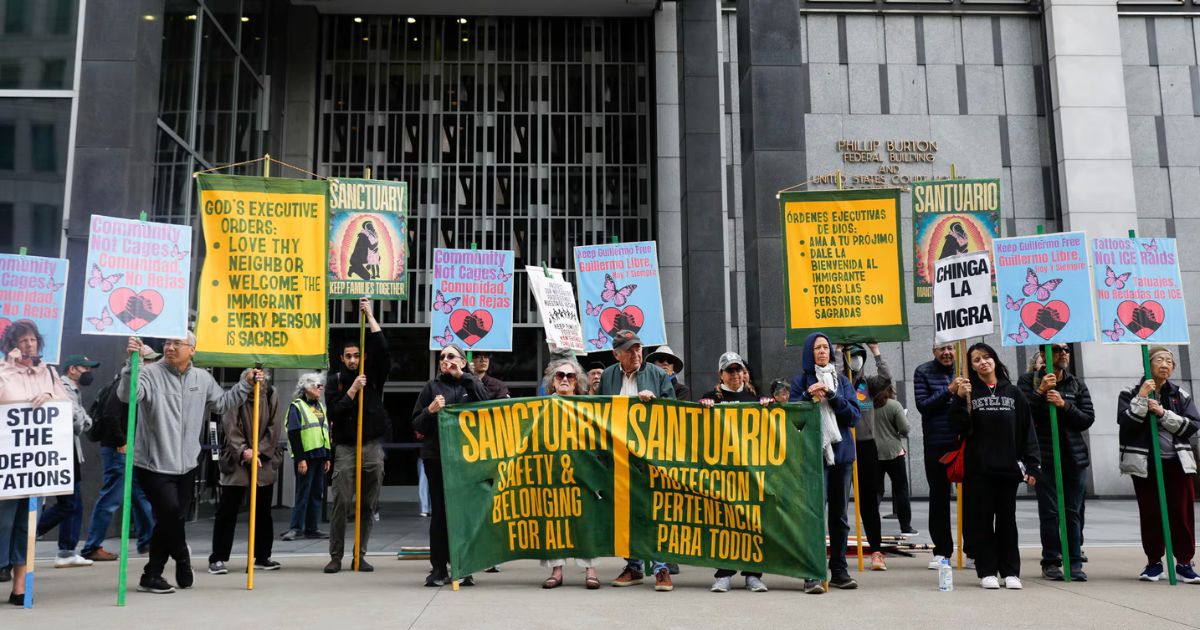
A peaceful protest turned chaotic on Thursday night when at least 13 people, including two journalists, were arrested after demonstrators blocked traffic on the John A. Roebling Suspension Bridge, a key link between Cincinnati, Ohio, and Covington, Kentucky, to protest the detention of a local immigrant and former chaplain.
The protest was held in support of Ayman Soliman, an Egyptian-born chaplain who had worked at Cincinnati Children’s Hospital and was recently detained by U.S. Immigration and Customs Enforcement (ICE) after appearing for a routine check-in. Outraged by his sudden detention, a crowd gathered in downtown Cincinnati before marching across the bridge carrying a large banner reading “Build Bridges Not Walls.”
But what began as a symbolic act of solidarity quickly escalated. Video footage from the scene shows Cincinnati police officers engaging protesters with force, including a moment where an officer is seen punching a demonstrator multiple times while others wrestle him to the ground. Another clip shows a black SUV attempting to drive through the line of protesters as a demonstrator in a neon vest pushes back against the vehicle.
Journalists Among Those Taken Into Custody
Among those arrested were Madeline Fening, a reporter, and Lucas Griffith, a photography intern—both on assignment for CityBeat, a Cincinnati-based news and culture outlet. They were covering the protest when they were detained and later charged with felony rioting, along with multiple other offenses, according to CityBeat’s editor-in-chief Ashley Moor. Both appeared in a Kentucky court on Friday morning, where a judge set their bonds at $2,500 each.
The Covington Police Department, which responded to the incident on the Kentucky side of the bridge, issued a statement defending the arrests, claiming officers were met with threats and hostility when attempting to communicate with the protest’s organizer. The department emphasized its support for peaceful protests but said blocking a critical piece of infrastructure like the bridge posed a danger to the public.
Charges filed against the arrested individuals include rioting, failing to disperse, obstructing emergency responders, criminal mischief, and disorderly conduct.
A Trend of Suppression of the Press?
This is not a singular occurrence. Numerous journalists have been arrested or hurt while reporting on rallies across the United States, especially those involving immigration enforcement. Earlier this year, anti-ICE protests in Los Angeles apparently resulted in the roughing up or injuries of over two dozen journalists.
One particularly concerning instance concerns Mario Guevara, an El Salvadorian journalist who speaks Spanish and was arrested in June while reporting on a No Kings demonstration outside of Atlanta. Guevara was turned over to ICE and is still being held at an immigration detention facility in Georgia, despite the fact that municipal charges against him were subsequently dropped.
His legal team maintains that Guevara had valid work authorization and legal residency in the U.S., yet deportation proceedings are still underway.
Who Is Ayman Soliman?
The man at the center of Thursday night’s protest, Ayman Soliman, had worked as a chaplain serving patients and families at one of Cincinnati’s most respected pediatric hospitals. Last week, during a routine check-in at their Cincinnati field office, ICE seized Soliman. Although there are still few details available about his case, his supporters contend that he has been a community member for a long time and that his abrupt imprisonment raises grave questions about the humanitarian effects of continued immigration enforcement.
As demonstrators call for action, tensions increase.
Demanding Soliman’s release and more comprehensive immigration reform, protesters chanted and crossed the Roebling Bridge. But according to Covington police, the demonstrators disregarded many warnings to leave. City authorities became frustrated when the bridge, a vital commuter route across the Ohio River, was closed for hours.
In a statement, the Covington Police Department said:
“While the department supports the public’s right to peaceful assembly and expression, threatening officers and blocking critical infrastructure, such as a major bridge, presents a danger to all involved.”
The Bigger Picture
The protest and subsequent arrests add to a growing national conversation around freedom of the press, immigration policy, and the criminalization of protest. As cases like Soliman’s spark localized outrage, they also serve as flashpoints in a larger clash over how the U.S. handles immigration enforcement—and how it treats those who report on it.
With legal proceedings now underway and bond set for the arrested, the eyes of both the public and press advocates are fixed on what happens next. For those who marched in solidarity with Ayman Soliman, Thursday night wasn’t just a protest—it was a demand to be heard across a river, a city, and a nation.