NEW DELHI: How a 22-Year-Old Woman and Her Rebel Network Defied an Empire Through the Power of Broadcasting.
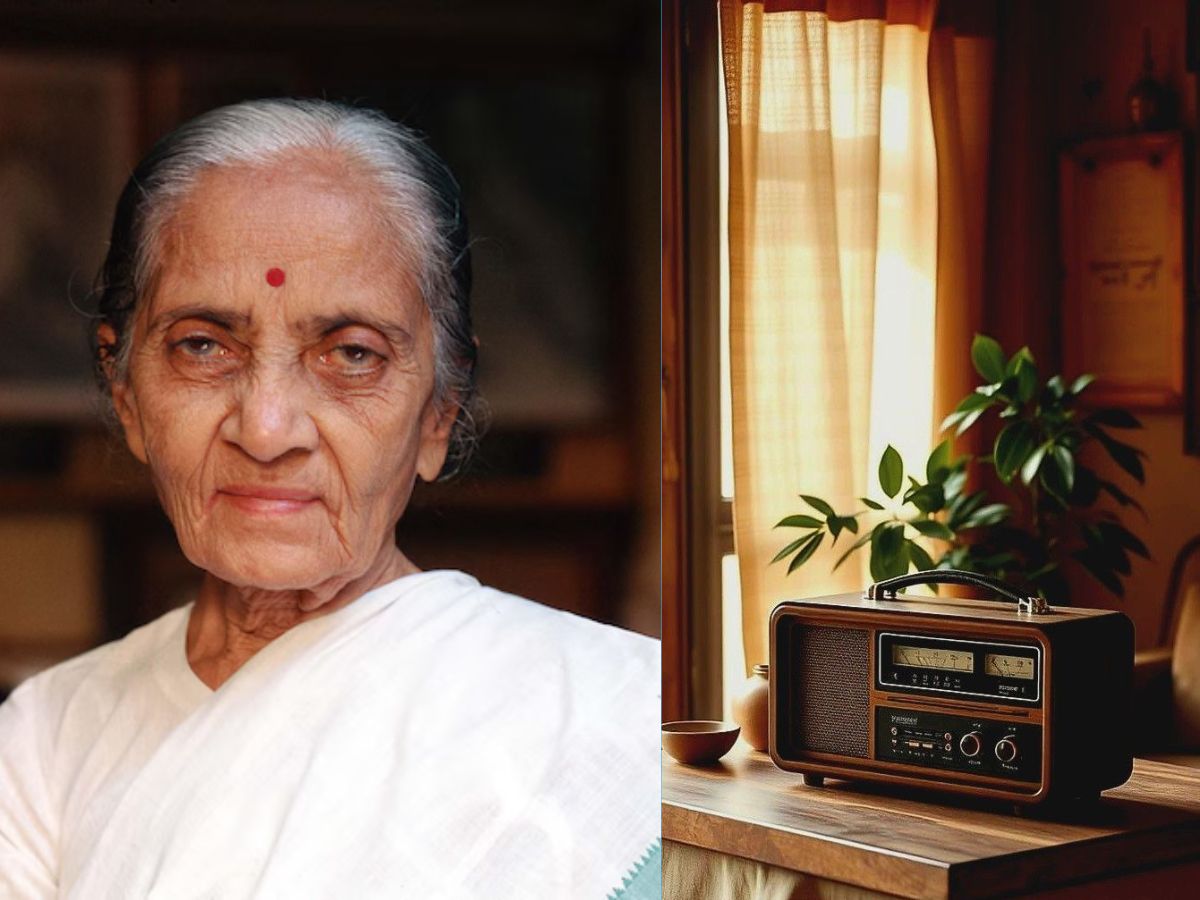
In the suffocating summer of 1942, as British colonial authorities tightened their iron grip on India, arresting every prominent freedom fighter they could find and censoring every newspaper that dared whisper resistance, something extraordinary happened. A voice crackled through the static on radio sets across the nation, calm yet defiant, announcing: “This is the Congress Radio calling on 42.34 meters from somewhere in India.”
That voice belonged to Usha Mehta, a 22-year-old woman who had just accomplished what the entire British Empire with all its surveillance machinery considered impossible. She had launched India’s first underground radio station, and in doing so, she rewrote the rules of what women could achieve in the male-dominated arenas of politics, technology, and revolutionary warfare.
THE GIRL WHO REFUSED TO RUN
Usha Mehta’s journey to becoming one of India’s most daring freedom fighters began not with grand proclamations but with small acts of extraordinary courage. At just eight years old, when her teacher was being beaten by British administrators and every other child fled in terror, little Usha did something remarkable. She didn’t run.
Instead, she confronted the armed police officers, grabbing their batons in a desperate attempt to protect her teacher.
This wasn’t youthful recklessness; it was the first glimpse of a character trait that would define her life: the refusal to accept injustice, regardless of the personal cost. That same fierce determination would later compel her to break a promise to her father, defy societal expectations, and risk her life for a cause greater than herself.
Born in Surat to a family of comfortable means, her father being a government judge under colonial rule, Usha had every reason to choose the safe path. She was brilliant academically, with achievements that could have guaranteed her a comfortable, conventional life. Her father, desperate to protect his daughter, made her swear on his head that she would abandon revolutionary activities and focus on building a constructive career.
For a brief moment, out of respect for her father, she agreed. But promises made under duress cannot bind a soul committed to freedom. The oath she had taken for her country’s independence weighed heavier than any family obligation. This decision, her third major act of resistance, reveals something profound about women’s empowerment: true agency means having the courage to make choices that society, and even loved ones, may not understand or accept.
WHEN COMMUNICATION BECOMES WARFARE
By August 1942, the Quit India Movement had erupted across India like wildfire. Mahatma Gandhi had given the clarion call: “Do or Die.” The British response was swift and brutal. Every major leader, including Gandhi himself, was arrested. Newspapers were muzzled. Public gatherings were banned. The colonial authorities believed they had successfully decapitated the movement.
THEY WERE WRONG
As Usha watched the systematic dismantling of communication networks, she recognized a pattern from history. The 1857 rebellion had failed partly because revolutionaries in different regions couldn’t coordinate their efforts or maintain morale through shared information. She was determined that 1942 would be different.
“WE NEED A RADIO STATION,” SHE ANNOUNCED TO HER COLLEAGUES
The proposal was met with skepticism and outright rejection by two of her comrades. A secret radio? In 1942? When the British controlled all broadcasting? When discovery meant certain imprisonment, possibly execution? It seemed not just dangerous but impossible.
Yet two colleagues believed in her vision, and more importantly, Usha believed in herself. This is the essence of women’s empowerment—not waiting for permission, not being deterred by those who say it cannot be done, but forging ahead with conviction and finding allies who share your audacity.
THE POWER OF WOMEN’S NETWORKS
The Congress Radio needed 4,000 rupees to become operational. In nine days of frantic fundraising, Usha and her team managed to collect only 551 rupees. The dream seemed to be slipping away, defeated not by British oppression but by simple economics.
Then came a moment that perfectly illustrates how women’s solidarity can move mountains. Usha’s aunt, an elderly woman who could no longer participate physically in protests or marches, removed all her jewelry and placed it in her niece’s hands. “I cannot pick up a stick due to my age,” she said, “but I can contribute this to the cause of our country’s freedom.”
This wasn’t just a financial transaction; it was a powerful statement about intergenerational women’s support, about older women enabling younger women to break barriers, about sacrificing personal treasures for collective liberation. Within women’s networks, empowerment flows in multiple directions, creating chains of courage that bind generations together.
BECOMING THE REVOLUTION
With funding secured, the real work began. Operating a clandestine radio station in 1942 required technical expertise that few possessed, regardless of gender. Radio technology was complex, dominated entirely by men, and tightly controlled by colonial authorities. Yet Usha and her team of women learned to operate transmitters, manage signal strength, understand electrical circuits, and maintain equipment under the most challenging conditions imaginable.
They didn’t just learn these skills; they mastered them while constantly moving locations, often in the dead of night, carrying heavy equipment through crowded streets without arousing suspicion. They developed covert signals, built trusted networks, and created sophisticated systems to warn each other of police raids. This was strategic thinking, operational excellence, and technological proficiency all rolled into one, shattering the myth that women lacked aptitude for technical or strategic work.
When Usha’s father discovered her activities and literally locked her in a room to prevent her participation, she faced perhaps her most difficult choice. She could submit to paternal authority, as society expected. She could prioritize family peace over national freedom.
Instead, she wrote a letter, left it on the table, and escaped through the window that very night.
Sometimes empowerment requires a disappointing those we love most. Sometimes choosing yourself, your convictions, and your purpose means breaking hearts, including your own. Usha made that choice, demonstrating that women’s agency isn’t just about what we achieve but about the sacrifices we’re willing to make for those achievements.
THE VOICE THAT TERRIFIED AN EMPIRE
From August 27, 1942, onward, the Congress Radio broadcast regularly, disseminating nationalist messages, patriotic songs, strategic instructions, and updates about protests across India. The broadcasts reached urban intellectuals and rural farmers alike, creating a sense of unity and shared purpose that the British had tried desperately to destroy.
The colonial authorities were both furious and confounded. Despite intensive efforts, raiding homes, monitoring signals, and deploying their most sophisticated detection equipment, they couldn’t immediately locate the source. Why? Because the operation wasn’t run by one person in one location. It was a network of women, coordinating seamlessly, moving equipment constantly, covering for each other, maintaining absolute secrecy even under surveillance.
This collaborative dimension is crucial to understanding women’s empowerment in the context of the Congress Radio.
While Usha Mehta rightfully became the public face of the operation, numerous other women worked tirelessly behind the scenes. They provided safe houses, transported equipment, maintained communication networks, spread broadcast schedules, and ensured that messages reached communities without radio access.
These women demonstrated technical acumen, carrying and concealing microphones, transmitters, batteries, and power supplies while avoiding detection.
They showed strategic brilliance, identifying secure locations and facilitating continuous relocations.
They exhibited tremendous courage, knowing that discovery meant imprisonment, torture, or worse.
THE PRICE OF DEFIANCE
Eventually, through persistent surveillance and signal tracking, the British located the Congress Radio in November 1942. By then, the station had operated successfully for three months, achieving what the colonial authorities had deemed impossible and maintaining the spirit of the Quit India Movement despite massive repression.
When arrest became inevitable, Usha Mehta made a choice that defined her character.
She personally operated the radio on that final broadcast, ensuring she would be arrested rather than allowing any of her colleagues to face that fate. She chose imprisonment over escape, torture over betrayal.