
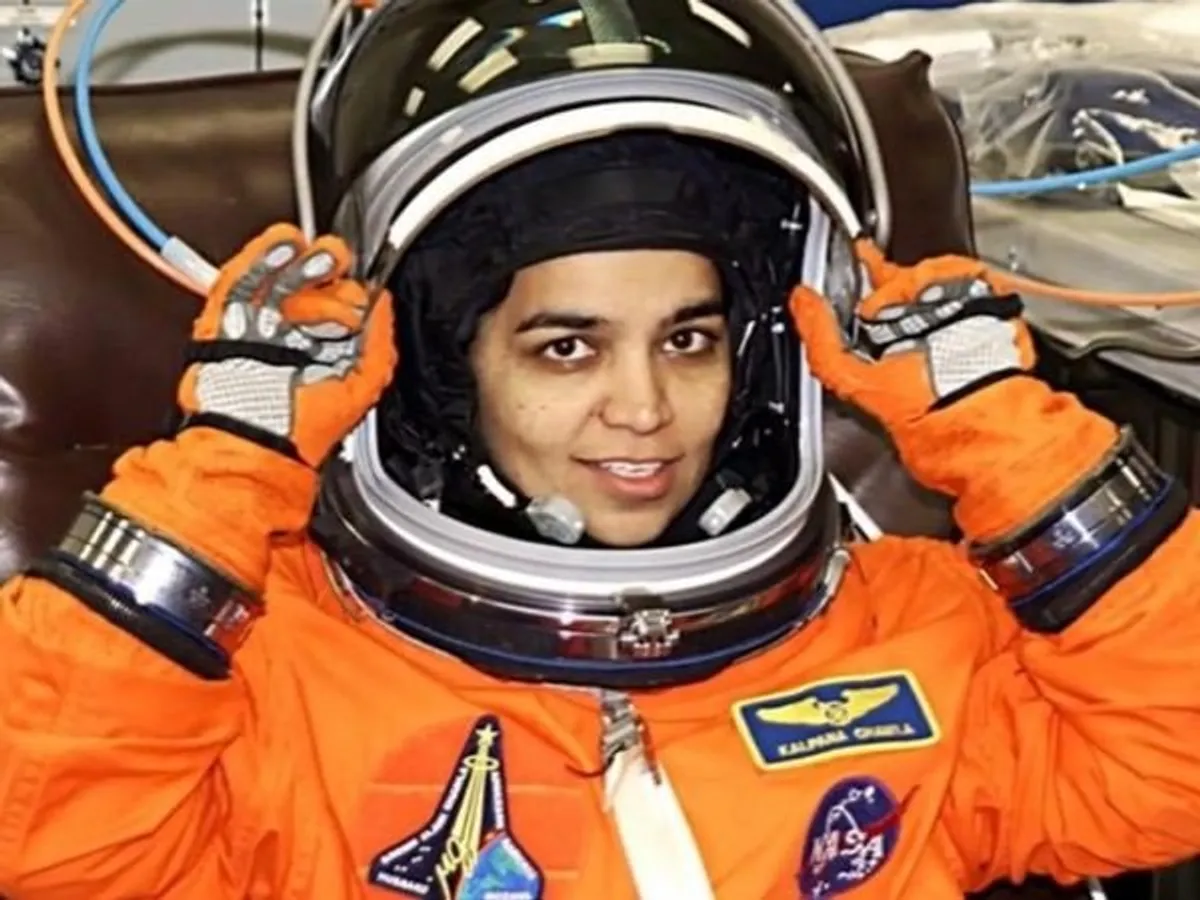
NEW DELHI: Somewhere in a small town in Haryana, a girl once lay on her terrace, staring at the stars.
She didn’t have a telescope. She didn’t have a famous scientist in the family. She didn’t have anyone telling her that girls from small Indian towns could fly among those stars one day.
BUT SHE KEPT LOOKING
That girl was Kalpana Chawla. And decades later, she floated in zero gravity aboard the Space Shuttle Columbia, becoming the first Indian woman in space, carrying with her the unspoken dreams of millions of girls who had also looked up but had been told to look down.
Her story didn’t end the way anyone wanted. She was lost in the Columbia disaster of 2003. But what she left behind was something no tragedy could destroy: proof that it was possible.
Today, across India’s space centres, research labs, and mission control rooms, women are carrying that proof forward. Not as symbols. Not as exceptions. But as scientists, engineers, and leaders who show up every day, solve impossible problems, and quietly make history, often while the world isn’t even watching.
THIS IS THEIR STORY. NOT THE POLISHED, HEADLINE VERSION. THE REAL ONE.
The Ones Who Went First
Every revolution has its first movers. The ones who walk into rooms where nobody looks like them and sit down anyway.
TESSY THOMAS: WAS ONE OF THEM
Growing up in Alappuzha, Kerala, she was the kind of kid who took apart radios to see how they worked. Her parents didn’t fully understand her fascination with rockets, but they didn’t stop her either. That small act of trust letting a girl follow her curiosity, changed the trajectory of Indian defence science.
Tessy went on to lead the development of the Agni-IV missile, becoming the first woman in India to head a missile project. The media gave her a dramatic title: “Missile Woman of India.” She accepted it with grace, though she’d probably prefer to be remembered simply as someone who did her job exceptionally well.
“When you’re the first woman in the room,” she once reflected, “you carry a weight that has nothing to do with the work itself. You know that if you fail, people won’t say she failed. They’ll say women can’t do this.”
SHE DIDN’T FAIL
Then there’s Ritu Karidhal. And if you want to understand what quiet strength looks like, her story is the one to know.
As Deputy Operations Director of the Mars Orbiter Mission (Mangalyaan), Ritu helped navigate India to Mars on a budget smaller than many Hollywood films. The mission succeeded on its first attempt, something even NASA hadn’t managed.
But here’s what the headlines didn’t capture: the late nights away from her children. The moments of self-doubt that she pushed past because the mission needed her. The subtle comments from colleagues who questioned whether a woman could handle the pressure of an interplanetary mission.
She handled it. India reached Mars. And Ritu went home and helped her kids with homework.
“People ask me how I balance everything,” she told an interviewer once, laughing softly. “I don’t balance. I juggle. Some days I drop things. But I pick them up and keep going.”
Behind these familiar names, there are hundreds of women whose contributions rarely make newspapers. Engineers like Minal Sampath, who spent years refining satellite systems and propulsion technologies. Painstaking, invisible work that makes every launch possible. Women who arrive early, stay late, and double-check calculations that could mean the difference between a successful mission and a catastrophic failure.
The Girls Who Followed
In 2023, when Chandrayaan-3 landed near the Moon’s south pole, making India the first nation to achieve this, something remarkable happened in living rooms across the country.
GIRLS WATCHED
Not passively. Not with idle curiosity. They watched with recognition. Because on their screens, in that mission control room, they could see women. Women who looked like their mothers, their aunts, their older sisters. Women in sarees. Women with bindi’s. Women adjusting their glasses and checking data readouts and making it happen.
That visibility changed something that no policy document or awareness campaign could.
Today, a new generation of women engineers at ISRO isn’t just continuing the legacy. They’re expanding it in directions the pioneers never imagined.
Young women are working on Gaganyaan, India’s first crewed spaceflight mission, designing life-support systems that will keep astronauts alive in the void of space. Others are applying artificial intelligence to satellite data, finding patterns in climate change and natural disasters that could save thousands of lives. Some are building components for rockets in labs where the average age is barely thirty.
And they talk about their work differently than the generation before them. Where the pioneers spoke carefully, aware that every word represented all women, this generation speaks with a matter-of-factness that is, in its own way, revolutionary.
“I’m an engineer,” says a twenty-eight-year-old propulsion specialist at ISRO, shrugging slightly when asked what it feels like to be a woman engineer. “I design engines. My gender doesn’t change the physics.”
She’s right, of course. But the fact that she can say it so casually, without defiance, without defensiveness, is a measure of how far things have come.
What Nobody Talks About
Here’s where the story gets uncomfortable. Because honest stories always do.
For every woman who made it into India’s space program, there are countless others who didn’t. Not because they lacked talent. But because the world around them made it too hard.
The girl whose parents told her that engineering was “not for girls” and married her off at nineteen. The college student who was the only woman in her physics class and endured four years of isolation. The young researcher who published brilliant work but watched male colleagues with weaker records get promoted ahead of her. The mother who was told, sometimes explicitly, sometimes through raised eyebrows and loaded silences, that wanting a career and children was selfish.
These stories don’t make it into inspirational speeches. But they are the reality that coexists with every triumph.
Even women who have reached the top speak about this. Quietly, often off the record, because they don’t want to seem ungrateful or difficult.
“There were meetings where I’d suggest an idea and it would be ignored,” recalls a senior scientist with more than two decades at ISRO. “Then a male colleague would say the same thing five minutes later, and suddenly it was brilliant. You learn to let it go. But it stays with you.”
Another woman, a mission planner in her forties, describes the guilt that accompanied her career: “My mother-in-law never said it directly, but I could feel it. The disapproval. Why does she need to work so much? Who is taking care of the children? My husband supported me, but the pressure from extended family was constant. I spent years feeling like I was failing at everything. Failing as a scientist because I couldn’t stay late enough. Failing as a mother because I wasn’t home enough.”
SHE PAUSES
“Eventually, I stopped trying to be perfect at both. I just decided to be present, fully present, wherever I was. At work, I was a scientist. At home, I was a mother. And I forgave myself for not being in two places at once.”
These aren’t stories of weakness. They’re stories of a strength that rarely gets acknowledged: the emotional labour of proving yourself in a world that wasn’t designed for you, while simultaneously maintaining the relationships and responsibilities that world expects you to carry.
Small Shifts, Big Impact. Change, when it comes to something as deep-rooted as gender bias, doesn’t arrive in a single dramatic moment. It arrives in small shifts. Individually modest. Collectively transformative.
A father in Lucknow who buys his daughter a telescope instead of a doll set because he saw Ritu Karidhal on television and thought, why not my daughter? A university professor who notices that her female students sit in the back row and deliberately calls on them first, because she remembers sitting in that same back row thirty years ago. Invisible. A team leader at ISRO who adjusts meeting times so that a young mother doesn’t have to choose between a project review and picking up her child from school, because he understands that flexibility isn’t a favour, it’s an investment.
A school in rural Rajasthan that invites a woman scientist to speak at its annual function and watches a fourteen-year-old girl approach her afterwards, eyes wide, voice trembling: “Can I really do this?”
These moments don’t make headlines. But they build the foundation upon which future missions, and future rotations, will stand.
Institutional efforts are growing too. Mentorship programs within ISRO now connect senior women scientists with younger professionals, creating the guidance networks that previous generations lacked. Scholarships targeting women in aerospace engineering are multiplying. Some organisations have introduced returns ship programs for women who took career breaks for family reasons, recognising that talent doesn’t expire simply because life intervened.
None of this is perfect. The gaps are still enormous. But the direction is unmistakable.
WHAT THEY REALLY WANT YOU TO KNOW
When you ask the women of India’s space program what message they’d send to the world, they don’t talk about awards or recognition. They talk about something simpler.
FREEDOM
“I want girls to know that curiosity isn’t unfeminine,” says a satellite communications engineer. “Wanting to understand how the universe works isn’t something you should apologise for.”
“Being a woman in aerospace is about resilience, passion, and never accepting a closed door as permanent,” reflects a mission systems designer. “You knock again. And again. And eventually, you build your own door.”
“We are proving that talent knows no gender,” states a young propulsion researcher, her voice steady. “But more than that, we’re proving that our daughters won’t have to prove it again.”
And perhaps the most quietly powerful statement of all comes from a woman who has spent thirty years in rocket science and asks that her name not be used:
“I don’t want to be called a ‘woman scientist.’ I want to be called a scientist. When that day comes, when the qualifier is unnecessary, we’ll know we’ve truly arrived.”
A PROMISE WRITTEN IN THE STARS
India’s space program is one of the most ambitious and cost-effective in the world. It has reached the Moon. It has reached Mars. It is preparing to send humans into orbit. And at every step of this journey, women have been there. Designing. Calculating. Leading. Sacrificing. Succeeding.
But the real revolution isn’t measured in missions accomplished or satellites launched. It is measured in something far more intimate: the moment a girl decides she is allowed to dream.
When Kalpana Chawla lay on that terrace in Haryana, staring at stars she could not yet name, she didn’t know she would one day fly among them. She just knew she wanted to.
Somewhere in India tonight, another girl is lying on another terrace, looking at the same sky. Maybe she’s in a city high-rise. Maybe she’s in a village where electricity is still unreliable. Maybe she has supportive parents. Maybe she doesn’t.
BUT SHE’S LOOKING UP
And because of the women who came before her Kalpana Chawla, Tessy Thomas, Ritu Karidhal, Minal Sampath, and the hundreds of unnamed engineers who built India’s path to the stars, she now has opportunities that previous generations could only dream. They didn’t wait for the world to be ready. They simply reached for the stars and brought the world along with them.