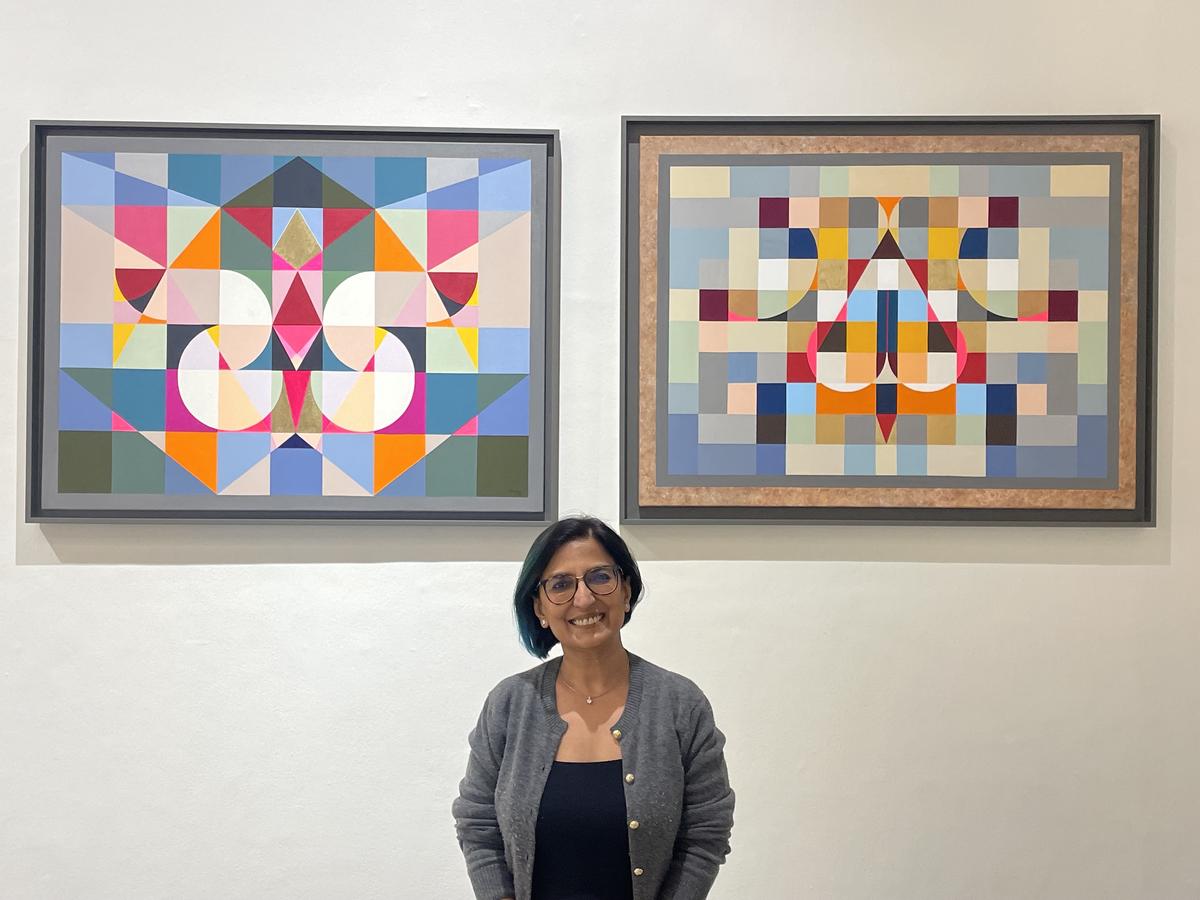
NEW DELHI: Creative fulfilment rarely arrives as a single triumphant moment. For many women artists, it unfolds quietly negotiated between expectation and self-belief, discipline and doubt, ambition and surrender. In the practice of Neerja Peters, fulfilment is neither loudly claimed nor theatrically displayed. It emerges through restraint, repetition and an evolving intimacy with silence. Her journey reflects not a dramatic breakthrough, but a steady alignment where process, purpose and personal truth converge.
For women in the arts, creative space has historically required negotiation. Time, autonomy and seriousness of intent are not always granted; they are carved out. Peters’ evolution embodies this quiet carving. Her early engagement with realism built a foundation of technical rigour and close observation skills often demanded of women artists to “prove” legitimacy. Yet she did not remain confined to expectation. Through years of experimentation across mediums and genres, she allowed herself to explore without the pressure of immediate recognition.
What distinguishes her mature work is not excess, but reduction. Geometry forms its structural backbone; grids, axes and horizons establish order without rigidity. In many ways, this geometry reads as metaphor. Within defined limits, she finds freedom. Within structure, she breathes. For women accustomed to navigating boundaries social, cultural or professional such containment can become a site of strength rather than restriction. Peters transforms discipline into liberation.
“This balance between control and openness shapes her current creative language. She no longer searches through complexity. Instead, clarity guides her. Each composition feels deliberate, pared down to essentials. There is an intuitive understanding of when to stop a confidence that does not demand spectacle. In a contemporary art landscape that often rewards scale and noise, her restraint feels radical. It signals a shift from striving to inhabiting, from external validation to internal resolution.
Colour becomes central to this inhabitation. Peters draws inspiration from the spiritual hour before sunrise Brahma Muhurat, or Amrit Vela a time associated in Indian philosophy with heightened awareness and stillness. Rather than depict dawn, she internalises it. Her palette carries the softness of emerging light, the quiet tension between darkness and possibility. For women artists, whose narratives are often expected to be bold or overtly political to be legible, such subtlety asserts another kind of authority. Meaning here does not shout; it unfolds.
Perhaps the most intimate gesture in her practice is her use of asemic writing abstract inscriptions reminiscent of ancient scripts and cosmological diagrams. These markings resist interpretation. They do not explain; they involve. Repeated rhythmically across the surface, they resemble visual mantras. The act of inscribing becomes meditative, almost devotional. In relinquishing literal language, Peters reclaims space from interpretation. She allows viewers to encounter rather than decode.
This refusal to over-explain carries particular weight for women creators. Historically compelled to justify their work or anchor it in narrative, women artists have often faced the burden of clarity. Peters steps away from that demand. In doing so, she models a form of creative confidence rooted in trust trust in process, in intuition, and in silence.
Recurring motifs bird-like silhouettes, linear migrations, subtle directional forms suggest movement and transition. They hover rather than resolve. There is no insistence on fixed meaning. Instead, ambiguity becomes fertile ground. Fulfilment, in her practice, lies not in arriving at answers but in remaining open.
Time itself is an essential collaborator. Her process is slow, immersive and resistant to urgency. In an era of accelerated production and visibility metrics, such slowness feels quietly defiant. For women balancing multiple roles, the act of claiming time for contemplative creation can itself be transformative. In these sustained intervals of attention, Peters experiences what Indian philosophy describes as Ananda — a quiet joy where the boundary between self and action dissolves.
Neerja Peters’ work does not attempt to persuade or overwhelm. It offers no spectacle, no overt narrative of triumph. Instead, it creates a contemplative field shaped by geometry, light and silence. Through this practice, she reframes creative fulfilment not as achievement, but as alignment — a way of being that makes navigating visibility, expectation and self-definition, her journey stands as a reminder; in art and in life art is not about conquering space it is about inhabiting it fully, and on one’s own terms.