NEW DELHI: Pink has never just been a colour. For decades, it has carried layered and often contradictory meanings—girlhood default, a fashion statement, a commercial symbol, and, increasingly, a political cue. Over the past few years, it has exploded back into mainstream culture with force, courtesy of Barbiecore—an aesthetic trend rooted in Barbie’s signature palette of bubblegum and fuchsia. But what began as a playful fashion moment quickly evolved into something far more contested and politically charged. Pink is no longer merely a shade: it is a site of cultural struggle.
The Barbiecore phenomenon emerged as a dominant sartorial trend in 2022 and 2023, fuelled by Mattel’s intentional marketing and a massive social media surge. Head-to-toe pink outfits, mini dresses, and bright accessories dotted red carpets, streetwear feeds, and celebrity closets. The trend reflected a renewed appetite for colour and maximalism after years of pandemic dullness—a collective desire for joy in post-COVID life.
Searches for pink mini dresses jumped nearly 970%, while pink bikinis and sunglasses soared by 343% and 190% respectively, according to retail data—a testament to the trend’s global reach. Celebrities helped amplify the motif. At red-carpet events and fashion weeks, stars turned up in striking pink ensembles—from rapper Saweetie’s bright pink tube top and gloves to Justin Bieber’s fuchsia beanie and Versace statements. Even traditionally non-pink personalities adopted the colour, signalling a broader cultural moment rather than a niche fashion whim.
Yet while Barbiecore thrived on optimism and nostalgia, critics soon began to push back and the backlash quickly transcended fashion critique. Some commentators and online voices argued that the trend represented nothing more than shallow nostalgia or consumerism. Vogue India published a pointed critique noting that Barbiecore felt two-dimensional and merely replicated unrealistic beauty standards tied historically to the Barbie doll, rather than offering fresh cultural insights.
The backlash wasn’t limited to fashion circles. On social media, critics began to frame the trend as a symptom of broader cultural contradictions—a colour associated with femininity was suddenly being read as emblematic of “himbo feminism”—a derogatory term used by some that conflates empowerment with superficiality. One activist critique on Hollywood Progressive labelled the embrace of Barbiecore as reactionary, suggesting it represented a regression in feminist discourse rather than advancement.
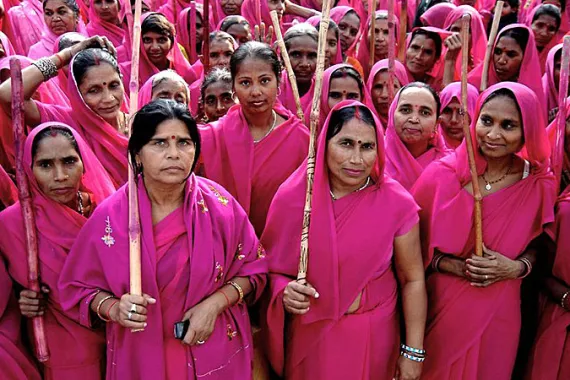
What complicates the conversation further is pink’s long history as a political colour. In the 2017 Women’s March in Washington, demonstrators wore pink “pussy hats” as a symbol of protest—deliberately contrasting the anger around political developments with a reclaimed expression of femininity and defiance. In India, groups like the Gulabi Gang used bright pink saris not as a fashion choice but as armour, mobilising women against gender-based violence and asserting visibility in patriarchal spaces. These examples show that pink has long held political resonance not simply as a frivolous hue, but as a symbol of resistance, identity, and collective assertion.
The reason pink stirs controversy today is that it sits at the intersection of identity, politics, and capitalism. The Barbiemovie itself became a cultural lightning rod—sparking viral memes, fashion moments, and widespread debate about representation and gender norms. At screening events and premieres, audiences embraced the pink aesthetic so fully that cinemas became meccas of pink attire and Barbiecore outfits, blurring the line between fandom and cultural expression.
Social media further intensified the trend and its contradictions. TikTok pushed hashtags like #Barbiecore into the millions of views, turning pink outfits into instantly recognisable cultural signifiers. But the same platforms also became breeding grounds for backlash, parody, and critique—with some users mocking the “Barbie superstition” or deriding pink as symbolic of shallow consumerism. People online debated whether embracing the trend was empowering or pandering to stereotypes.
In political commentary, even conservative pundits took aim at Barbiecore and related aesthetics, portraying them as emblematic of a cultural shift they oppose—positioning pink not as a fun fashion choice but as a marker of cultural excess or a rejection of traditional values. This reaction underscores how deeply aesthetics have become weaponised in culture wars. A colour that once simply adorned clothing racks now signals broader anxieties about gender, power, and social change.
Beyond aesthetics, the Barbiecore backlash echoes a deeper cultural question: Who gets to define empowerment? For some, embracing pink is a joyful reclaiming of femininity without apology—a rejection of the notion that seriousness requires neutral or masculine styles. For others, it feels like a commercialised mimicry that glosses over structural issues related to gender equality, body image, and representation. The debate reflects broader tensions in contemporary feminism between critique and celebration, between resistance and enjoyment.
In a world increasingly polarised by identity, political symbolism, and internet outrage cycles, pink has become a surprisingly effective shorthand—whether embraced, mocked, or contested. Far from fading with fashion seasonality, the debates around Barbiecore and pink aesthetics reveal that a colour can carry layers of meaning far beyond its pigment. Pink today is more than just a trend. It is a cultural battleground—a coded symbol in debates about gender, identity, capitalism, and power. Whether seen on a runway, in a protest march, or on a social media feed, it continues to provoke, divide, and inspire—proving that sometimes, what appears superficial on the surface holds far deeper cultural currents underneath.