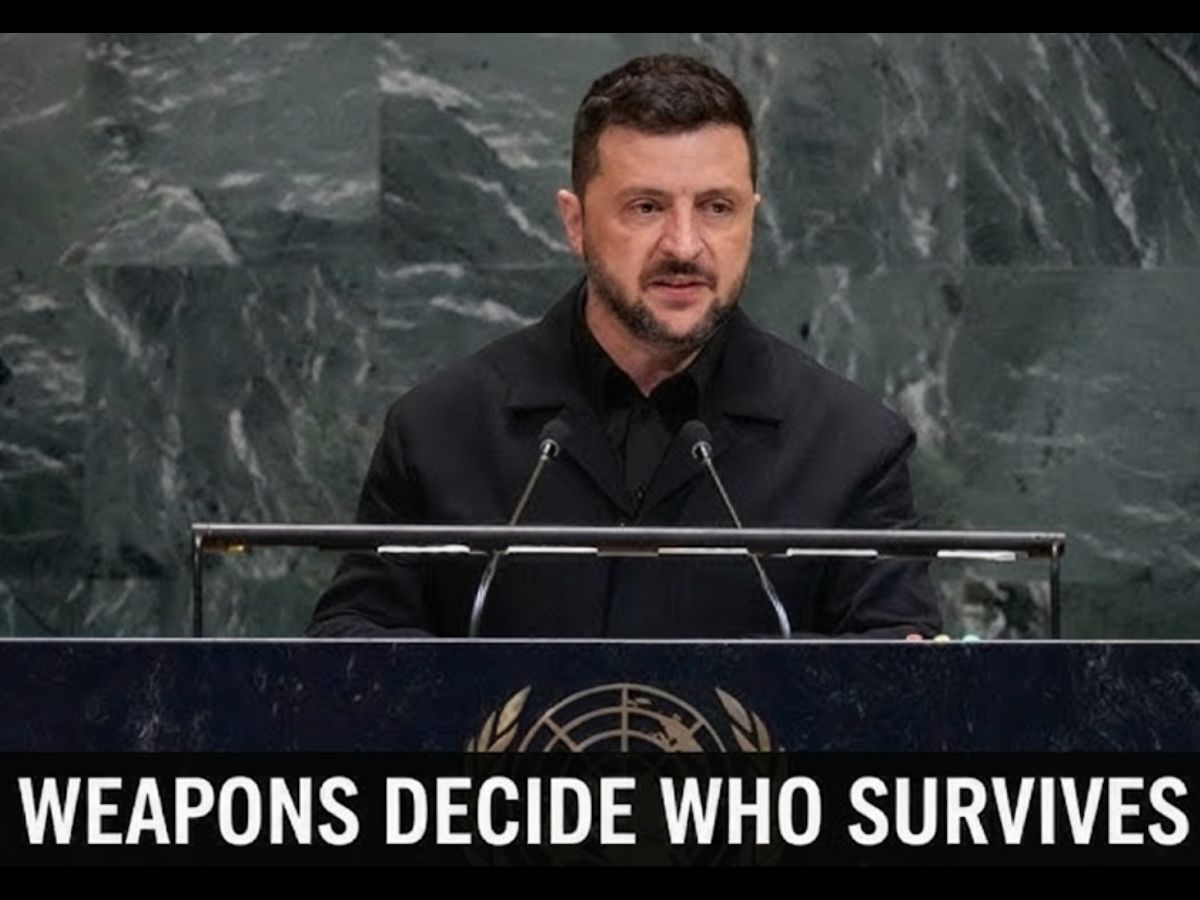
In a strong address to the UN General Assembly, Ukrainian President Volodymyr Zelensky warned that Vladimir Putin “will keep driving the war forward wider and deeper” unless the world acts together. Zelensky described the conflict in Ukraine as a key moment for global security and linked the need for military support to the risks of a new arms race involving artificial intelligence.
What Was Zelensky’s Central Message to the World?
President Zelensky’s core argument was that Russian aggression will not stop at Ukraine’s borders. He asserted that more countries would inevitably face similar threats unless allies demonstrate unwavering unity and significantly increase their support. He criticized international institutions as being “too weak” to offer real security guarantees, adding that even membership in a long-standing alliance like NATO “doesn’t automatically mean you are safe.” He directly appealed for early action, saying that “stopping Russia now” is much cheaper for the world than facing the consequences of an emboldened Putin later.
How Did Zelensky Frame the Broader Global Threat?
Beyond the immediate fighting, Zelensky painted a worrying picture: humanity is now in “the most destructive arms race in history.” He urged the world to see the link between today’s war and the dangers that advanced military technology could bring in the future. He called for urgent global rules governing the use of Artificial Intelligence in weaponry, stating that “weapons decide who survives.” He expressed particular concern about autonomous drones and unmanned planes, suggesting they represent a far greater risk than traditional warfare and could even lead to the nightmare scenario of a simple drone carrying a nuclear warhead.
Also Read: Iran’s President Denies Nuclear Weapons Ambition Ahead of Critical Deadline
What is the Significance of Trump’s Changed Position?
The Ukrainian leader’s speech came amidst a significant shift in the position of US President Donald Trump. For the first time, Trump stated that Ukraine could win back all of its occupied land, a marked change from his previous suggestions that Kyiv should accept “land swaps.” He also described Russia as a “paper tiger” fighting “aimlessly.” Zelensky praised Trump, calling their meeting “good,” and indicated he understood the US was willing to provide security guarantees after the war, potentially including more weapons, air defences, and drones. This shift introduces a new dynamic into the Western support structure for Ukraine.
How Did Russia Respond to These Developments?
The Kremlin swiftly dismissed Trump’s characterization. Spokesman Dmitry Peskov retorted, “Russia is in no way a tiger. It’s more associated with a bear. And there is no such thing as a paper bear.” He suggested Trump’s comments were made “under the influence of the vision put forward by Zelensky” and were in “absolute contrast” with Moscow’s view. Despite the rhetoric, the highest-level US-Russia contact in weeks occurred when Secretary of State Marco Rubio met his Russian counterpart, Sergei Lavrov. Rubio reportedly reiterated Trump’s “call for the killing to stop,” signalling a continued, if contentious, diplomatic channel.
Also Read: Why Delhi’s Declining Girl Child Ratio Signals a Deep Social Crisis | Experts Warn of a ‘City of Men’
Why Did Zelensky Specifically Mention Moldova and NATO Airspace?
Zelensky expanded the scope of his warning beyond Ukraine, stating that Europe “cannot afford to lose Moldova” to Russian influence. This comment aligned with Moldovan President Maia Sandu’s recent accusation that the Kremlin is spending hundreds of millions to destabilize her country ahead of a critical election. Furthermore, Zelensky’s warning about the insufficiency of alliance guarantees was underscored by recent events: NATO members Estonia, Poland, and Romania all reported violations of their airspace by Russian aircraft, leading to formal requests for alliance consultations. Zelensky’s claim that the threat is already threatening NATO’s boundaries is supported by these occurrences.