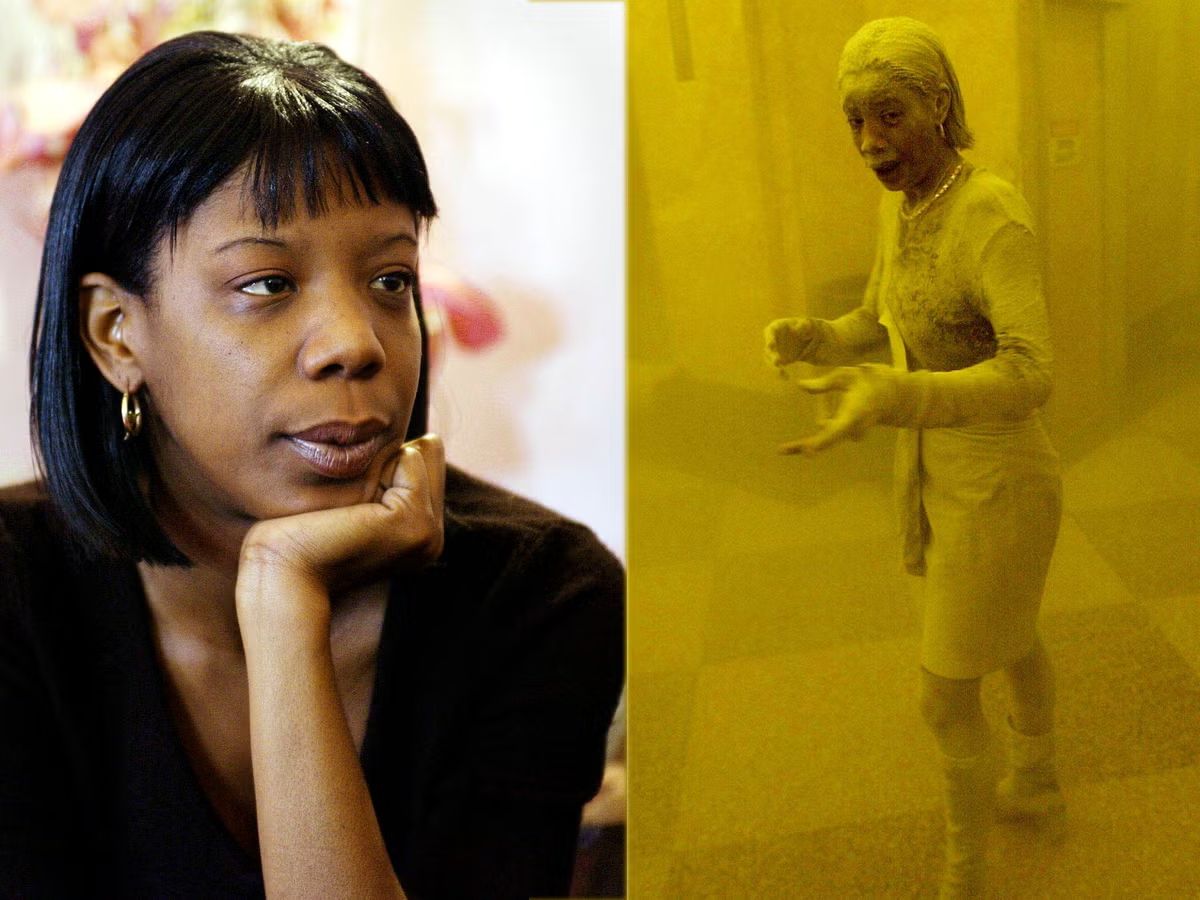
On September 11, 2001, a single, haunting image came to symbolize the terror, confusion, and sheer human will to survive.
It was an image of a woman with her eyes wide with astonishment and bewilderment, her face completely covered in thick, gray ash, and her professional attire. Marcy Borders became known to the world as the “Dust Lady.” Yet her survival from the collapsing Twin Towers marked only the beginning of a long, painful struggle that revealed the hidden and enduring wounds of that day.
Who Was the ‘Dust Lady’?
On the morning of September 11, Marcy Borders, a 28-year-old legal assistant at Bank of America, was at her desk on the 81st floor of the North Tower when panic and terror broke out after the first plane struck. In the midst of it, a photographer captured her stunned survival—a picture that soon became one of the tragedy’s most enduring and widely shared images. One of the most iconic and widely shared photos of the catastrophe was taken when a photographer caught her in that moment of stunned survival. She didn’t even know the photo existed until she saw her own ash-covered face staring back at her from newspapers and TV screens around the world.
Also Read: Behind Closed Doors: Trump’s Alleged Affairs, Secrets, And The Scandal
What Happened After the Cameras Stopped Rolling?
For Borders, survival came at a profound cost. The immediate goal of getting home to her young daughter was achieved, but her life was irrevocably broken. The trauma of that day triggered severe psychological wounds. She developed crippling anxiety, post-traumatic stress disorder (PTSD), and a deep fear of the world around her. “I didn’t do a day’s work in nearly 10 years, and by 2011, I was a complete mess,” she told the New York Post. “Every time I saw an aircraft, I panicked. If I saw a man on a building, I was convinced he was going to shoot me.” The unbearable weight of her trauma led her to addiction in a desperate attempt to escape. “I started smoking crack cocaine, because I didn’t want to live,” she admitted.
Borders fought hard to reclaim her life. She checked into rehab, determined to overcome her addiction. She cited a sense of closure in 2011 after the death of Osama bin Laden, saying, “[God] got rid of my biggest fear… I used to lose sleep over him, have bad dreams about bin Laden bombing my house, but now I have peace of mind.” It seemed she was finally on a path to healing, having battled her deepest demons.
What Was the Final Toll of That Day?
Tragically, the toxins she inhaled on 9/11 had already set a silent killer in motion. The dust that coated her that morning was a poisonous mix of pulverized concrete, glass, asbestos, and other carcinogens. In 2014, Borders was diagnosed with stomach cancer. She believed, and her family adamantly maintains, that the cancer was a direct result of her exposure on 9/11. After a fierce battle, Marcy Borders died in 2015 at the age of 42. She is counted among the thousands of 9/11 victims, a casualty of the attacks, even if her death came 14 years later.
What is the Key Takeaway?
The story of Marcy Borders is more than the story of a famous photograph. It stands as a powerful reminder that for survivors, trauma lingers, a battle waged both against the visible wounds of history and the hidden, enduring toll of psychological and physical illness. Her story guarantees that the legacy of 9/11 remembers not just the lives lost, but also those who survived—only to battle its aftermath long after the dust cleared.