
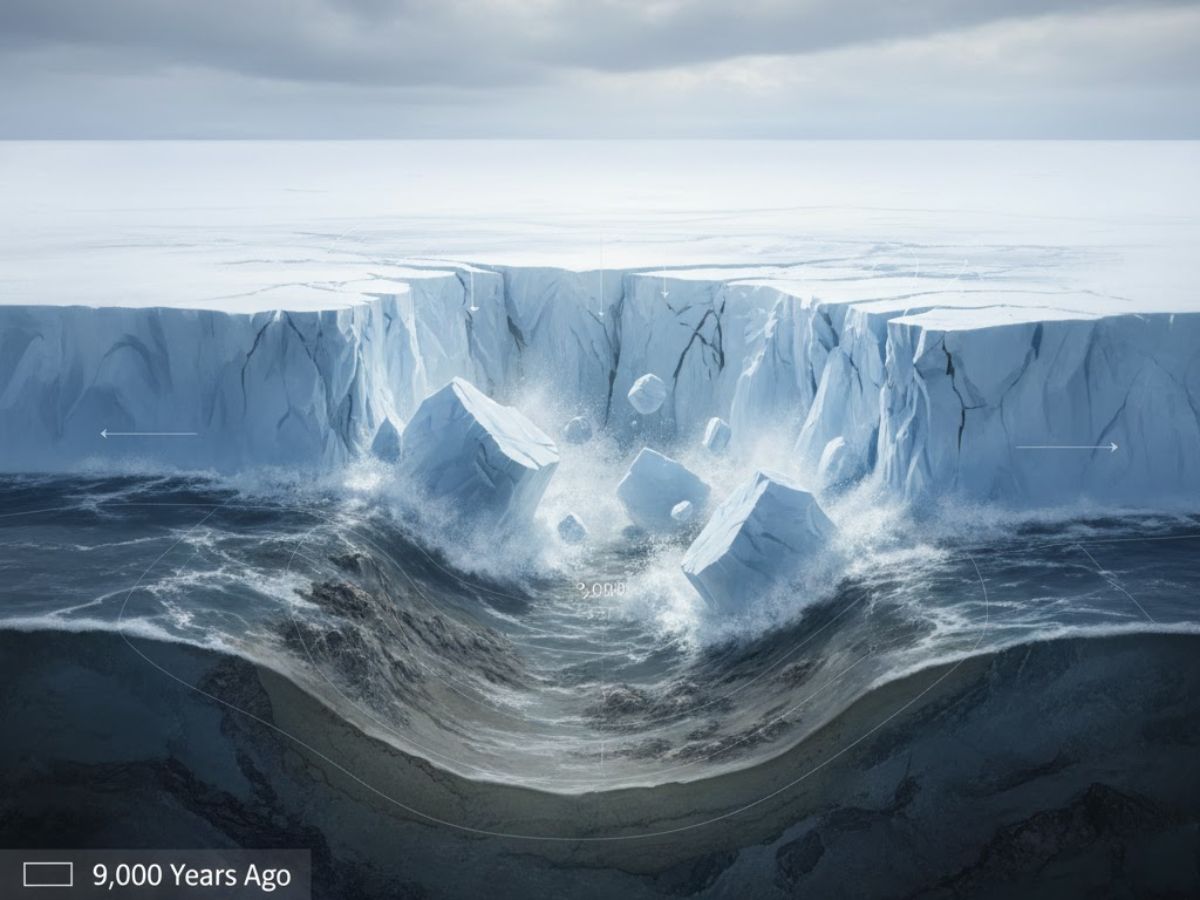
TOKYO, Dec 26 — A groundbreaking study has revealed that the massive East Antarctic Ice Sheet, long considered more stable than its western counterpart, underwent a complete and rapid collapse 9,000 years ago. This ancient disaster, which was caused by warmer ocean currents, is a sobering reminder of how vulnerable the greatest ice sheet on Earth may be to current climate change.
Sediment Cores Reveal an Ancient Ice Apocalypse
The discovery, led by Professor Yusuke Suganuma of Japan’s National Institute of Polar Research (NiPR), came from studying sediment cores taken from the seafloor near Japan’s Syowa Station in Lützow-Holm Bay. Layers from the early Holocene period, when global temperatures were several degrees warmer than today, were preserved in the sediments as a historical record. Researchers dated the ice sheet’s collapse by identifying rare beryllium isotopes and analysing microscopic marine fossils in the cores.
The Culprit: A Sneaky, Warm Ocean Current
The study pinpoints the Circumpolar Deep Water (CDW) as the precise cause of the collapse. Deep beneath the ocean’s surface is a warm, salty stream. The study’s data indicates that 9,000 years ago, this warm water moved upward onto the continental shelf and lapped against the base of Antarctica’s ice shelves. The floating ice shelves that serve as vital buttresses to hold back the inland ice were undercut and weakened by this process, called basal melting. The grounded ice sheet lost stability as these shelves broke, and it quickly flowed into the ocean.
A ‘Cascading’ and Rapid Downward Spiral
The collapse was not a slow event but a rapid geological catastrophe. The scientists describe a dangerous “cascading positive feedback loop” that accelerated the melt. As ice melted from Antarctica, it poured freshwater into the surface ocean. This lighter freshwater sat on top, preventing it from mixing with the denser, warmer water below. The stratification set off a self-sustaining cycle of destruction, letting warm Circumpolar Deep Water attack the ice shelves without interruption. Seafloor structure and rising sea levels also played a role in accelerating the collapse.
A Dire Warning for the Future
Although the East Antarctic Ice Sheet is stable today, the study shows it has an unknown weak point. It proves that with enough ocean warming, even Earth’s largest ice store can collapse quickly and completely. The findings speak directly to present concerns, showing how the same warm-water melting seen in West Antarctica today could also begin in the east, potentially driving sea levels up by many metres over centuries.