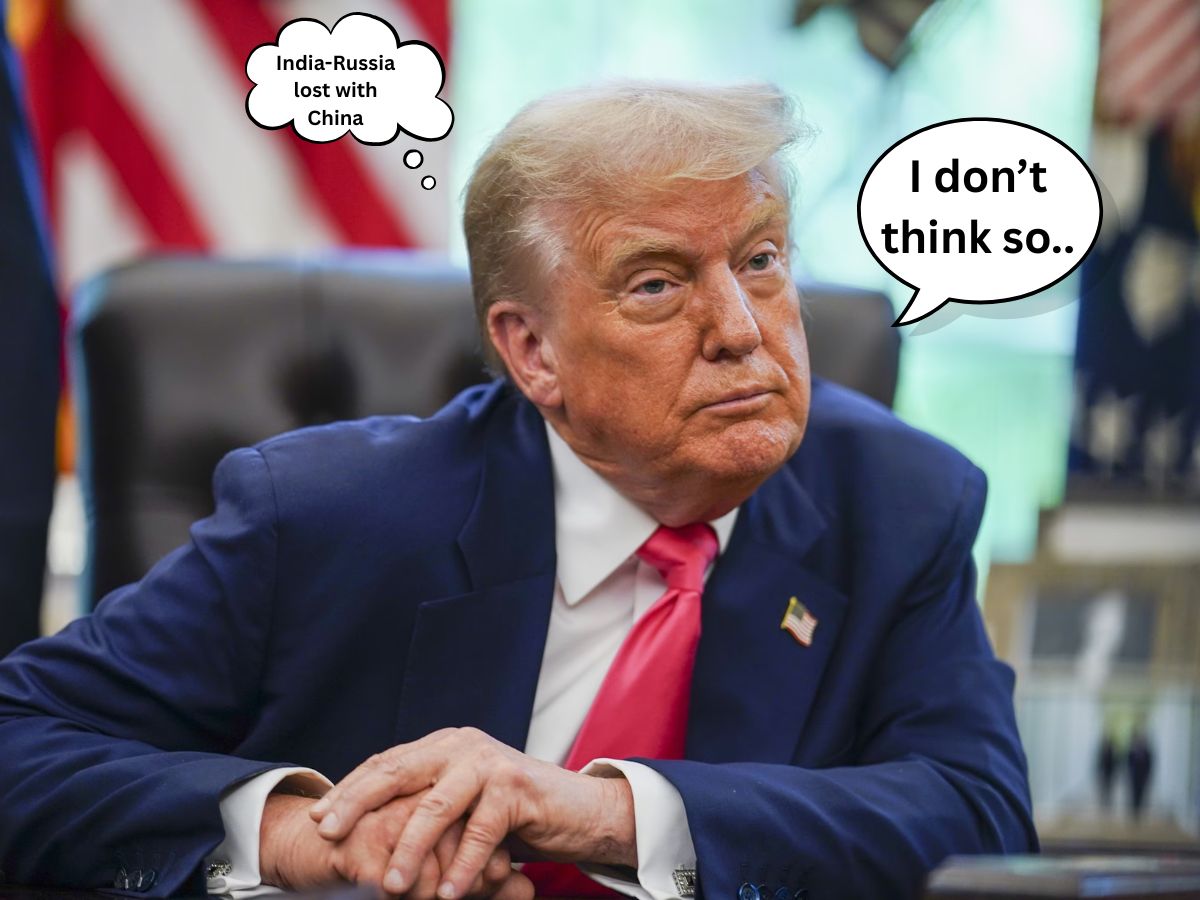
US President Donald Trump’s recent remark regarding “losing India and Russia to deepest, darkest China” created huge diplomatic waves and strong media interest across the world. Nevertheless, his latest responses display an effort to tone down the language, explain his position, and possibly indicate damage control following increased tensions in US-India relations and moreover the fact that India and China are getting closer than ever.
ALSO READ | The ‘Ceasefire’ Donald Trump Deserves the Credit For!
The Truth Social Post in Controversy
Trump’s sharp-ended post on his social media website Truth Social was published days after the Shanghai Cooperation Organisation (SCO) summit in Tianjin, where India, Russia, and China’s leaders stood united, indicating warmer relations between the three countries.
His initial post was, “Looks like we’ve lost India and Russia to deepest, darkest China. May they have a long and prosperous future together!” The message was widely interpreted as a blunt admission of diluting US influence in Asia and frustration with New Delhi’s and Kremlin’s growing alignment with Beijing.
This remark was made against the backdrop of the Trump administration imposing heavy tariffs (50%) on Indian products, particularly in retaliation for India’s ongoing purchase of the discounted Russian crude alongside the Ukraine war which translates to ‘funding the war’ apparently by India. Trump’s timing and tone were deemed provocative in troubled US-India relations after a traditionally strong bilateral relationship.
ALSO READ | Voter Adhikar Yatra: Confidence or Arrogance? | Progress Report
Trump’s Latest Reaction: Is He Caving?
During a White House media encounter soon after the backlash, Trump seemed to back off from the absolutism of his initial post. When asked if he had lost India, he responded resolutely, “I don’t think we have.” He sounded disappointed with India’s imports of Russian oil but reiterated that the US had strongly conveyed concerns by imposing tariffs. Yet Trump underlined his own good relationship with Indian Prime Minister Narendra Modi, remarking, “I get along very well with (PM) Modi. He was here a couple of months ago, and we had a Rose Garden press conference.” These remarks appear to be an attempt to reassure that relations are still somewhat intact despite the public disagreement.
This soft adjustment was interpreted by some experts as damage control, a reset recognising the geopolitical value and complexity of US-India relations. Though Trump did not completely withdraw his initial conclusion, he stressed on the implication of lost partnership and emphasised sustained diplomatic interaction.
How Do the Experts View This? : The Broader Context
Analysts point out that even though Trump acknowledges the strengthening of ties among India, Russia, and China, his administration’s aggressive trade policies and tariffs strained relations and unintentionally brought India closer to China. A number of commentators believe that Trump’s previous statements are a sign of frustration with diplomatic setbacks and not a strategic loss. Former US officials have openly called on the administration to repair ties, and they point to India as an important strategic ally in counter-balancing China’s growing influence in Asia.
India upholds its autonomous foreign policy position, stressing that bilateral relations with a nation are maintained on mutual merits, irrespective of the impressions on a third nation. The Indian Ministry of External Affairs has avoided making detailed comments but reconfirmed continuous trade talks with the US.
ALSO READ | Navarro’s Foot In his Mouth Again, This Time for ‘Brahmins’ Adani-Ambani!
Nutshell
Trump’s recent words reflect a subtle shift of rhetoric instead of an outright giving in on his “lost India” comments. Though criticising India for its Russian oil relations publicly and imposing sharp tariffs, he also insists on personal rapport with PM Modi and ongoing diplomacy at the same time. The incident highlights the attempt of fine balancing act in US-India relationships against global equations. With tensions climbing on, pragmatic approach to diplomacy seems essential to avoid further damage to this strategic alliance.