
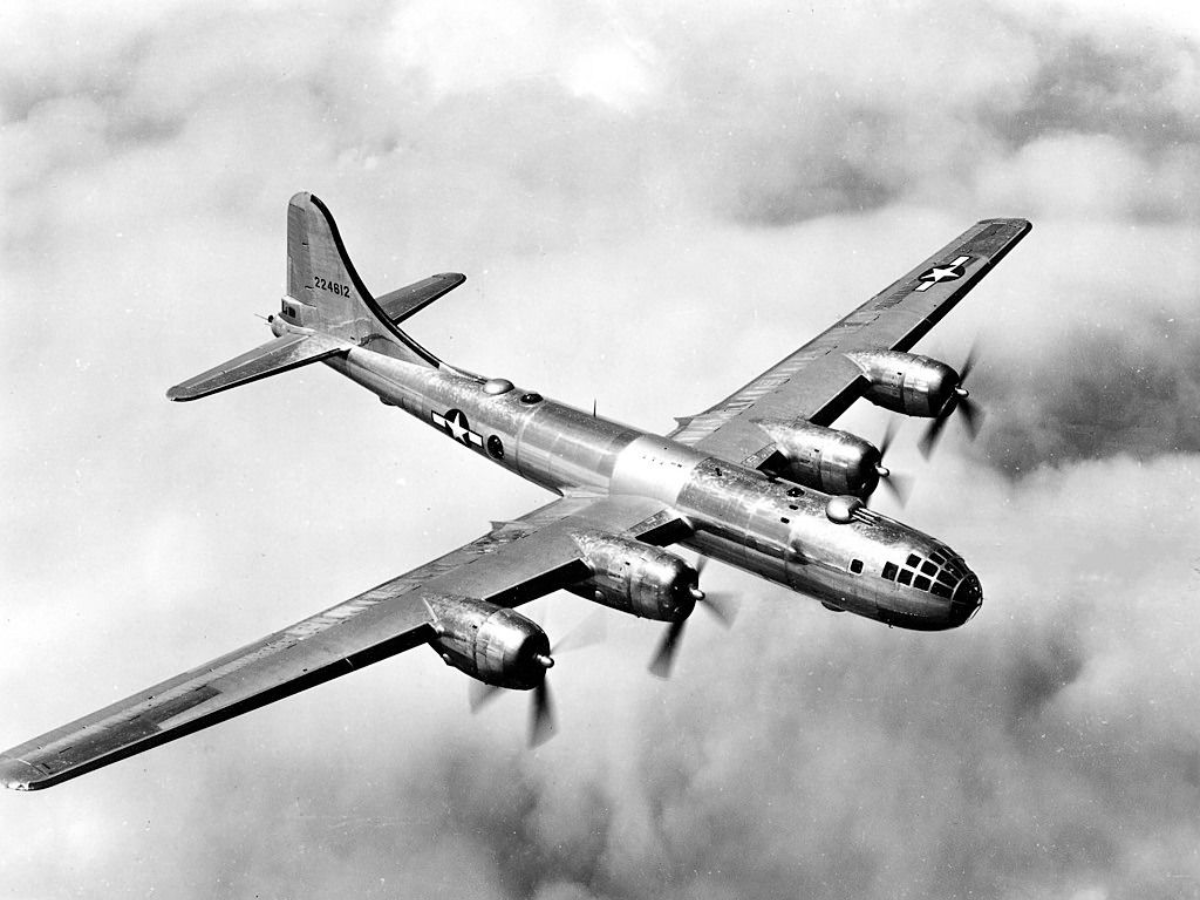
Manhattan Project when Americans think about the most costly weapon in World War II it usually comes to mind. More resources were consumed by the B-29 Superfortress than by the atomic program. The B-29 program cost around $3 billion almost 50 percent more than the Manhattan Project’s $1.9 billion in 1940s dollars. If adjusted to current valuations, the cost for building and producing more than 3,900 B-29 bombers would be nearly a staggering $55 billion.
B-29 Bomber: Creating a Super Bomber
Even before the United States was part of the war, in 1940 and the Army Air Corps had called for an aircraft that was completely different than anything that existed in ability to fly. Boeing‘s XB-29 design was eventually selected to fill that role.
Equipped with recently advanced Wright R-3350 engines, this aircraft was fitted with state of the art features such as pressurized cabins, remote controlled gun turrets and unprecedented ranges. The intension was to strike deep into Europe and Asia without refueling it was here that this capability about to prove vital.
ALSO READ: Cosmic Cannibalism: Dark Predators Matter Turn Planets into Black Holes Theory
Early models frequently displayed engine overheating and mechanical failures. Under wartime urgency, the U.S. mounted a massive crash program of thousands of workers scrambling to get the B-29 into combat under the Battle of Kansas in 1943. Even with defects, that gamble paid off it hastily produced an aircraft that redefined aerial warfare.
B-29 Bomber: Turning the Tide in the Pacific
B-29 Bomber was fast becoming the backbone of the U.S. air strategy by 1944 in the Pacific. Because of its long flying distance, the American forces could devastatingly bomb their cities from bases in the Mariana Islands. As a result, under the command of General Curtis LeMay, strategies changed from precision to incinerating raids from low altitude levels and which razed vast areas of Tokyo and other cities.
But their most ill-famed missions were in August of 1945. The Enola Gay and Bockscar dropped the atomic bombs on the cities of Hiroshima and Nagasaki, exacting Japan’s surrender and shutting the book on World War II. It is such moments that will forever bind the B-29 to one of history’s most momentous decisions.
ALSO READ: SpaceX Launches 28 More Starlink Satellites: Falcon 9 Rocket Boosts Global Internet Vision
B-29 Bomber: Legacy Beyond Theatre
This Superfortress was also groundbreaking in its technology for example, via the pressurized cabin and long-range performance and both early aspects to modernize civil aviation. Postwar air travel boomed in part through borrowing innovations from it to pave the way for modern passenger travel.
It also hemispheric zed geopolitical weight. Capturing a downed B-29 allowed the Soviets to manufacture the Tupolev Tu-4, which would become a rivalry icon of the Cold War. This is how an aircraft shaped the outcome of World War II and, in many ways, balanced power for decades thereafter.
B-29 Bomber: Symbol of Industrial Might
B-29 Superfortress remains an eyewitness unto America’s wartime industrial power. It embraced more complexity than any other weapon of the time, demonstrating both the power and the struggles of innovating under pressure. The B-29 would define the skies of the postwar world while the Manhattan Project ushered in the nuclear age. It was the costliest weapon of its time; it was an instrument that symbolized victory and sacrifice as well as the technological leaps that would shape aviation for generations.
ALSO READ: Scientists Find Evidence Marsquake Data Reveals Hidden Blobs from Ancient Cosmic Collisions