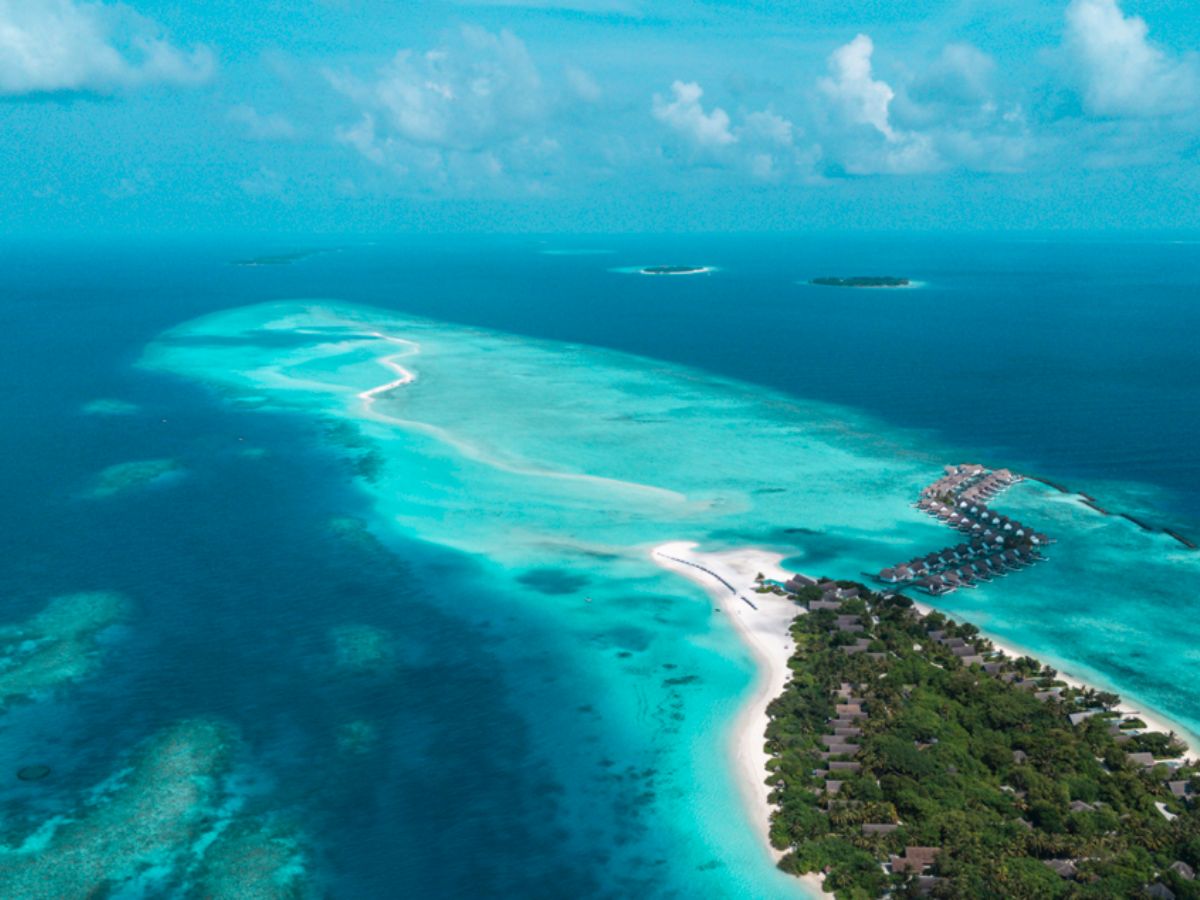
At Four Seasons, Landaa Giraavaru, luxury feels lighter, wiser, and more alive.
Aane do, aane do, dil mein aa jaane do Keh do muskurahat ko Hi, hi, hi, hi Jaane do, jaane do, dil se chale jaane do Keh do ghabrahat ko, Bye, bye, bye, bye, bye, bye Love you, zindagi Love you, zindagi Love you, zindagi Love me, zindagi — Love You Zindagi!, Dear Zindagi
There’s a lightness in ‘Love You Zindagi’ — the simple permission to let ease enter, and to wave goodbye to worry — that feels especially apt in the Maldives. Here, relief arrives not only from distance but from a change in elements: the last strip of runway heat giving way to sea-spray air; the geometry of Malé dissolving into blues; and then, at last, an island that seems to have been imagined first as a feeling.
Recently I visited Four Seasons Landaa Giraavaru on a private trip, which sits in the remote northern Baa Atoll, part of a UNESCO-designated biosphere reserve, where the Maldives begins to look less like a postcard and more like a living system: lagoon, reef, jungle, sky, repeating in patient cycles. The Four Seasons resort there opened in November 2006, on what used to be a coconut plantation, with much of the original vegetation preserved.
I’ve visited enough luxury coasts and far-flung hideaways to know that indulgence can sometimes feel disconnected—beautiful yet faintly sealed. What makes the Four Seasons Resort Maldives at Landaa Giraavaru different is how effortlessly it locates you, not in a fantasy, but in a living atoll.
The resort is designed so the Maldives is never just a backdrop. Every day keeps nudging you back to what sustains the experience: the reef’s health, the marine teams and local hands that protect it, the way your body softens when it’s finally moving with light and water. It also makes you see the real bargain at the heart of Maldivian tourism: paradise can remain paradise only if the very things tourists strains — coral, coastline, freshwater, waste systems, energy — are protected with the same seriousness as comfort.
Built like a memory of the Maldives: The design language is unshowy in the best sense: native Maldivian forms rendered with a contemporary ease — steep thatched roofs, traditional coral walls, generous outdoor living, and foliage that feels less landscaped than simply respected. The villas, 103 in all, are designed to live with the sound of leaves or the sound of water, and sometimes both. There is a certain romance to archetypes in the Maldives, but it is easy for it to become formulaic. Here, some water villas are designed with mezzanine lofts reached by a spiral staircase: an almost childlike invitation to climb up and look out, as if the ocean’s horizon still deserves wonder rather than capture. And then there is the scale of it — not a sliver of escape, but a full-bodied sanctuary: a sweep of natural jungle held against waters that belong to a biosphere. Landaa describes itself as a meeting point of wellness, innovation, and conservation — and here, the words don’t feel like a tagline so much as a fact of everyday experience.
Every day keeps nudging you back to what sustains the experience: the reef’s health, the marine teams and local hands that protect it, the way your body softens when it’s finally moving with light and water.
The moment you arrive here by the Four Seasons seaplane, you realise wellness here goes beyond indulgence. Through its AyurMa philosophy — “Mother of Life” — the resort integrates Ayurveda, yoga therapy, and planetary well-being into a structured, doctor-led practice. Guests can undertake seven-night Ayurvedic immersions, including Panchakarma programmes, personalised herbal therapies, and scientific yoga modules. Wellness is treated as discipline, not décor.
Yet, the true luxury at Landaa lies in its commitment to conservation. What truly impressed me was not just the customary card placed on the bed — as many hotels do — requesting guests to reuse linens to save water, but the genuine and hands-on work they undertake, especially in protecting and rehabilitating sea turtles. At the heart of the island stands the Marine Discovery Centre (MDC), developed in partnership with Reefscapers under the Marine Savers initiative. Its Turtle Rehabilitation Centre rescues, treats, and rehabilitates injured Olive Ridley and hawksbill turtles, offering long-term veterinary care before releasing them back into open waters. Turtle release events are not staged spectacles but moments of awareness. Guests learn about ghost nets, plastic pollution, and habitat loss — and understand how tourism can either harm or help. In a destination built on ocean beauty, protecting its most vulnerable species is not optional; it is essential.
More resorts across the Maldives — and globally — must adopt similar commitments, making marine conservation an industry norm rather than an exception. Turtle care forms part of a broader marine vision. Over 6,100 coral restoration frames have been deployed and monitored around the island. Guests can adopt coral frames, directly contributing to reef regeneration. The Sustainable Aquaculture Lab responsibly breeds ornamental fish for reef release and pioneers low-impact marine farming — conservation here is scientific, measurable, and ongoing.
I saw seven turtles there, each in different conditions, receiving dedicated care and treatment on their journey to recovery. A similar example I have seen in India was at The Oberoi Vanyavilas Wildlife Resort, where they lovingly cared for the elephant Lakshmi in Ranthambore. Landaa Giraavaru represents the future of Maldivian luxury — where indulgence and accountability coexist. Paradise, it reminds us, survives only when it is protected. Today, the true measure of luxury is not how untouched a place appears, but how committed it is to staying alive. What Four Seasons Resort Maldives at Landaa Giraavaru is doing in the field of conservation is truly remarkable. Their commitment goes far beyond hospitality, setting a powerful benchmark that other hotel chains would do well to learn from.