Tehran:
In a post on X, Pezeshkian praised officials and institutions involved in the negotiations, which led to the agreement expected to be formally signed later this week.
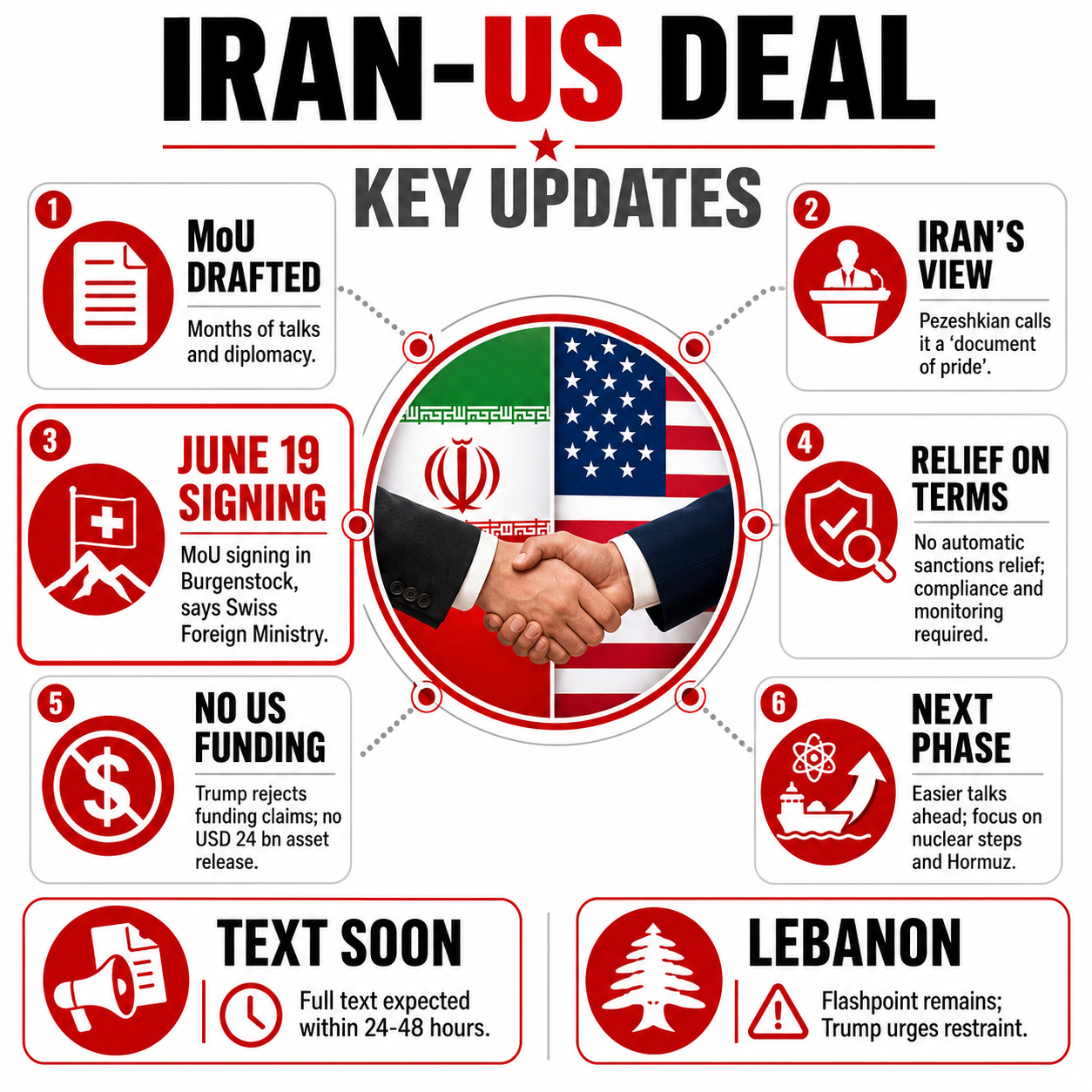
“The memorandum of understanding that has been drafted is the result of months of dialogue and persistent follow-ups in this regard, and if all its provisions are properly implemented, it can be considered a document of pride for the country,” he wrote.
He also thanked Dr Qalibaf, Araghchi, members of the Shura Council and others involved in the process.
His remarks come as Washington and Tehran prepare for the formal signing of the agreement in Geneva, Switzerland. The MoU sets out a framework for future engagement between the two countries and links sanctions relief to Iran’s compliance with nuclear verification measures and broader regional security commitments.
US President Donald Trump, speaking on the sidelines of the G7 Summit in Evian, France, said the full text of the memorandum would soon be made public.
“I think pretty soon. I want it to be released because it’s a very powerful document,” Trump said, adding that the publication was likely after the formal signing ceremony later this week.
According to CNN, a senior US administration official said the complete text of the agreement would be released within 24 to 48 hours, stressing the administration’s commitment to transparency.
While the United States and Iran have already digitally signed the document, officials from both sides are working towards a formal signing ceremony expected in Geneva on Friday.
Switzerland has welcomed the agreement, calling it an important step towards de-escalation and regional stability. The Swiss Federal Department of Foreign Affairs said it was coordinating with the United States, Iran, Pakistan and Qatar to facilitate the signing process.
Meanwhile, US Vice President JD Vance said the agreement would operate under a performance-based framework and that sanctions relief would not be automatic.
“We already signed the deal digitally yesterday, and there’s been no money released, and that won’t change,” Vance told ABC’s Good Morning America.
He said sanctions relief would depend on verifiable Iranian actions, including reducing enriched uranium stockpiles and allowing international monitoring of its nuclear programme.
STANDALONE
Iran deal done, second stage easier: Trump
EVIAN: US President Donald Trump on Tuesday expressed optimism over the next phase of negotiations with Iran after the signing of a peace deal aimed at ending hostilities in West Asia, saying the second stage of talks would be “actually easier”.
Speaking during a bilateral meeting with Qatar’s Emir Sheikh Tamim bin Hamad Al Thani on the sidelines of the G7 Summit in Evian, France, Trump said the agreement with Iran had already been reached and described it as a “fair” and “good” deal.
“We have our deal done with Iran, and it should be successful. It goes to a second stage, which I think will be actually easier,” Trump said.
He also referred to recent US military action against Iran during the first phase of negotiations, saying he had preferred to avoid strikes but his administration was left with limited options.
“I didn’t want to attack them last week, but we had no choice, and we did it twice, actually. We’re doing it a third time, and we’re able to not have to do that, but we have a deal that’s a fair deal. It’s a good deal,” he said.
Trump firmly rejected reports that Washington would invest money in Iran as part of the agreement, calling the claims “ridiculous”.
“We are not investing any money in Iran. We have no obligation to invest any money in Iran,” he said.
According to CNN, officials said the next phase of discussions is expected to focus on technical aspects of Iran’s nuclear programme, economic relief for Tehran, mechanisms for reopening the Strait of Hormuz and a proposed USD 300 billion reconstruction fund, which would be financed by Gulf countries.
US Vice President JD Vance said Iran “could have access” to the reconstruction fund if it fulfils the conditions and obligations outlined in the agreement. He also rejected claims that the deal includes the release of USD 24 billion in frozen Iranian assets.
Trump had earlier said the deal with Iran was “complete” and that the Strait of Hormuz would reopen after the agreement is formally signed on Friday. In a post on Truth Social, he said the “Great Deal” would bring “peace and security” to the region and restore oil flows through the strategic waterway.
Meanwhile, Trump also addressed tensions over Lebanon, where Tehran has insisted that any ceasefire arrangement with Washington must include Lebanon, while Israel remains opposed to that position.
Trump said there would be “no Israel” without him and urged Israeli Prime Minister Benjamin Netanyahu to be “more responsible” in Lebanon.
“Iran’s the big one, but we have that little pinprick out there that constantly rears its head, and that’s Hezbollah,” Trump said.
He also appeared critical of Israeli strikes in Beirut, saying “too many people are being killed”.
“You don’t have to knock down an apartment house every time you’re looking for somebody because there’s a lot of people in those apartment houses — and they’re not all Hezbollah,” he said.
Trump added that he had suggested Israel allow Syria to “take care” of Hezbollah, saying it could do a better job.