Chennai:
It is being designed inside research labs, assembled on factory floors and tested long before a soldier ever lays hands on it.
Behind tightly controlled doors, NewsX became one of the first television networks to gain exclusive access inside ZUPPA’s state-of-the-art drone manufacturing and R&D facility, where some of India’s most advanced indigenous unmanned aerial systems are taking shape. The visit offered an unprecedented look at the technology, engineering and innovation powering the country’s rapidly evolving drone ecosystem.
The tour began inside the Electronics Manufacturing Services (EMS) room, where engineers unveiled what they describe as the heart of every platform: the fully indigenous autopilot motherboard. Designed, developed and manufactured in India, the autopilot serves as the drone’s brain, controlling navigation, flight stability, mission execution and autonomous decision-making. For a country steadily reducing its dependence on imported defence technology, this represents far more than another electronic component; it is a symbol of India’s growing technological confidence.
Moving deeper into the R&D facility, the manufacturing process came alive.
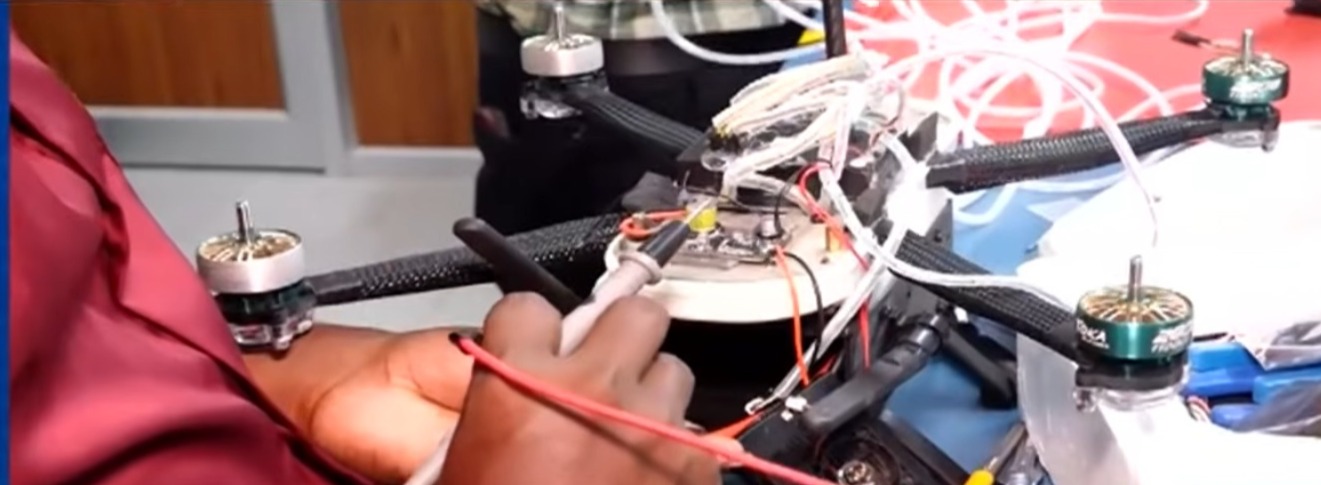
Engineers were seen assembling airframes, integrating sensors, testing electronics and calibrating payloads with meticulous precision. Every workstation represented a different stage in the life cycle of a drone, from design and prototyping to testing and final assembly. Rather than functioning as a conventional production unit, the facility operates as an innovation hub where new ideas are continuously translated into operational military platforms.
The experience turned interactive inside ZUPPA’s simulator room.
NewsX flew one of the drones through an advanced simulation platform, offering viewers a rare glimpse into how operators are trained before real-world deployment. The simulator recreated mission scenarios that require precision, situational awareness and rapid decision-making, highlighting the growing role of virtual training in modern military preparedness.
Across the facility, multiple drone platforms were displayed, each built for a distinct operational requirement.
The Hawk, Eagle, Baza, Ajeet and Condor platforms together represent an indigenous ecosystem capable of surveillance, reconnaissance, intelligence-gathering, logistics support and autonomous operations. Engineers demonstrated how each platform is designed with different payload capacities, endurance levels and mission profiles to suit varied operational environments.
Among them, one platform stood apart.
The Hawk VIO, designed specifically for GPS-denied environments, has become one of ZUPPA’s most significant indigenous achievements. Company officials confirmed that variants of this platform formed part of the 500 drones supplied to the Indian Army and were deployed for surveillance during Operation Sindoor, where electronic interference and GPS denial made conventional navigation increasingly difficult. Instead of depending solely on satellite signals, the platform relies on sophisticated visual navigation technologies, enabling it to continue operating even when GPS is jammed.
Its smaller counterpart, the Ajeet Mini Hawk (VIO), offers similar capabilities in a compact, rapidly deployable platform, making it suitable for tactical surveillance and frontline missions.
In an exclusive conversation with NewsX, Managing Director Sai Pattabiram spoke candidly about how recent conflicts have fundamentally altered military thinking.
“Operation Sindoor has shown that the battlefield is changing rapidly,” he said. “Drones are no longer optional assets. They are becoming central to surveillance, intelligence-gathering and operational success. India is moving in the right direction, and we remain committed to developing indigenous technologies that strengthen our armed forces.”
Perhaps the biggest revelation came when Pattabiram disclosed the company’s next ambitious project.
“We are now developing an indigenous interceptor drone,” he revealed, describing it as the next phase of India’s evolving counter-drone capability. The system is intended to detect, pursue and neutralise hostile unmanned aerial vehicles, adding another layer to India’s growing defence architecture against emerging aerial threats.
He also said the Ministry of Defence’s support for indigenous start-ups has created an ecosystem where innovation is increasingly being translated into operational capability.
“When homegrown companies receive opportunities to contribute to national security, it inspires an entire generation of innovators,” Pattabiram remarked. “It tells young entrepreneurs that they, too, can build technologies for the nation.”
The timing of the visit is significant.
India’s defence production has touched a record ₹1.78 lakh crore, while defence exports continue to scale new highs. Increasingly, the country’s ambition extends beyond manufacturing equipment. It seeks to design, engineer and export cutting-edge military technologies.
Inside ZUPPA’s factory, that ambition is impossible to miss.