
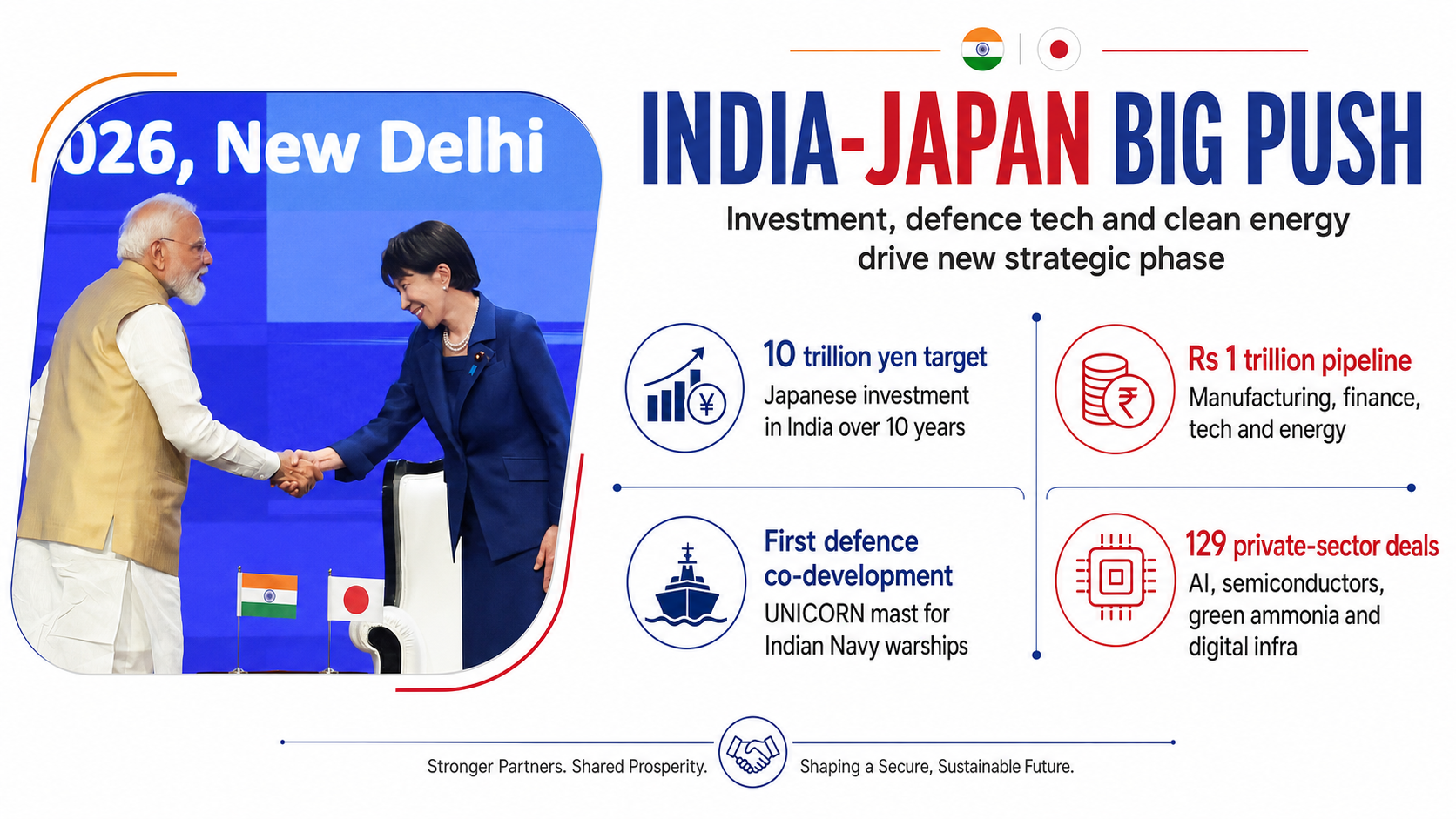
New Delhi:
Prime Minister Narendra Modi and Japanese Prime Minister Sanae Takaichi held bilateral and delegation-level talks before addressing the India-Japan Joint Economic Forum, where both sides underlined their commitment to deepen cooperation in resilient supply chains, clean energy, semiconductors, critical minerals, digital infrastructure and emerging technologies.
The two countries reaffirmed their long-term target of mobilising 10 trillion yen in Japanese investment into India over the next decade. Modi said the number of Japanese companies operating in India should double in the next 10 years, while Takaichi announced around 129 private sector cooperation agreements involving investments of more than 2 trillion yen.
“Today, Prime Minister Takaichi and I have decided to further speed up and deepen our partnership,” Modi said, adding that agreements had been signed on economic security, AI, defence, health and other areas to make the partnership “futuristic and limitless”.
A key outcome of the summit was the announcement of the first India-Japan defence co-development project: the UNICORN naval radio antenna mast for Indian Navy warships. The integrated mast combines multiple communication and sensor systems into a single structure, improving the stealth profile and operational capability of naval platforms. Modi said the project would open a new chapter in the defence technology partnership and help strengthen maritime security and a rules-based order.
The summit also saw the adoption of joint documents on economic security, energy resilience and artificial intelligence. Modi said the convergence of Japan’s precision technology and India’s software capabilities would give fresh momentum to global AI development. Agreements in pharmaceuticals, medical devices and biotechnology, he added, would help deliver affordable and advanced health solutions.
The economic package includes major projects across manufacturing, finance, clean energy, digital infrastructure and frontier technologies. Among the largest commitments are a Rs 400 billion partnership between MUFG and Shriram Finance, and a Rs 170 billion collaboration between SMBC and Yes Bank.
In manufacturing, Toyota will set up a new plant at Bidkin in Maharashtra with an investment of Rs 65 billion, while Suzuki will invest Rs 50 billion towards land acquisition for a new manufacturing facility. Daikin will establish a research and development centre in Haryana with an investment of Rs 10 billion. JFE Steel and JSW will jointly develop integrated steelworks with an investment of Rs 160 billion.
Clean energy emerged as a major pillar of the partnership. IHI Corporation and ACME will develop a Rs 295 billion green ammonia project, while Itochu Corporation and Larsen & Toubro will work on a Rs 189 billion green ammonia project at Kandla Port. Other projects include a Rs 100 billion renewable energy investment by Sumitomo Corporation, a Rs 90 billion green methanol project by Mitsubishi Gas Chemical and ACME, and a Rs 38 billion collaboration by Sumitomo Corporation in Haryana covering renewable energy, electric mobility, industrial parks and smart cities.
Takaichi said Japanese and Indian companies would jointly develop a green ammonia project with an annual capacity of about 400,000 tonnes, calling it a symbol of a new chapter in energy security cooperation. She said Japan and India would also expand cooperation in petroleum stockpiling under Japan’s Power Asia initiative.
In digital infrastructure, NTT Data will invest Rs 38 billion in submarine cable infrastructure and collaborate with Persistent Systems on next-generation telecommunications technologies. In semiconductors, Fujifilm will establish semiconductor materials production in Gujarat, while Toho Koki and IIT Guwahati will collaborate to strengthen the semiconductor manufacturing ecosystem.
The technology partnership will also extend to frontier sectors. Mitsubishi Electric and IIT Hyderabad will work on human resource development in AI, quantum technologies and security. Yaqumo and the Indian Institute of Science will collaborate on a quantum technology ecosystem, while iSpace and Digantara will work together on a joint lunar exploration mission.
Modi also announced a dedicated Japan Business Week to be organised by the Prime Minister’s Office, during which senior officials will engage with Japanese businesses to address concerns and improve ease of doing business in India.
The two leaders also inaugurated Maruti Suzuki’s fourth vehicle manufacturing facility at Kharkhoda in Haryana. Modi said two-thirds of Suzuki’s cars worldwide are now made in India and exported to more than 100 countries, adding that Japanese companies had played a major role in India’s growth story.
Takaichi, who is on a three-day official visit to India from July 1 to 3, was earlier accorded a ceremonial welcome at Rashtrapati Bhavan. She said Japan and India, as major democratic and market economies in the Indo-Pacific, must work together to promote peace, stability and prosperity.
Both sides also agreed to deepen maritime security cooperation, enhance exercises in the Indian Ocean and hold the next India-Japan 2+2 Foreign and Defence Ministers’ meeting before the end of the year.
As India and Japan approach the 75th anniversary of diplomatic relations in 2027, the summit marked a significant expansion of cooperation across trade, investment, defence, technology, energy security and people-to-people ties.