New Delhi:
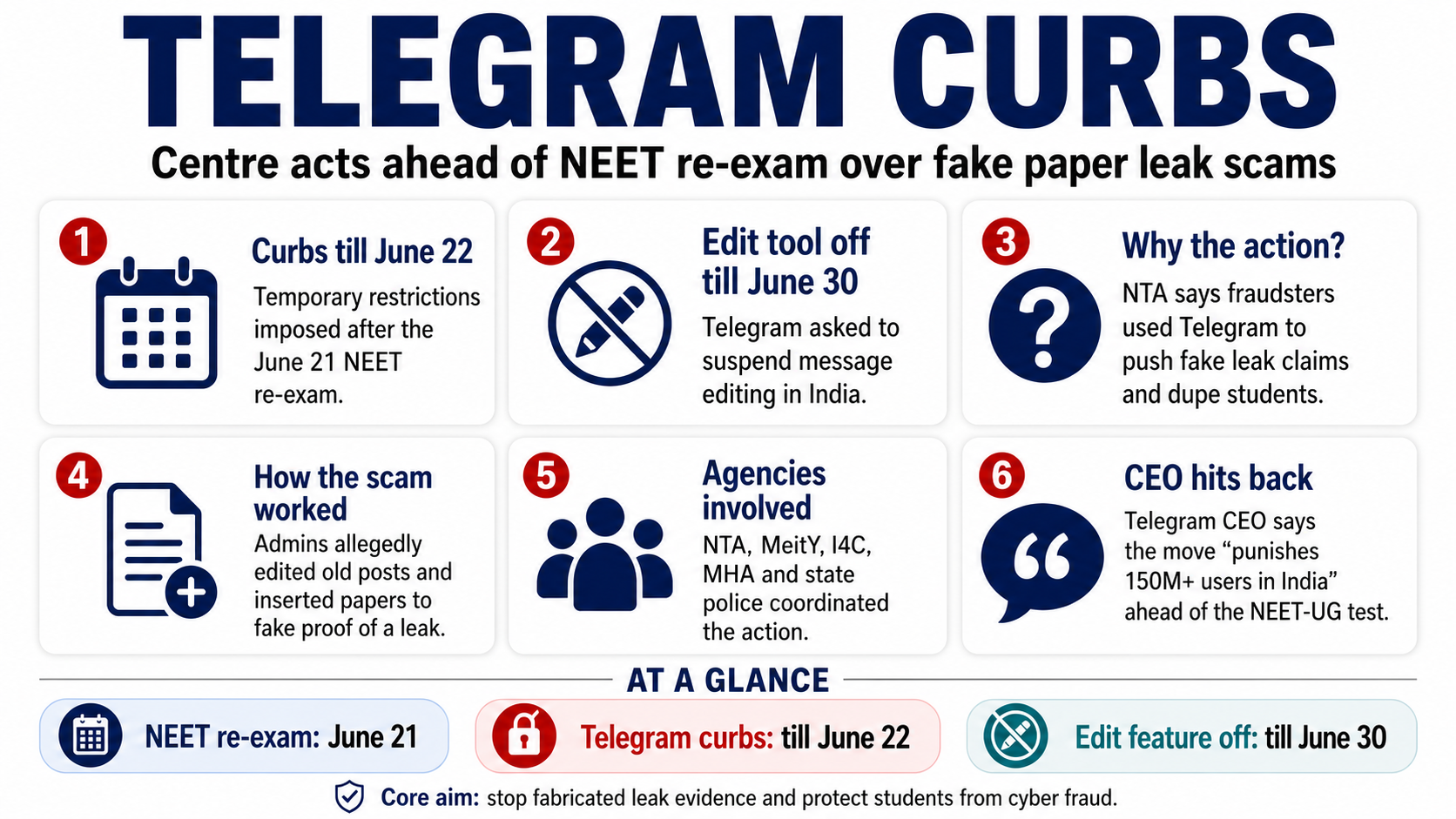
Acting on recommendations from the National Testing Agency (NTA) and the Department of Higher Education, the Ministry of Electronics and Information Technology (MeitY) issued directions under Section 69A of the Information Technology Act, citing the platform’s alleged misuse by organised cyber fraud networks to dupe students through fake paper leak claims.
Telegram has also been directed to disable its message-editing feature in India until June 30. According to the NTA, the feature has been repeatedly exploited to fabricate false evidence of question paper leaks after examinations have concluded.
The agency said the action was taken in the interest of public order following repeated instances of cheating rackets using Telegram channels and groups to solicit money from candidates and their families in exchange for purported access to examination papers.
“Over the preceding weeks, channels operating openly under names such as ‘PAPER LEAKED NEET’, ‘Re-NEET 2026’, ‘Private Mafia’ and ‘REE NEET MAFIAA’ demanded sums ranging from a few thousand rupees to several lakhs from candidates,” the NTA said in a statement.
According to the agency, the move follows weeks of coordinated action involving the Indian Cyber Crime Coordination Centre (I4C), the Ministry of Home Affairs, MeitY and state police forces.
Authorities had already secured the removal of several Telegram channels, groups and bots allegedly involved in spreading misinformation and running examination-related frauds. However, the NTA said channel-by-channel takedowns were proving insufficient, prompting platform-level intervention.
Earlier this month, the Bihar Police Economic Offences Unit issued a public advisory warning students and parents against Telegram-based claims of access to the NEET re-examination paper.
In another significant case, the Ahmedabad City Cyber Crime Branch arrested members of an alleged interstate cyber fraud syndicate accused of operating eight Telegram channels that falsely promised examination papers and admission assistance. Investigators found transactions worth nearly ₹1.5 crore routed through fraudulent bank accounts, while around 1,000 mobile phone users had reportedly been contacted by the network in a single month. The investigation remains ongoing.
The NTA said the restriction on Telegram’s message-editing feature addresses a specific method used by fraudsters. Under Telegram’s current design, channel administrators can edit previously posted messages and replace attached files while retaining the original timestamp.
According to the agency, this has enabled operators to insert actual question papers into older posts after an examination and then circulate screenshots as purported proof that the paper had leaked before the test.
Officials said disabling the feature during the post-examination period would prevent the creation of such fabricated “paper leak” evidence.
STANDALONE
‘Education is fundamental right’: Court relief for NEET accused
Sambhav Sharma
New Delhi
A Delhi court on Wednesday granted interim relief to Yash Yadav, an accused in the NEET-UG 2026 paper leak case, allowing him to appear for the NEET-UG examination scheduled for June 21 and attend his sister’s wedding.
However, the court directed that he remain in police custody throughout the period.
The Rouse Avenue Court also permitted Yadav to keep study material and books with him.
While passing the order, the court observed that education is a fundamental right and that no person should be deprived of it.
Yadav had sought 15 days of interim bail to take the examination and participate in his sister’s wedding ceremonies.
The Central Bureau of Investigation (CBI) opposed the plea and informed the court that Yadav had allegedly received leaked examination papers through the messaging platform Telegram.
The agency told the court that question papers recovered from Telegram and WhatsApp matched the actual NEET-UG 2026 examination papers.
The CBI further stated that Yadav’s mobile phone had been seized and that incriminating material was found during the investigation.
According to the agency, the probe is focused on uncovering a larger conspiracy behind the paper leak.
Investigators are examining the possible involvement of public servants and government employees, as well as the role of the printing press in the leak.
The CBI has arrested several accused in the case, including Shubham Khairnar from Nashik, who is alleged to have supplied the question papers to Yadav.
Other accused, including Mangilal Bival, Vikas Bival and Dinesh Bival, were arrested from Jaipur, while Yadav was arrested from Haryana.
The investigation continues as the CBI attempts to uncover the full extent of the alleged examination paper leak network.