
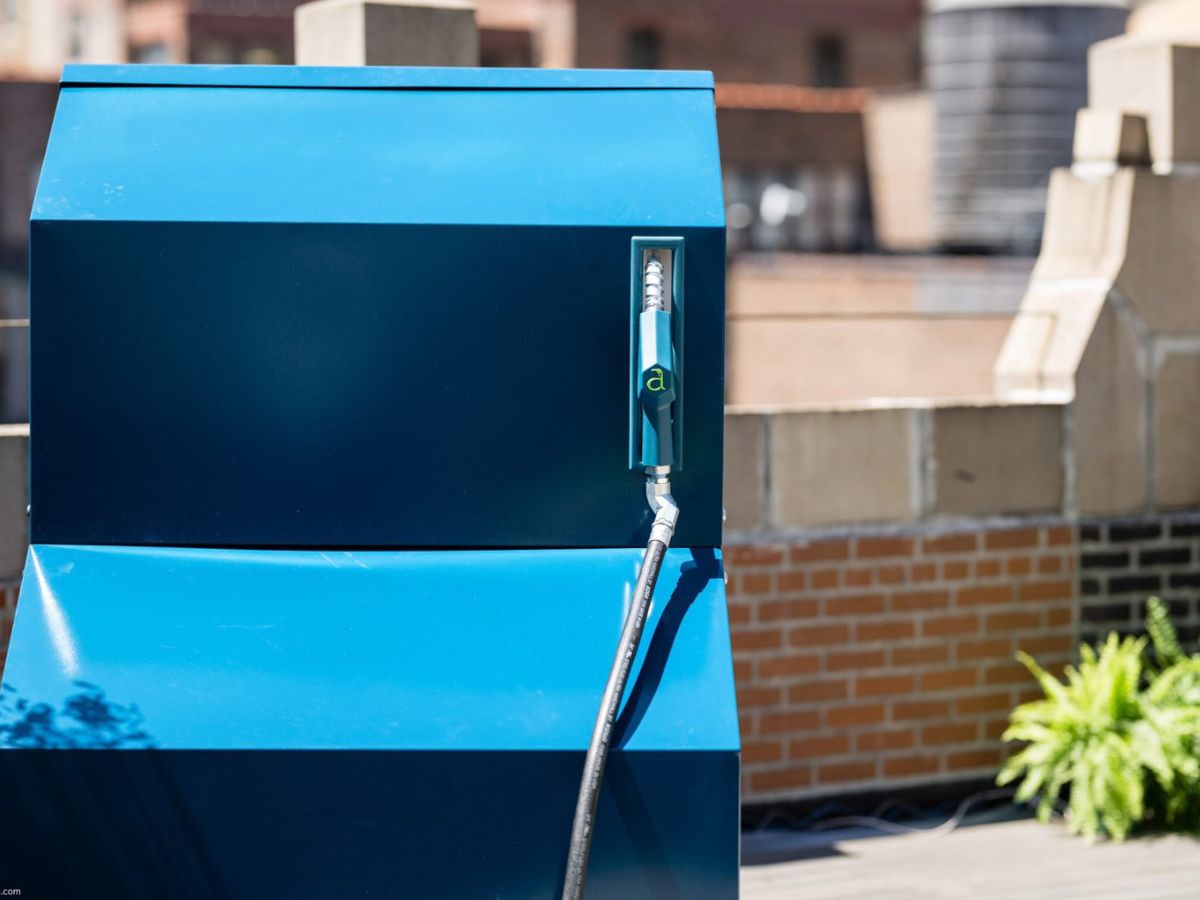
A new climate-tech startup is unveiling a compact device that can quietly convert ordinary air into usable gasoline with no crude oil, no drilling operations, no pipelines, and no engine upgrades. Strong investor backing and a demo-ready system already working outside the lab may position this technology to shift the global clean-energy debate.
A Fridge-Sized Machine Producing Fuel Out of Thin Air
Air-to-fuel device captures carbon dioxide directly from the surrounding air and transforms it into synthetic gasoline that can be used in any standard petrol engine. Because the fuel matches the chemical structure of conventional gasoline, it avoids the need for refinery processes or modifications to vehicles and fuel stations. The company confirms the system is already operational.
Who invented the machine?
The breakthrough device has been developed by Aircela, a New York-based climate technology company. The air-to-fuel device by Aircela has been invented by Eric Dahlgren and Mia Dahlgren, the co-founders of the startup. They refined earlier direct-air-capture concepts pioneered by scientists like Klaus Lackner, but the machine’s engineering, design, and commercial application are the direct work of the Dahlgrens and their development team.
This launch comes at a very critical juncture. At a time when the world is debating the pace and shape of the clean-energy transition, Aircela offers a different direction. With global investments tilted in favor of electric vehicles, the company’s approach introduces carbon-neutral fuel that seamlessly works with existing infrastructure. If scaled correctly, the technology could lower dependence on extensive EV-charging networks and provide a functional, transitional solution toward moving away from fossil fuels without overhauling worldwide transport systems.
What is the fuel type?
The device produces synthetic gasoline, carbon-neutral fuel manufactured by combining carbon dioxide from the air with hydrogen extracted from water. This fuel is chemically identical to ordinary petrol and can power cars, motorcycles, generators, and other engines without modification. It contains no sulfur, no ethanol, and fewer contaminants, so the fuel is cleaner compared to traditional fossil gasoline. When powered by renewable electricity, this process will provide fully carbon-neutral gasoline, offering a greener alternative that fits effortlessly into today’s fuel infrastructure.
How the Machine Works
Aircela’s system works in two key steps:
- Capture CO₂ from the air with a compact direct-air-capture module.
- Take that carbon and, using renewable electricity, combine it with hydrogen extracted from water to make liquid gasoline.
- During a public demonstration, the machine filled a standard gasoline bottle as officials, including New York City Councilmember Erik Bottcher and New York State Energy Chairman Richard Kauffman, looked on. Aircela emphasized that its fuel mirrors fossil gasoline at the molecular level but is cleaner because it excludes impurities such as sulfur and ethanol.
- Unlike biofuels or specialty blends, this synthetic gasoline requires no engine or infrastructure adjustments. This drop-in capability might speed up its adoption.
- Its strategy relies on modular distribution, where each unit, roughly appliance-sized, is designed to act in a standalone fashion for homes, businesses, and remote areas alike. Instead of central refineries, Aircela envisions a future where gasoline will be produced locally and on demand.
How much will the machine cost?
Aircela has not officially released pricing, but early industry reports estimate that the unit could cost anywhere between $15,000 and $20,000. The company estimates that with relatively inexpensive renewable power, the resulting fuel could be produced for as low as $1.50 per gallon. In reality, costs will depend on energy prices, system efficiency, and production speed. Since the technology is new, long-term expenses-such as maintenance, component lifespan, and operational energy requirements-remain uncertain and may evolve as the device scales toward commercial deployment.
A Possible Turning Point for the Energy Transition
Where liquid fuels are often considered a thing of the past in a world that’s moving toward EVs and hydrogen solutions, Aircela’s invention is a different way of thinking. Instead of rivaling electric mobility, the invention introduces another viable route to reduce emissions. Replacing internal-combustion vehicles, of which 1.4 billion are still in use today worldwide, will take several decades. A carbon-neutral fuel that works within existing vehicles, their supply chains, and users’ habits could therefore achieve immediate global impact. More than an engineering milestone, direct fuel production from air, water, and renewable power focuses on resilience, flexibility, and compatibility. This could prove particularly useful in areas that are hard to reach, developing markets, and those sectors that are more difficult to electrify, such as aviation, shipping, and farming.
Also Read: PM Modi Set for Key Visits to Oman, Jordan to Boost Trade, Investment This Month