In Part One of this story I published last month (Thursday, 11 December), you learnt that while in pure engineering terms all kinds of AWD/4WD/4×4 vehicles come under the “All-Wheel-Drive category,” specific use-cases and auto manufacturers’ marketing teams’ latching on to them over decades marked a clear distinction between AWD and 4WD/4×4 vehicles. However, as clear that distinction is in some parts of the world where people just can’t do without power going to all four wheels of their vehicle, it’s quite blurry in India, because, right from the alleged founding fathers of Indian automotive journalism to the most popular automotive YouTubers of our country everyone has always been, and still remains, indifferent to differentials and transfercases. That’s why this series of stories is important for you and everyone else interested in knowing the basic (and advanced too, at a later stage) concepts of AWD and 4WD vehicles.
If you missed reading the first part of this story last month, I’d suggest you read that first and then come back here as it would be better for your understanding. You may still choose to hang around and see where this takes you though. However, those of you, who have read it, would know that this story would now continue from where we left last time—the major differentiating factor between AWDs and 4WDs.
HOW TO KNOW WHETHER A VEHICLE IS AN AWD OR A 4WD?
It’s simple, and something that’s mentioned in the first paragraph of this story. If a vehicle has a transfercase, it’s a 4WD vehicle. If it doesn’t have one, even if the manufacturer claims that it’s a 4WD/4×4, it’s actually an AWD vehicle. See how simple that was?
So, if not a transfercase, what does an AWD vehicle have, you ask? Well it would ideally have a center differential, or at least a clutch pack which is summoned when the sensors shout, “Mayday Mayday Mayday!” conveying to the ECU that the primary set of wheels (it’s just one wheel, but we’ll address that later in the series) is losing traction, so please send power to the opposite set. Alright. “Mayday” was an exaggeration; the power transfer doesn’t take that long and it happens in milliseconds without the driver ever noticing it (at speed). Offroad, at slow speeds, would be the only time you might notice it.
EXAMPLES OF AWD VEHICLES
As mentioned in part one of this story, the Jeep Compass 4×4, Meridian 4×4, Skoda Kodiaq 4×4, and VW Tiguan 4Motion are all AWDs. Again, the Hyundai Tucson AWD and Mahindra XUV700 AWD, as mentioned in their nomenclatures, are AWDs, and the same is true for the Toyota Hyryder AWD and Maruti Suzuki Grand Vitara AWD as well.
EXAMPLES OF 4WD VEHICLES
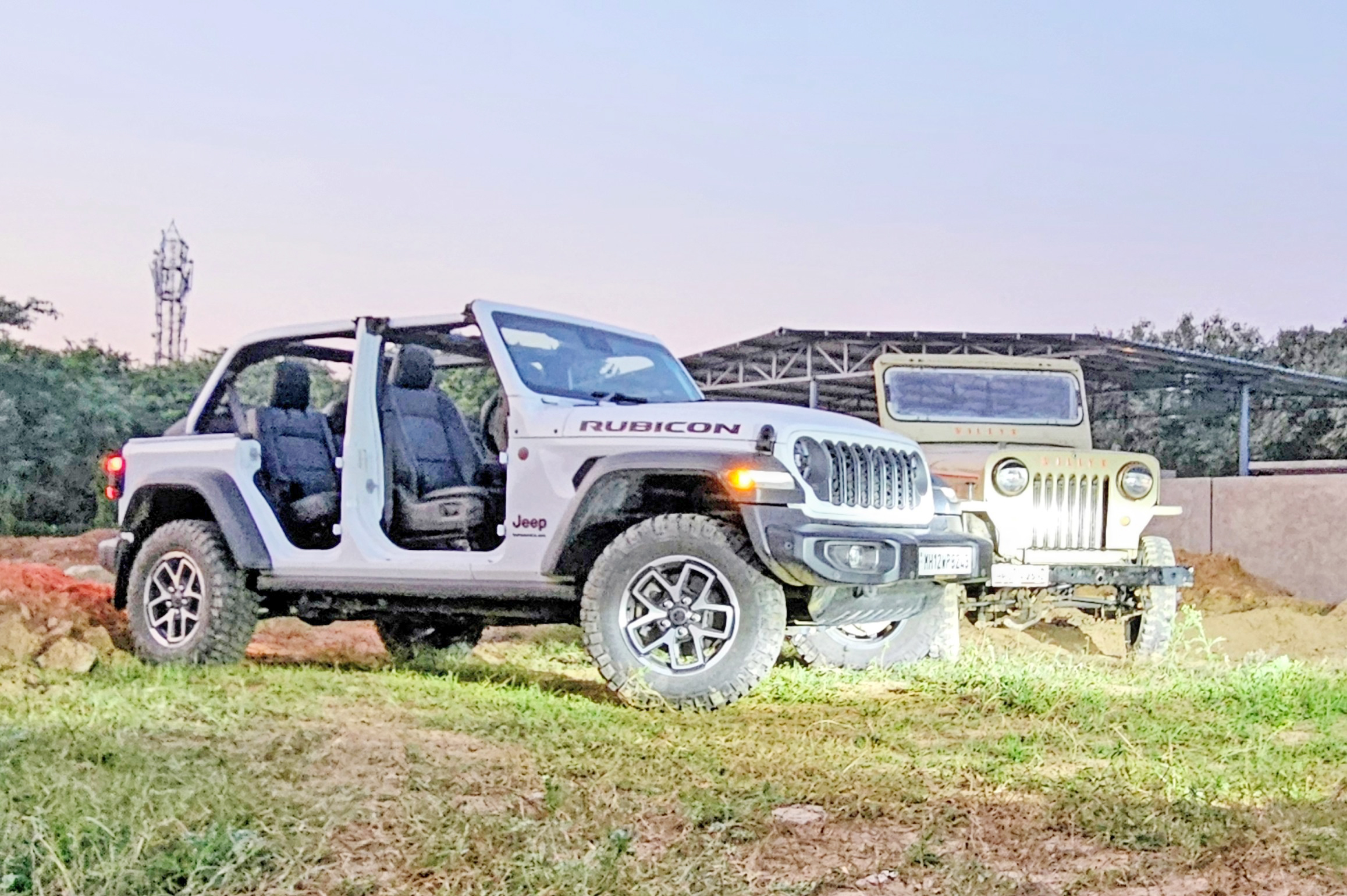
The Jeep Wrangler Rubicon, Lexus LX500D, Mercedes-Benz G-Wagon, Toyota Fortuner, Toyota Hilux, Isuzu MUX, Isuzu V-Cross, Mahindra Thar, Maruti Suzuki Jimny, and Force Gurkha are some of the most hardcore 4WD vehicles you can buy in India. Of course, some of these vehicles are available in 2WD variants as well, and it’s obvious that here I am talking about their 4WD versions only.
Also, while the majority of vehicles in this list are traditional “part-time” 4WDs where you should never engage the transfercase on the road (hard surfaces like tarmac, concrete, etc.), there are a few vehicles here that have both a transfercase and a center differential each. Can you guess and let me know which are those vehicles? Also, there is one that has a transfercase AND a clutch pack that allows you to engage 4WD, in a particular mode, on the road as well. Can you tell me which is that vehicle and what mode allows you to drive it in 4WD on the road? You’ll find my email at the end of this story.
I must also mention here that while all the vehicles in this list (4WD) have two speed (4H and 4L) transfercases, there are vehicles like the Jeep Grand Cherokee that are available with both single speed and two speed transfercases. However, only the former is available in India for now. It’s still quite potent, both on the road and off it, and though I had reviewed it a couple of years ago, there is no rule that says I can’t review it again. So, yes, you may get to read a comprehensive review of it again sometime soon.
ONE MORE CRUCIAL DIFFERENCE BETWEEN AWD AND 4WD
So now that you know what makes a vehicle an AWD or a 4WD it’s time to quickly know about one more crucial difference between the two. The majority of AWD vehicles, especially the ones available in India, are FWD (Front-Wheel-Drive) where power primarily goes to the front wheels; the rear wheels get power only when needed. However, the majority of 4WD vehicles are RWD (Rear-Wheel-Drive) where power primarily goes to the rear wheels, and the front wheels will get power only when YOU engage 4WD. Yes, it’s in your hands. Some AWDs also give you an option to lock the clutch pack/center differential, but it’s not always a 50:50 split between the front and rear axles like it is on most 4WD vehicles.
There is one more peculiarity though, that too in both AWD and 4WD vehicles. You have many AWD vehicles that are truly all wheel-drive, which means power is constantly sent to all four wheels. These vehicles have a proper center differential, and not just a clutch pack. Almost all Subarus, and quite a few Mercs, Audis, BMWs, Porsches, etc., come with full-time AWD systems. Similarly, power also goes to all four wheels all the time in full-time 4WD vehicles. These have a transfercase AND a center differential. The Lexus, Range Rover, and Jeep Grand Cherokee you see on this page comprise a few examples of full-time 4WD vehicles.
I must also mention here that the best offroad vehicle in the world, the Jeep Wrangler Rubicon, is the most unique 4WD vehicle in this aspect as well. It’s theoretically a hardcore part-time 4WD, but it can also function as a full-time 4WD in its 4H Auto mode. There, I gave you the answers to both the questions I had asked earlier in the story. I won’t get into torsen differentials, viscous couplings, etc., for now as there would be a dedicated story on differentials, where these, and more, would be covered in detail. Therefore, for now we summarise that there are four types of configurations available when we talk about AWD and 4WD vehicles: part-time AWD, full-time AWD, part-time 4WD, and full-time 4WD.
SO, SHOULD YOU BUY AN AWD OR A 4WD?
You’ll get more and more clarity on it with every story in this series, but even right now I can give you an answer if you have been holding off your purchase due to the confusion around AWDs and 4WDs. See, for the majority of city dwellers, 2WD vehicles would suffice, and these are actually the vehicles that get sold the most in India as compared to their AWD or 4WD versions. Still, when it comes to choosing between 2WD and AWD, please always try to go with the latter as it will keep you a lot safer on the road as compared to a 2WD vehicle. In an AWD, you will have twice the amount of traction than you would in a 2WD, which means your vehicle will almost always go in the direction you want it to unless you’re trying to defy the laws of physics, which you shouldn’t ideally be doing on public roads.
Now let’s get back to the original question, which is “choosing between AWD and 4WD” where you certainly know that you would drive to places where you won’t feel confident in a two-wheel-drive vehicle but aren’t sure whether to go for an AWD or a 4WD. I’ll make it simple for you. Get an AWD if your sporadic “adventurous excursions” would entail driving primarily on “man-made paths,” even if they are covered in a bit of snow/ice. Anything more severe should have you looking at a 4WD. It’s really as simple as that.
NEXT 4WD STORY
Although I would be covering everything about 4WD and offroading in this series, you may still let me know the topics you expect me to cover FIRST, and I might just oblige. Write to me at [email protected]