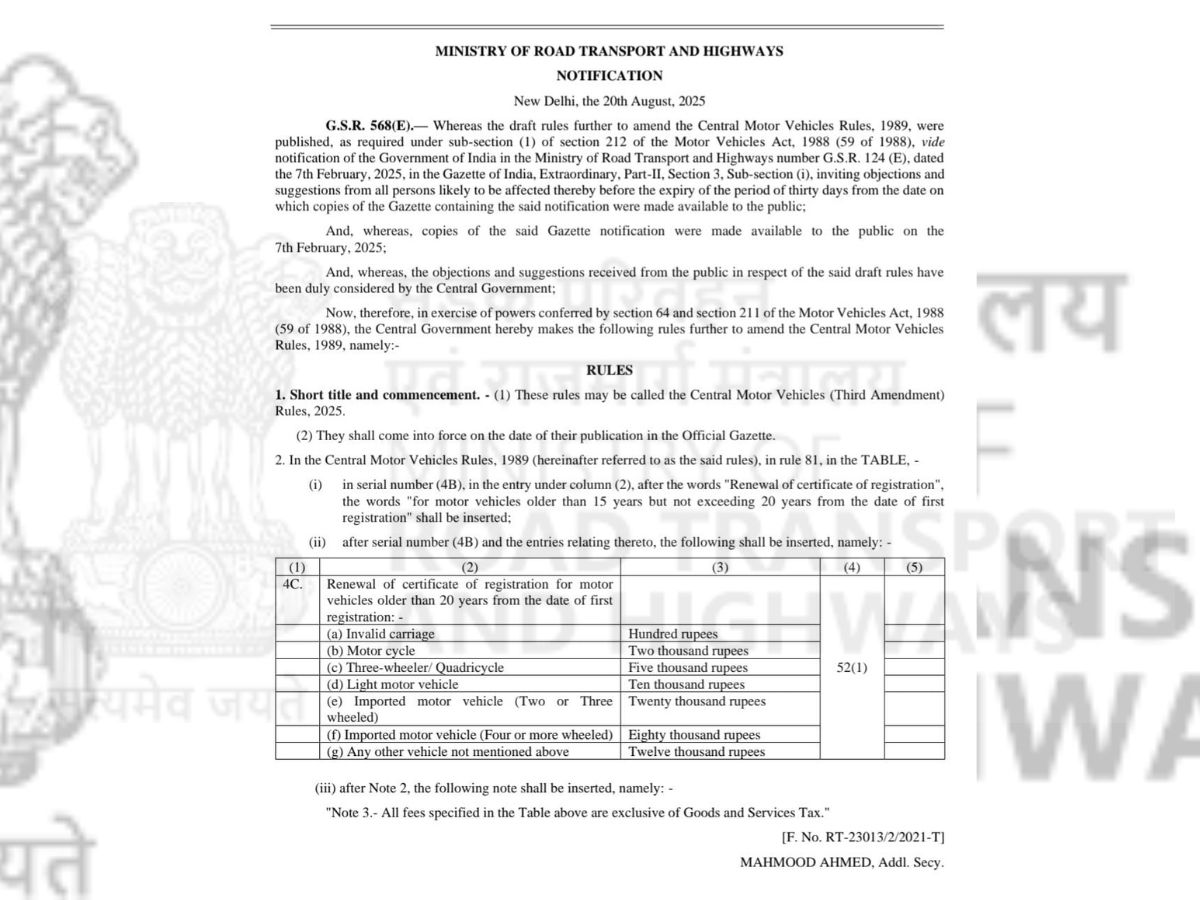
In a significant policy shift to harmonise environmental considerations with hard realities of car owners, the government of India has resolved to increase the maximum age limit for petrol and diesel cars to 20 years from 15 years. The increase is a drastic shift in the laws that regulate road vehicles, and the move has elicited conflicting views among policymakers, environmentalists, the industry, and the general public.
Policy Shift: What Does the Extension Imply?
Earlier, petrol and diesel cars more than 15 years old were subject to more stringent norms, such as periodic fitness permits or phased out in some cities under pollution control policies. The new amendment permits such cars to be used for up to 20 years from the year they were registered, as long as they meet the required fitness and emission tests.
The decision seeks to mitigate the financial load on car owners, particularly in poorer sections and rural regions, who tend to struggle to upgrade older cars with newer and costlier vehicles. It also acknowledges the realities of India’s heterogeneous mobility system where ownership trends, vehicle utilisation intensity, and regional requirements are quite different.
ALSO READ | Fed Rate Cut: A Double-edged Sword for the Indian Stock Market
Justification Behind the Extension
Officials opine that the extension is beneficial in a number of ways.
- Firstly, it decreases pressure on consumers who use personal vehicles for incomes, including small businesses and transport operators. Prolonging the vehicle’s legal lifetime enables improved use and amortisation of expenses.
- Secondly, the government is optimistic that increased and more stringent fitness and pollution tests will keep existing older vehicles on the road environmentally compliant, preventing excessive pollution hazards. This is more a sense of responsible vehicle maintenance than banning on age grounds alone.
- Third, with the world movement towards electric vehicles (EVs), the extension is viewed as a bridging step to prevent abrupt shocks while India develops charging facilities, encourages people to take up EVs, and stabilises supply chains.
Environmental and Public Health Concerns
Despite government assurances, environmental experts caution that extending the lifespan of internal combustion engine vehicles could exacerbate air pollution problems, particularly in highly polluted urban centers. Older petrol and diesel vehicles often fail to meet stricter Bharat Stage VI emissions standards, contributing disproportionately to smog and health hazards.
Critics call for the extension not to water down efforts to phase out highly polluting vehicles and be supported by stringent emission monitoring, retrofitting pollution control device incentives, and more investment in public transport alternatives.
ALSO READ | Stock Recommendations : Brokerage firms Cautiously Make Their Calls
Industry and Market Impact
The auto market views this extension with ambivalence. While it might impede near-term demand for new cars by extending the life of the old ones, it also creates opportunities for the car-maintenance, repair, and auto-parts industries.
Further, by softening the transition towards cleaner cars, policymakers and manufacturers have more time to develop and promote affordable electric and hybrid versions, which could level out adoption curves.
Public Perception and Future Prospects
Public reactions have been mixed; a majority of car owners appreciate the relief and convenience, while eco-friendly sections of society lament what they perceive as a setback to the ongoing battle in India against pollution.
In the future, the success of this policy will depend on strict enforcement of fitness tests, vehicle scrappage measures, awareness against pollution effects, and massive promotion of cleaner vehicle options.
ALSO READ | SBI Report Hints Slower GDP Growth Due to Global Turmoil
Conclusion
The raising of the lifespan of petrol and diesel vehicles from 15 to 20 years is a pragmatic policy decision in view of India’s distinct socio-economic environment. While it brings economic and operational convenience to vehicle owners, it also raises challenges to environmental objectives. Balancing regulatory enforcement, pollution management, and infrastructural development will be key to promoting sustainable mobility and clean air for the country over the coming decades.