
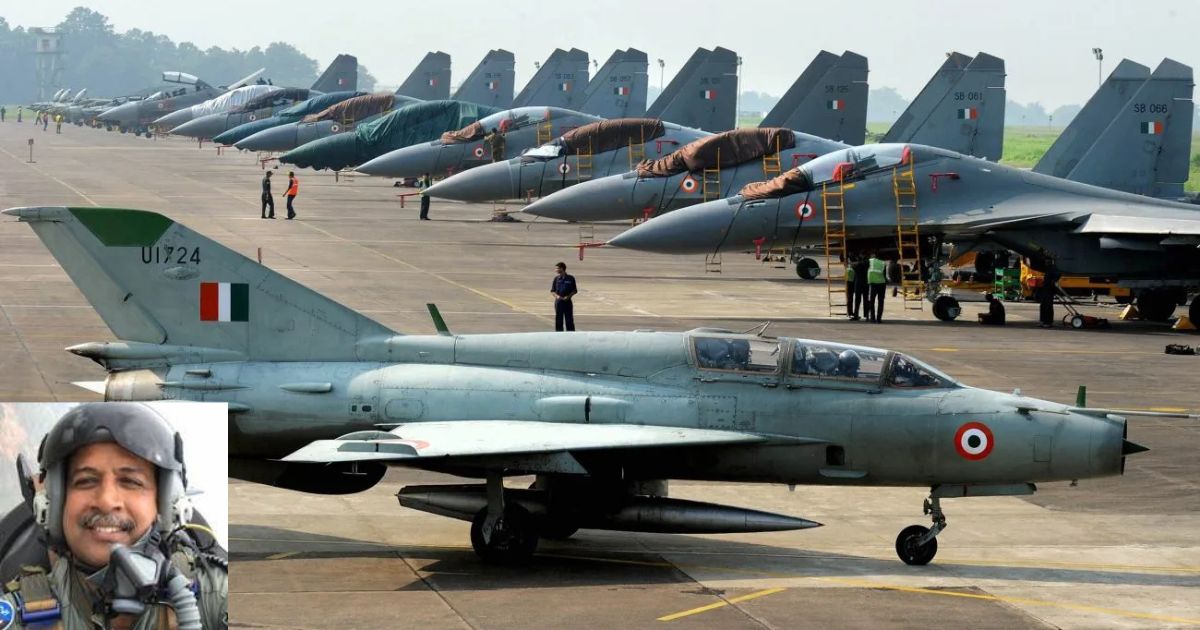
The MiG-21, the IAF’s legendary fighter aircraft, will retire in September 2025 after flying for more than six decades, with spectacular success and serious challenges. Group Captain MJ Augustine Vinod (Retd), who is a veteran IAF pilot and flew MiG-21s extensively, recently looked back on his hair-raising experiences with this legendary aircraft, exposing its unparalleled capabilities as well as its savage temperament.
The MiG-21’s history with the IAF dates from its induction in the early 1960s to becoming India’s air defense workhorse for decades. The aircraft was prized for its speed, maneuverability, and fighting ability — the same attributes that made it a gem in conflicts like 1965, 1971, and Kargil. It was also the plane piloted by dashing pilots like Wing Commander Abhinandan Varthaman, who famously shot down a Pakistani F-16 in 2019. But the MiG-21 also gained the sobering moniker “Flying Coffin” due to its accident rate.
“Two near deaths”, Grp Cpt recalls
Group Captain Vinod mentions two near-death MiG-21 experiences in 1995. On one, his engine had been on fire at takeoff, and he had seconds to eject and survive with injuries. On the other, a hydraulic failure in mid-air led to an uncontrollable flight, but through skillful maneuvering, he managed to land safely. These experiences show the challenging character of the jet — it rewarded skill but was merciless to error or technology failure.
“Rocket with Wings”, Best Skills required
Group Captain Vinod recalls the MiG-21 as a “rocket with wings” that demanded the best pilot skill and stamina. The airplane’s design — delta wings and nose shock cone — was state-of-the-art when it was launched and a milestone in the Indian aviation history book. To the pilots, flying the MiG-21 was a challenge and a privilege, demanding lessons in discipline and valor.
MiG-21- Malfunctions, Crashes and Phase-out
More than 500 MiG-21 crashes have taken place in India since 1963, and over 170 lives have been lost. The causes of accidents are technical malfunction, pilot blunder, bird hits, and spatial disorientation. Even modernization through the “Bison” version with improved avionics and missiles did not address the maintenance issues of the old fleet.
In light of this reality, the IAF has been phasing out MiG-21 squadrons and substituting them with homegrown Tejas Light Combat Aircraft. The final MiG-21 Bison squadron, No. 3 “Cobras,” will be retired on September 19, 2025, ending a half-century chapter.
As the IAF says goodbye to the MiG-21, it pays tribute to a machine that defined India’s air defense and the pilots who put their lives on the line to master its potential. The legacy of the jet is a mix of technological wonder and human courage, a bittersweet passage to contemporary air combat technology.