
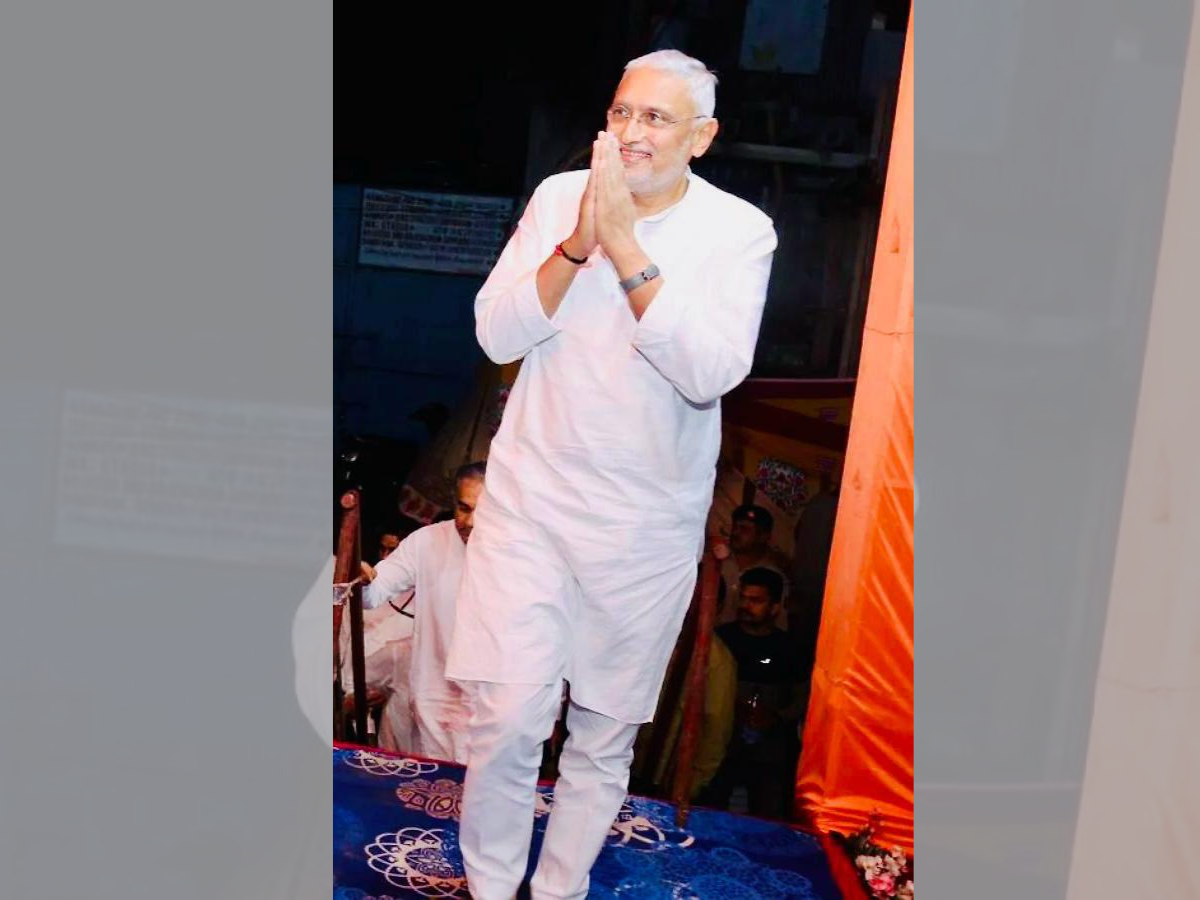
Ahmedabad: When Jagdish Vishwakarma stepped into the BJP’s Gujarat headquarters, Shri Kamalam in Gandhinagar in October 2025 to file his nomination for state president, it marked the completion of a 27-year political journey. At 51, he was elected unopposed, showing the party’s trust in his long-term commitment. Unlike many leaders, he did not come from a political family or gain sudden popularity. He started at the grassroots level as a booth worker, which is the lowest but one of the most important roles in elections. His journey reflects the BJP’s belief in promoting “sangathan karyakartas,” or organization-based workers who rise step by step.
Vishwakarma’s appointment is not only strategic but also a masterstroke in Gujarat’s electoral arithmetic, which is shaped by caste and religious dynamics. The BJP has long demonstrated a calibrated approach to social engineering in Gujarat. With Chief Minister Bhupendra Patel belonging to the dominant Patidar community, the choice of an OBC leader as state president maintains a delicate balance.
According to the Jhaveri Commission, Other Backward Classes constitute nearly 49% of Gujarat’s population. Vishwakarma, who comes from the Vishwakarma (Panchal) community, fits suitably into this category. His elevation signals continuity in the BJP’s formula: distributing power across caste groups to preserve a broad electoral coalition.
Timing is also important in politics. With municipal and panchayat elections due in 2026 and assembly elections in 2027, the BJP requires a leader capable of mobilizing OBC voters while retaining support among Patidars, Kshatriyas, Brahmins, Dalits, and Adivasis. The Congress’s move to appoint OBC leader Amit Chavda as its Gujarat president adds competitive urgency to this strategy.
The Making of an Organization Man
What distinguishes Vishwakarma is his deep familiarity with the BJP’s organizational machinery. His political journey began in 1998 as a booth in-charge in Thakkarbapanagar, a role often overlooked but critical in India’s electoral system. Booth-level workers are responsible for voter outreach, mobilization, and ensuring turnout, the micro-foundation of electoral success.
From there, Vishwakarma’s rise was steady and methodical. He served as an industry cell convenor in 2013, became Ahmedabad city BJP president in 2015, and held the position until 2021. Alongside, he secured three consecutive victories as MLA from the Nikol constituency in 2012, 2017 and 2022, and served as Gujarat’s former Minister of State for Cooperation.
His most notable achievement came in the 2021 Ahmedabad municipal elections, where, under his leadership, the BJP won an overwhelming 160 out of 192 seats. This performance cemented his reputation as a results-oriented organizer, someone who understands not just politics, but the mechanics of winning.
As one senior party functionary noted, Vishwakarma’s strength lies in “activating booth-level workers and translating organizational energy into votes,” a skill set that aligns perfectly with the BJP’s election-centric structure.
Networks of Power
In politics, competence alone is insufficient; relationships are equally decisive. Vishwakarma has cordial relations with all leaders and is empowered by the absolute confidence of the foremost two national leaders.
At the same time, he has cordial ties with Chief Minister Bhupendra Patel and reportedly enjoys access to national leadership channels, including the Prime Minister’s Office. This triad of connections, state leadership, central organization and national command, places him in a uniquely advantageous position.
Yet, the road ahead is challenging. Vishwakarma inherits a party at the peak of its dominance where it won a record-breaking 156 seats in the 2022 assembly elections. Maintaining such a high benchmark will be a formidable task.
Internal factionalism poses an immediate challenge. Vishwakarma faces three key challenges: internal party feuds, public discontent over local issues, and the need to balance caste interests without favoring his own community.
The Test of Leadership
The upcoming local body elections in 2026 will serve as Vishwakarma’s first major test. Success will surely reinforce the BJP’s momentum heading into the 2027 assembly elections. Vishwakarma must now scale his booth-level expertise to a statewide strategy, converting organizational depth into political dominance. The BJP has placed a calculated bet on a combination of discipline and charisma, structure over spectacle, and continuity over disruption. Whether Jagdish Vishwakarma can deliver will shape not just his political future, but also Gujarat’s electoral trajectory in the years ahead. As a senior party leader succinctly put it: “He has the tools, the relationships and the opportunity. Now, it is about execution and timing. In politics, both are everything.”